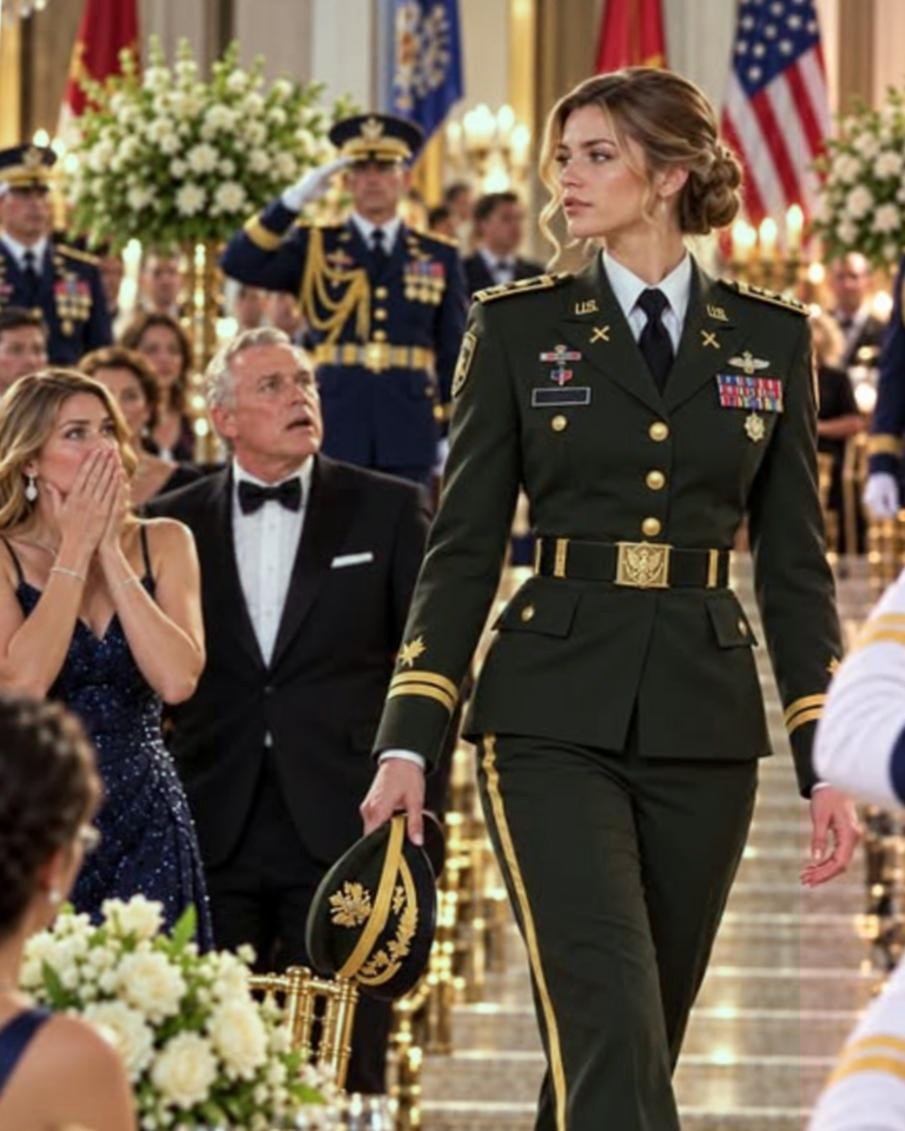

“Who is it?” I asked.
For several seconds, only breathing could be heard on the phone.
“The foundation’s director, Victor Haley. He is also in the hall.”
I slowly turned around.
Victor was standing on the left side of the stage. About fifty years old, in a well-tailored suit, with a wineglass in his hand. He had been smiling all evening, but now his fingers were gripping the stem of the glass so tightly that his knuckles had turned white.
My father looked at him.
“Victor, tell her that this is nonsense.”
Victor shook his head.
“Richard, I have already told you enough.”
A whisper spread through the hall.
My father walked toward him.
“You promised me that everything would be protected.”
“You promised me that you would never use your daughter’s name publicly,” Victor replied. “But you wanted more money.”

The general signaled to the security guards.
“Both of you will remain where you are.”
“This is a private event,” my father shouted.
“No,” I said. “This is already the scene of an investigation.”
My phone rang again. The military prosecutor told me that the investigative team was on its way and that a temporary restriction on the bank accounts had already taken effect.
My father quickly came closer to me.
“Claire, please. I am your father.”
Those words had been a shield for him for twenty years. This time they sounded only like a tired phrase.
“That is exactly why I believed you,” I replied.
“I was doing everything for the family.”
“You did not do it for the family. You did it for your own name.”
“I was helping your career.”
“Your lies did not create my career. I created it with nights, fear, and responsibility.”

The general signaled to the technician. The video began again.
My father heard his own voice.
“Claire will never dare to resist.”
His face slowly changed. For the first time he heard his own words as others heard them. Not as a joke. Not as family anger. As deliberate humiliation.
He turned his back on the screen.
“Turn it off.”
“No,” the general said.
“This is illegal!”
“The recording was obtained by court order,” the prosecutor answered from the phone.
My father fell silent.
Victor tried to sit down on a chair, but his legs gave way and he leaned against the wall.
Madison came to me.
“Did Dad know that he was collecting money in your name?”
“Now we know that he did.”

“And I was helping him send the invitations.”
“You could not know everything.”
“But I should have asked.”
For the first time there was no envy in her voice. Only shame.
Ethan stopped in front of me.
“Forgive me.”
“For what?”
“For always believing that you were less than me.”
I put my hand on his shoulder.
“You were also listening to Father’s stories. I simply stopped believing them earlier.”
Later, when the guests were leaving the hall, my father remained alone. His phone rang continuously. A lawyer called him, but the conversation ended after several minutes.
“He withdrew from the case,” my father told me.
“Why?”
“He said that I had hidden the accounts from him.”
I did not answer anything.
“Claire, you can put an end to this. Say that you do not want charges to be brought.”
“This is no longer my decision.”
“I will end up in prison.”
“Maybe. Maybe something else will happen too. But I can no longer shield you from the consequences.”

At the end of the night I returned home. When I opened the door, I noticed for the first time how small the room was in which I had lived for years. On the wall hung only one photograph — me in military uniform, at the age of twelve, when I still believed that my father would someday be proud of me.
I took the photograph down.
And I placed the small copper compass on the table. Its cracked glass still reflected the light.
Three weeks later I went to court as a witness. My father pleaded guilty to financial fraud and the use of false military recommendations. Victor handed over all the documents in the case to the investigators. He too was charged, but cooperation with the prosecution softened his sentence.
I sat calmly in the courtroom.
My father no longer looked toward me.
It was painful.
But less so than searching for his gaze all my life.
Four months later I moved to a new city. I lectured at a military academy on operational planning and crisis decisions. In the morning I brewed coffee in a small kitchen, at midday I checked the students’ notebooks, and in the evening my nine-year-old niece, Lily, drew with me.

One day she drew large mountains on a sheet of paper. Above the mountains was a small red dot.
“What is this?” I asked.
“A road,” Lily told me. “When you get lost, it shows you the way back.”
“Who taught you?”
“You.”
I smiled.
“I never taught you that.”
“Then your compass taught me.”
After that the compass lay on my desk. Not as a memory of war, but as a reminder that sometimes you find your direction when everyone tells you that you are lost.
Six months later my father sent me a letter. It was short.
“I want to meet you. Now I understand better how many things I did not know.”
I held the letter in my hand for a long time.
Then I wrote a reply.
“I no longer need your knowledge in order to know who I am. I wish you peace, but I cannot go back.”

I received no reply.
The first snow came on a December morning. Lily stood by the window and caught snowflakes in her palm. I went to my desk and picked up the compass.
White light fell on the cracked glass.
It was still pointing in the right direction.
This time I chose the road.
Missed the beginning?
Related posts:
 My Father Was Fed by a Poor Woman at Night, but When I Followed Her Trail, a Stranger’s Face Suddenly Turned Pale
 Three Little Boys Met Me with Humiliation, but When I Told Their Father the Truth, the Glass in His Hand Stopped Motionless
 My son’s wheelchair space was taken away, but the man’s face changed when the old woman opened the little box
 An Unknown Man Humiliated Me in Front of Everyone, but the Restaurant Owner Looked at Me Only Once — and His Smile Immediately Disappeared
 I accidentally entered the mafia boss’s meeting in wet clothes — but instead of getting angry, he came straight toward me, and everyone’s faces changed
 My Father Dropped My Military Medal into Mashed Potatoes, but the General Who Came to the House Suddenly Turned Pale