

The inspector did not take an hour to arrive.
Mark immediately began making calls.
First he called the bank.
“You cannot freeze the account,” he repeated. “This is a misunderstanding.”
Then he contacted his lawyer.
“This is a family dispute,” he told him. “My mother is simply angry.”
The lawyer listened for a few seconds and then shook his head.
“I cannot accept this, Mark.”
“What do you mean, you cannot accept it?”
“I mean that I will no longer make statements in your name until I see the documents.”
Mark ended the call and dropped the phone on the table.
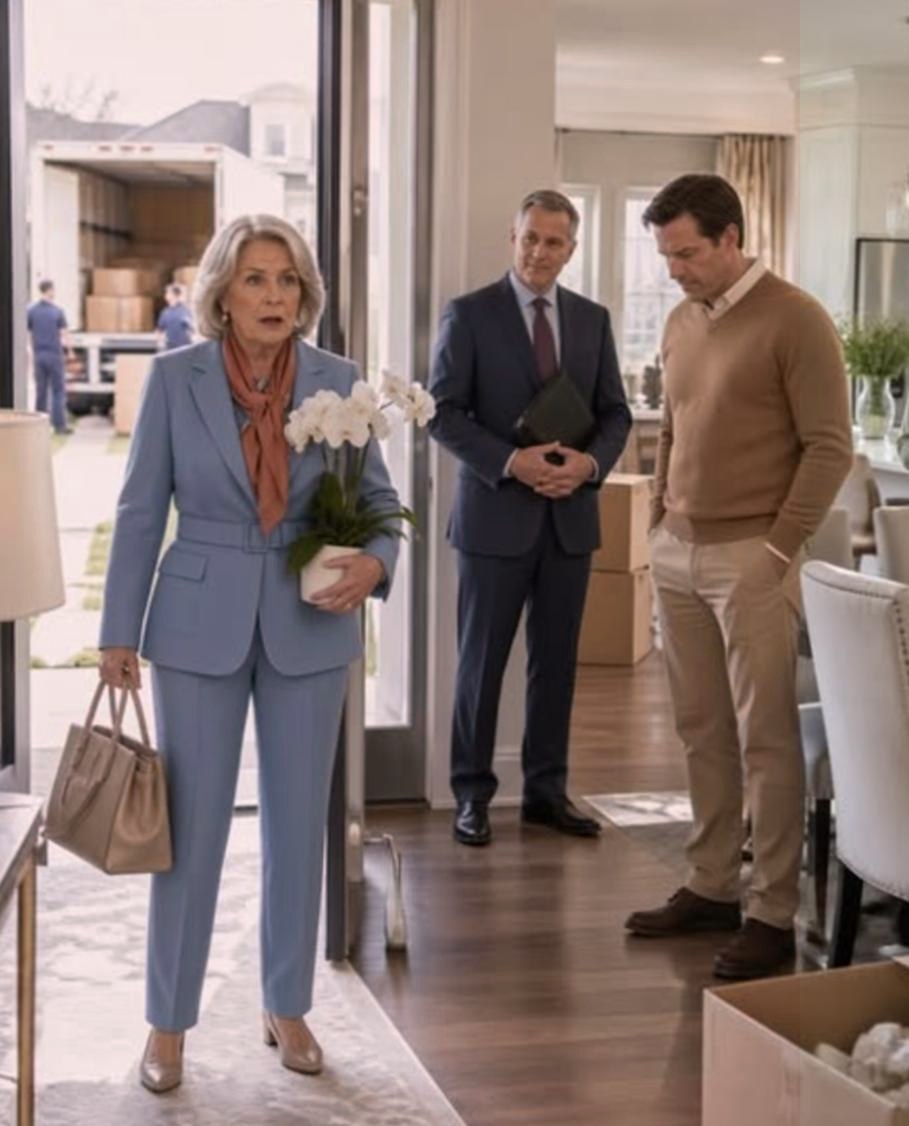
Carol stood by the window. Outside, the movers were waiting by the truck. One of them held a cardboard box on which it said in black marker: “Carol’s bedroom.”
I looked at this inscription for several seconds.
Then I looked away from the box.
A police inspector, a bank representative, and Mark’s business auditor entered the house. The mud from the rain brought in on their shoes left dark marks on the new floor.

Mark was still trying to regain control.
“All of this is a conspiracy against me.”
The inspector calmly opened the folder.
“Then explain why you told your mother that you participated in the purchase of the house.”
“I did not say that.”
Dennis placed a small voice recorder on the table.
“Mark, that is your own voice.”
The recording started.
“We got the house with your money. Linda will resist, but her room will be yours.”
Mark’s voice sounded through the room again.
I knew what he was saying. It still struck me.
Carol lowered her eyes.
“Did you say this?”
Mark grabbed the chair.
“It is taken out of context.”
“My own voice does not need context for my own ears,” Dennis said.
Mark fell silent.
The inspector gathered the documents.
“There are other discrepancies in your company accounts as well. The inspection will continue. Until it is completed, you cannot dispose of the frozen funds or sell the property.”

“No one will take my house from me,” Mark shouted.
“This is my house,” I said.
For the first time I did not flinch at hearing my own voice.
Carol looked toward me.
“Linda, did you know this?”
“No. But I knew that the house money was mine. That is why I kept every receipt.”
I had the documents. Transfers, contracts, account statements. Mark thought that my caution was distrust. In reality, it was the only reason why I did not leave my own house that day.
Carol looked at the boxes of her belongings.
“Movers, take everything back.”
Mark raised his head sharply.
“Mom, don’t leave me like this.”
“You already left me when you sold my future to cover your debt.”
These words were painful, but Carol no longer shouted. Neither did I.
That evening Mark moved into the guest room. Only one bed and an open suitcase remained in the room. There was a new bed in our master bedroom, but I still did not have the desire to lie on it.
I left the white orchid on the table. Its stem was broken, although the flower had still not fallen.
In the following days, the calls did not stop.
Mark’s lawyer called me again.
“He wants the house to be temporarily sold and the money divided.”
“This house was purchased with my money.”
“I know. That is exactly why he wants an agreement.”
“An agreement exists only when both sides tell the truth.”

Mark sent me a letter too.
“Linda, I will put everything in order. Just do not destroy the family.”
I looked at this sentence for a long time.
Then I wrote back: “I did not destroy the family. I only opened the door and let the truth in.”
Two weeks later Mark left the house. He took clothes, work bags, and his brown cup, which had a small crack on its handle.
I saw the empty wardrobe for the first time.
Only one thing remained there—the sock that I had put on the bed that morning. Mark had taken the other one, and this one had fallen under the drawer.
I picked it up and stood for a long time.
It is strange how a small sock can show you an entire marriage.
Three months later I started a new job at a local housing agency. I helped people choose houses. I told each client to read every document themselves, check every number twice, and never believe the phrase: “I will take care of it.”
In the mornings I drank coffee by the window. Silence in the house no longer frightened me.
Carol came on Sundays. At first she stood awkwardly at the door, as if she still did not understand my boundary.
One evening she brought me a little girl’s drawing—a house on each side, a bridge between them, and a big sun above.
“This is you,” she told me. “In your house.”
“You can be here too, if you call me beforehand.”
Carol smiled.
“Now I already know that I must do that.”
The investigation into Mark’s case ended. The company was charged with covering its debts, and Carol recovered part of her money through the court. Mark kept his freedom, but for the first time in his life he no longer had the opportunity to blame everything on others.


I did not want to punish him.
I wanted him to remain alone with his decisions.
Six months later the first snow came. A white covering settled on the roof of the house. New curtains hung in the kitchen, and I arranged the guest room for Carol, but only when she came to visit herself.
That night Mark called me one last time.
“Linda, may I come and explain everything to you?”
I looked at the snow from the window.
“You have already explained it.”
“I still love you.”
“Love that is afraid of the truth is no longer enough for me.”
“Will you just leave me like this?”
“No, Mark. I simply will no longer catch you when the weight of your own choice bears down on you.”
The call ended.
The next morning I replanted the white orchid in a new pot. I cut off the broken stem, carefully pressed down the soil, and placed it by the window.
A new bud appeared within several weeks.
That same day I put the old sock in the trash bin. In its place, in the drawer, I arranged my documents, house keys, and the little girl’s drawing.
I watered the orchid.
Now this house was truly mine.
Missed the beginning?
Related posts:
 In the New House, My Mother-in-Law Demanded My Bedroom, but When the Moving Truck Filled the Yard, the Smile Disappeared from Her Face
 My son left a twelve-point order in my kitchen, but at the news of my departure it was he who lost color first
 La masa de Paște, mătușa mea a umilit copiii mei, iar când am plecat, mama a rămas cu furculița în aer
 My Husband’s Mother Smashed My Daughter’s Birthday Cake on the Floor, and Suddenly Everyone in the Room Fell Silent
 She returned to my workshop after eighteen years and changed everything with one phrase — the woman standing at the door suddenly turned pale
 Before her husband died, he gave something to the doctor, but when I needed to open it, the doctor’s face suddenly turned pale