
The message was still flashing on the screen when Karina took the phone from my hand.
“You are not going anywhere alone,” she said.
“I was not planning to.”
“The message has already been automatically forwarded to several addresses. Whoever sent this may only be trying to distract us.”
At that same moment the phones in the building began ringing simultaneously.
First Castañeda was called.
Then Karina.
Then my phone.
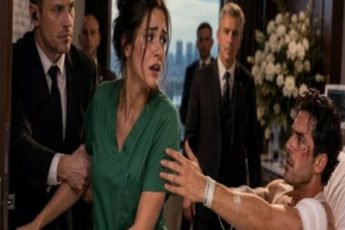
My father was trying to regain a calm expression, but his hands no longer obeyed him. With his right hand he twisted the button of his jacket, and with his left he gripped the edge of the table.
“All of this is illegal,” he said. “I demand a lawyer.”
His lawyer appeared in the doorway, the one who had entered with the family a few minutes earlier. Sweat covered his face.
“Mr. Herrera, we have to leave.”
“No one is leaving here,” Karina told him.
The lawyer looked at Father.
“No. I said I will not remain with you.”
Father froze.
“What does that mean?”
“It means that you hid the bank accounts and the pressure on the witnesses from me. From this moment, I no longer represent you.”
Mother cried silently. Renata was looking at the phone lying on the floor. The live broadcast was still on, and the comments were changing across the screen with lightning speed.
One viewer wrote: “His father is now saying himself that he deceived people.”
A second: “This is no longer just a family drama.”
A third: “Daniela, do not turn off the broadcast.”
I was no longer reading them.

Karina turned to Ortega.
“Put your weapon and service identification on the table.”
“I was only carrying out the warrant.”
“Then why did you erase your entry record?”
Ortega could not answer.
Paula turned the computer around. Security-camera footage appeared on the screen. Two days earlier, Ortega had entered the archive at night. In his hand he held the same folder that had been brought to my home.
“This has been edited,” he said.
“No,” Paula replied. “The camera saves a copy directly to the network.”
Ortega heard his own voice for the first time when the recording played.
“Daniela must be arrested by morning. If the judge sees the trust documents, they will arrest all of us.”
Then my father’s voice was heard.
“Pay him double. This time you must not make a mistake.”
Everyone in the room fell silent.
Father was staring at the screen as if another man were standing there.
“I did not say that,” he whispered.
Karina stopped the recording.
“That is your voice.”
“Maybe… maybe someone else had the phone.”
“But it is your voice,” I said.
I looked at him and for the first time saw not the powerful businessman whom I had regarded like a god in childhood, but a frightened man who could no longer find a way out in the wall of his own lies.

The judge remotely issued arrest and search warrants. Agents entered the house, the office, and the accounting company simultaneously.
Father tried once more to regain control.
“Daniela, we are family. If you stop all this, I will give the house back to you.”
“The house is mine anyway.”
“I will give you the company too.”
“The company was never yours.”
He bent toward me.
“You cannot manage all this alone.”
“I am not going to. That is why Grandmother left it in an independent fund.”
Father lowered his eyes.
It was the first time that, since my childhood, his silence did not feel like a victory to me. I simply felt that I had finally become free of him.
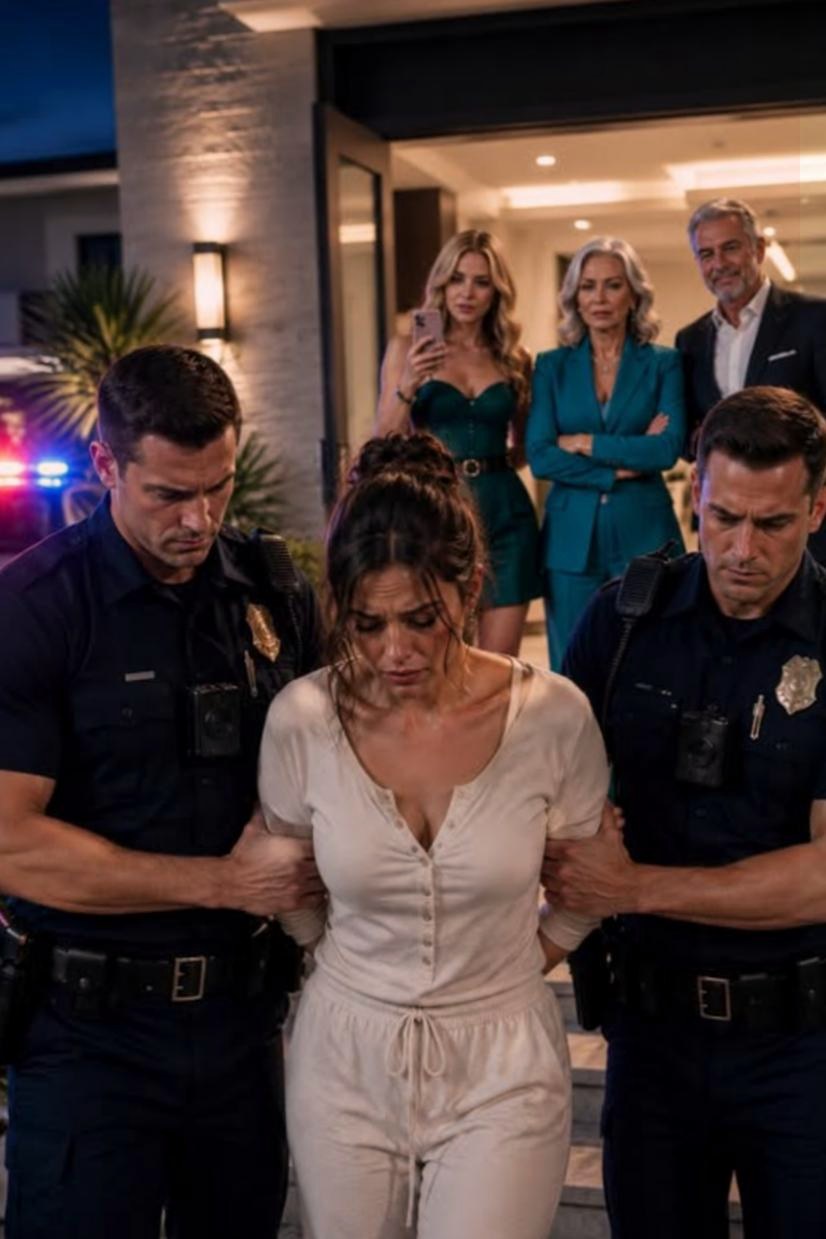
That same morning a search was conducted at the Chapala house. Grandmother’s portrait still lay in the living room, only the frame was broken. I replaced the glass, but kept one small fragment. I do not know why. Perhaps because on the night when they handcuffed me, I was standing right beside it and still did not fall.
In Father’s office they found forged contracts, a list of hidden accounts, and dismissal lists prepared for employees. Julia’s letter and the recording finally confirmed that the will had been forged and that pressure had been applied to Grandmother.
In the following weeks the case reached court.
I did not attend every hearing.
Sometimes one call from my lawyer was enough.

Renata tried to delete the recording of the live broadcast, but hundreds of thousands of people had already saved it. Her main sponsor terminated the contract. Under the videos, people who had earlier demanded my arrest were now writing.
Mother requested a settlement.
She admitted that she knew about the forged will and had participated in intimidating Julia. Her responsibility was less than my father’s, but she still could not escape the crime.
Renata called me for the first time during the trial.
“Daniela, I did not know that Father was changing the medicines.”
“But you knew that a forged will existed.”
“I only wanted to protect the family.”
“No. You protected your own viewers. They did not need the truth.”
“Can we start over?”
I was silent for a long time.
“Starting over without the truth is impossible.”
I ended the call.
Several months later the new board of the transportation fund met. The employees elected their own representatives. The sound of engines could still be heard in the workshops, while the office smelled of coffee and motor oil.
I was no longer the temporary supervisor. The independent board kept me as a permanent adviser, although I no longer carried out daily management. My new job was in another part of the city—the Property Crime Prevention Center. There I taught people how to protect their companies from family members and shell partners.
In the first days I checked my bag three times every morning.
Then the habit disappeared.
Grandmother’s copper bookmark lay on my desk. I no longer hid it in my wallet. Everyone could see it.

One evening, when the first snow was falling by the window, my seven-year-old nephew, Leon, ran into the room. He was Renata’s son. After the trial, his guardianship had temporarily been taken from his mother because Renata could no longer manage her own life. I never blamed the child for the mistakes of adults.
Leon held out a sheet of paper to me.
“I drew this for you.”
In the drawing, a woman stood beside a truck. In her hand she held a small copper object.
“Is that me?”
“Yes. You are not afraid.”
I went to the window.
“Sometimes I am afraid.”
“Then why are you standing?”
I knelt beside him.
“Because fear does not always mean that you should run away.”
He rested his head on my shoulder.
That evening I understood for the first time that Grandmother’s true inheritance had not been the house or the company. It had been the ability not to change yourself even when everyone convinces you that you are guilty.
At the end of winter I received a letter from my father. It was not from prison—he was still awaiting the final decision in the case—but it had been sent through his lawyer.
“Daniela, I have lost many things. You are the only one who can end all this. Just tell me that you will not fight against me to the end.”
I read the letter several times.
Then I wrote a reply.
“I am not fighting against you. I simply am no longer protecting you from the consequences of your decisions.”
I put the paper in an envelope and sent it back.
After that he did not write again.
One morning I went alone to the Chapala house. The wind shook the trees in the yard. Grandmother’s portrait hung on the wall, now with new glass. Her blue-cornered notebook lay on the table. On the last page only one sentence was written: “Conscience is the most valuable property, because no one can sell it in your place.”
I placed the copper bookmark on the notebook.
The engraved figure of the small truck flashed in the sunlight.
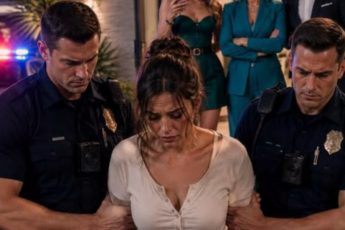
That night a million people watched my arrest.
But I was looking at only one thing.
The light passing through the broken glass.
Missed the beginning?
Related posts:
 My Father Was Fed by a Poor Woman at Night, but When I Followed Her Trail, a Stranger’s Face Suddenly Turned Pale
 A Flat Tire Stopped Me at a Desert Diner, but When the Waitress Heard My Name, the Color Drained from Her Face
 An Unknown Man Humiliated Me in Front of Everyone, but the Restaurant Owner Looked at Me Only Once — and His Smile Immediately Disappeared
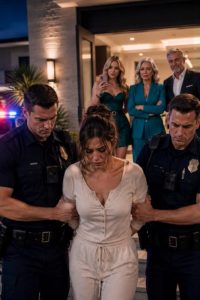 A million people watched my arrest live, but when my father heard one question, the color drained from his face
 After My Husband’s and Daughter’s Funeral, My Mother Asked Me for the Insurance Money, but the Bag on My Table Suddenly Erased Her Smile
 My Breakup Message Reached the Most Dangerous Man in the City, but When He Saw My Necklace, His Face Changed