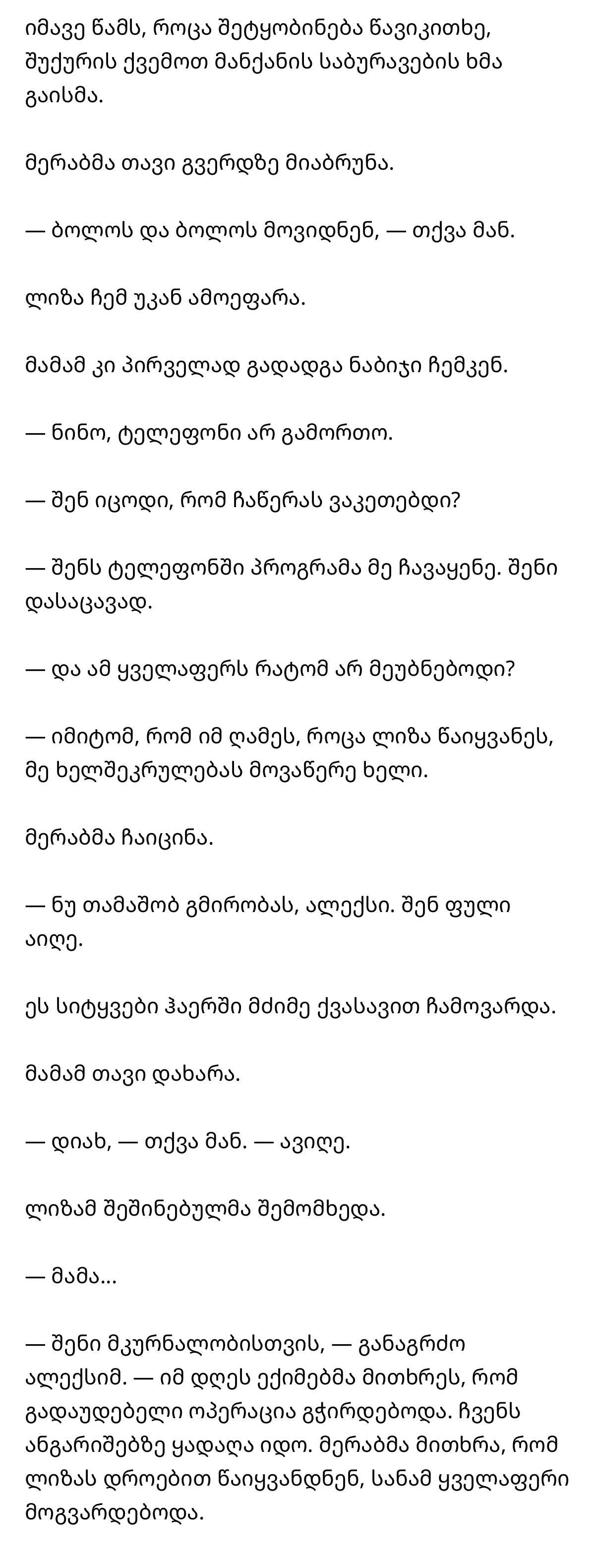

At the very moment I read the message, the sound of car tires was heard below the lighthouse.
Merab turned his head to the side.
“At last they have come,” he said.
Liza hid behind me.
And Father took a step toward me for the first time.
“Nino, do not turn off the phone.”
“You knew I was recording?”
“I installed the program in your phone. To protect you.”
“And why didn’t you tell me any of this?”
“Because on the night when Liza was taken away, I signed the contract.”
Merab chuckled.
“Don’t play the hero, Alexi. You took the money.”
These words fell into the air like a heavy stone.
Father lowered his head.
“Yes,” he said. “I took it.”
Liza looked at me frightened.
“Father…”
“For your treatment,” Alexi continued. “That day the doctors told me that you needed an urgent operation. Our accounts were under seizure. Merab told me that they would take Liza temporarily, until everything was settled.”
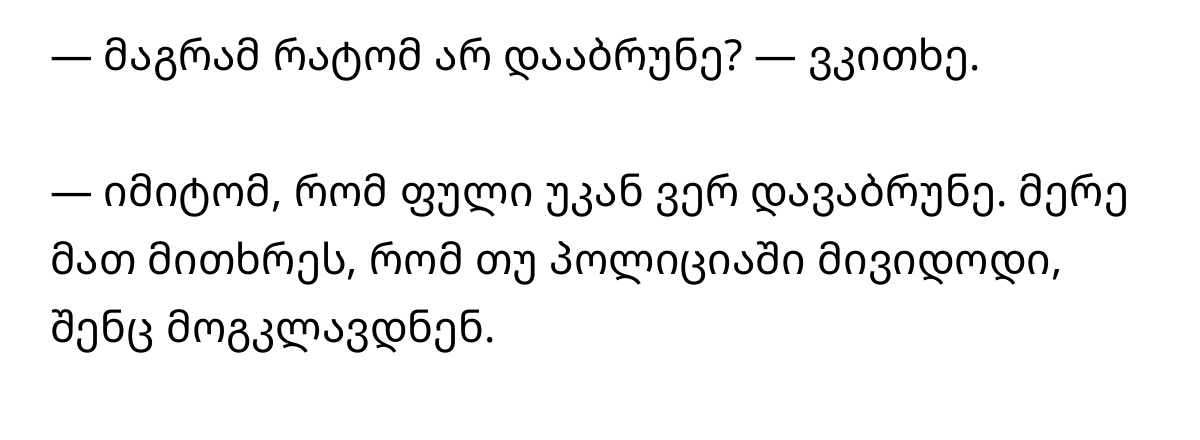
“But why didn’t you bring her back?” I asked.
“Because I could not return the money. Then they told me that if I went to the police, they would kill you too.”


Merab took his hand out of his pocket.
“Enough.”
Then two cars stopped at the same time below. Police officers came up, but they were not alone. Behind them a woman was coming, holding a white folder in her hand.
“Nino Kapanadze?” she asked me.
“Yes.”
“I am Investigator Ketevan. Your phone automatically sent the recording of the last twenty-eight minutes to our server.”
Merab laughed, but the laughter soon disappeared.
“This is illegal.”
“Your voice is on the recording,” the investigator replied. “You yourself admitted to selling the child, preparing false documents, and intimidating Nino.”
Merab looked at Father.
“You ruined everything.”
“No,” Alexi said. “I ruined everything when I signed.”
A police officer put handcuffs on Merab. He did not fight. He only looked at me.
“Your sister will not last long beside you,” he whispered to me. “You are strangers to each other.”
Liza took my hand.
“We are not strangers,” I answered. “They simply stole time from us.”

The investigator searched Merab’s car. Under the back seat they found passports, false birth certificates, and a list containing the names of more than ten children.
Merab was taken away.
Father sat down by the lighthouse wall. The wind fluttered the hem of his coat.
“You must go to the police too,” I told him.
“I know.”
“You may end up in prison.”
“I know.”
“Then why did you protect me for so many years?”
He looked into my eyes.
“Because once I could not protect you. Then I always thought that if I stayed silent, I would not make a second mistake.”
“Keeping silent is also a choice, Father.”
“I know, Nino.”
That evening all three of us went to the station. Liza looked out the window the whole way. The little shell clip hung from her fingers, as if she could not part with a talisman that had come from the past.

Merab’s lawyer refused to continue the case the next morning.
“My client hid everything,” he said. “I am no longer remaining in this case.”
Merab was still trying to regain control. He called, sent letters, and searched for my old address. Once he called me and said only one sentence:
“I managed to save your family.”
“No,” I answered. “You destroyed it and then took the money too.”
That same day the investigator let me listen to the recording of his conversation. In the headphones I heard not my own voice, but Merab’s voice, cold and confident:
“Nino will never find out. The girl will stay with us, and the father will live in fear all his life.”
Merab himself had said these words.
But when he heard them for the first time, he covered his face with his hands.
“Turn it off,” he whispered.
“Why?” the investigator asked. “Do you not recognize the voice?”
He could not answer.
Three days later we locked up our childhood home. There was no longer a bed in Liza’s room. Only a small square remained on the wall, where her photograph had once hung.
On the windowsill I found one thing — an old glass jar in which Liza used to collect sea sand. The jar had lost its lid, and inside it lay three white pebbles.
Liza stood at the door of the room.
“Did I sleep here?” she asked.
“Yes.”
“I remember the window. And I also remember that you told me a fairy tale every night.”
“I thought you did not remember.”
“Some things remain in a person’s body, even if they forget their name.”

Father did not enter the room. He only leaned against the wall at the door and looked at the empty room for a long time.
“I want to know everything,” Liza told him.
“I will tell you everything,” he promised.
“Slowly.”
“Slowly.”
For the first time in twelve years we sat in one room and nobody lied.
Father’s trial lasted several months. He confessed to the crime, but helped the investigation find all the accounts and names. The court reduced his sentence, although that did not mean freedom for him.
I testified against him.
It was the hardest day.
As he left the courtroom, he asked me only:
“Can you at least forgive me now?”
“Perhaps I will forgive you someday,” I told him. “But I will no longer protect you from your own truth.”

Weeks passed.
Liza moved into my small apartment, far from the sea, in Tbilisi. In the first days she checked the door in the morning and woke at noises at night. I heated milk in the kitchen and asked her nothing.
One evening she put a sheet of paper on the table.
“I drew this for you.”
On the paper three people stood on the beach. Their hands were joined to one another. A large yellow sun could be seen in the sky, and below it was a small orange shell.
“What is this?” I asked.
“The place where everything began again.”
I started working at a children’s aid center. There I helped parents search for missing children. Every morning I arranged documents, and in the evening I waited for Liza when she returned from her drawing course.
We were learning to get to know each other again.
She liked hot bread, but hated raisins. And I discovered that Liza fell asleep to the sound of the sea. So I recorded the sound of waves on the old recorder and placed it beside her bed.
The first snow came in December.
Liza stood by the window and turned the little shell clip in her hand.
“Shall we go to the beach tomorrow?” she asked.
“If you want.”
“I want to. This time let’s take a photo together.”

That same night I received a last letter from Merab. It had been sent from prison.
“Your family was saved thanks to me after all. Come and explain to me in person why you condemned me.”
I tore the letter in two.
Liza looked at me.
“You will not write back?”
“No.”
“Why?”
“Because his remorse is no longer my business.”
The next morning we went to the beach. The sky was clear, and the sand shone golden in the sun. Liza tied up her hair and fastened the orange shell-shaped clip.
I set the phone on the sand.
This time nobody was hiding in the background.
Only Liza and I stood side by side, looking out at the sea.
The wind moved the clip slightly.
Liza squeezed my hand.
“You will not delete it now, will you?”
“Never again.”
A wave rolled a small shell to our feet.
I picked it up and gave it to Liza.
For the first time the sea no longer looked like the place that had taken my sister from me.
It became the place where she returned to me.
Missed the beginning?
Related posts:
 My wife accidentally revealed my infidelity while talking to a friend, but when a certain name was mentioned, the phone slipped out of my hand.
 An Unknown Woman Accidentally Appeared in a Seaside Photo, but When the Father Saw a Small Detail, the Color Left His Face
 My Father Was Fed by a Poor Woman at Night, but When I Followed Her Trail, a Stranger’s Face Suddenly Turned Pale
 Before our fifth anniversary, I overheard my husband’s secret conversation and his laughter suddenly stopped
 When My Husband Chose My Sister, My Nine-Year-Old Daughter Took the Microphone at the Wedding and Everyone’s Face Changed
 A Flat Tire Stopped Me at a Desert Diner, but When the Waitress Heard My Name, the Color Drained from Her Face