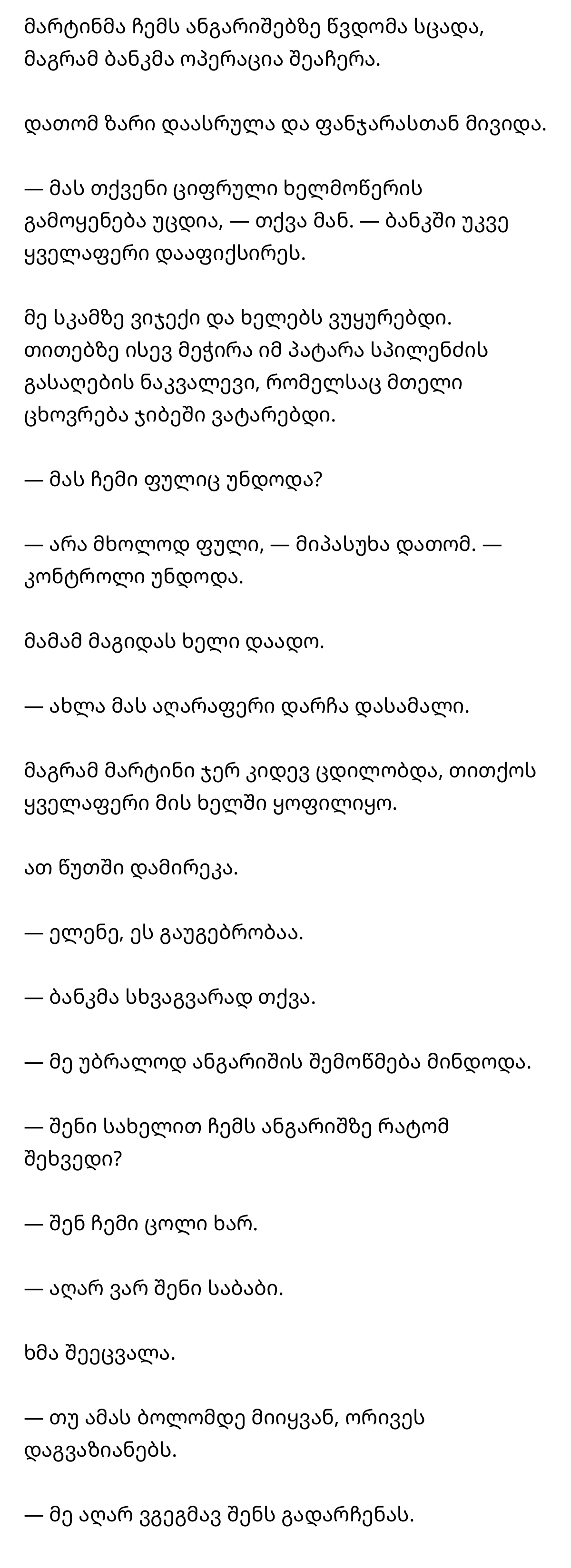

Martin tried to access my accounts, but the bank stopped the operation.
Dato ended the call and went to the window.
“He tried to use your digital signature,” he said. “The bank has already recorded everything.”
I was sitting on the chair and looking at my hands. The imprint of that little copper key, which I had carried in my pocket all my life, was still on my fingers.
“Did he want my money too?”
“Not only money,” Dato replied. “He wanted control.”
Father put his hand on the table.
“Now he has nothing left to hide.”
But Martin was still trying to act as if everything were in his hands.
Ten minutes later he called me.
“Elene, this is a misunderstanding.”
“The bank said otherwise.”
“I only wanted to check the account.”
“Why did you enter my account in your name?”
“You are my wife.”
“I am no longer your excuse.”
His voice changed.
“If you take this all the way, you will hurt us both.”
“I am no longer planning to save you.”
“You will be left alone.”
“Is that a threat?”
In response I heard only his heavy breathing.
“No,” he said at last. “It is a warning.”
“Then give me the right warning for the first time.”
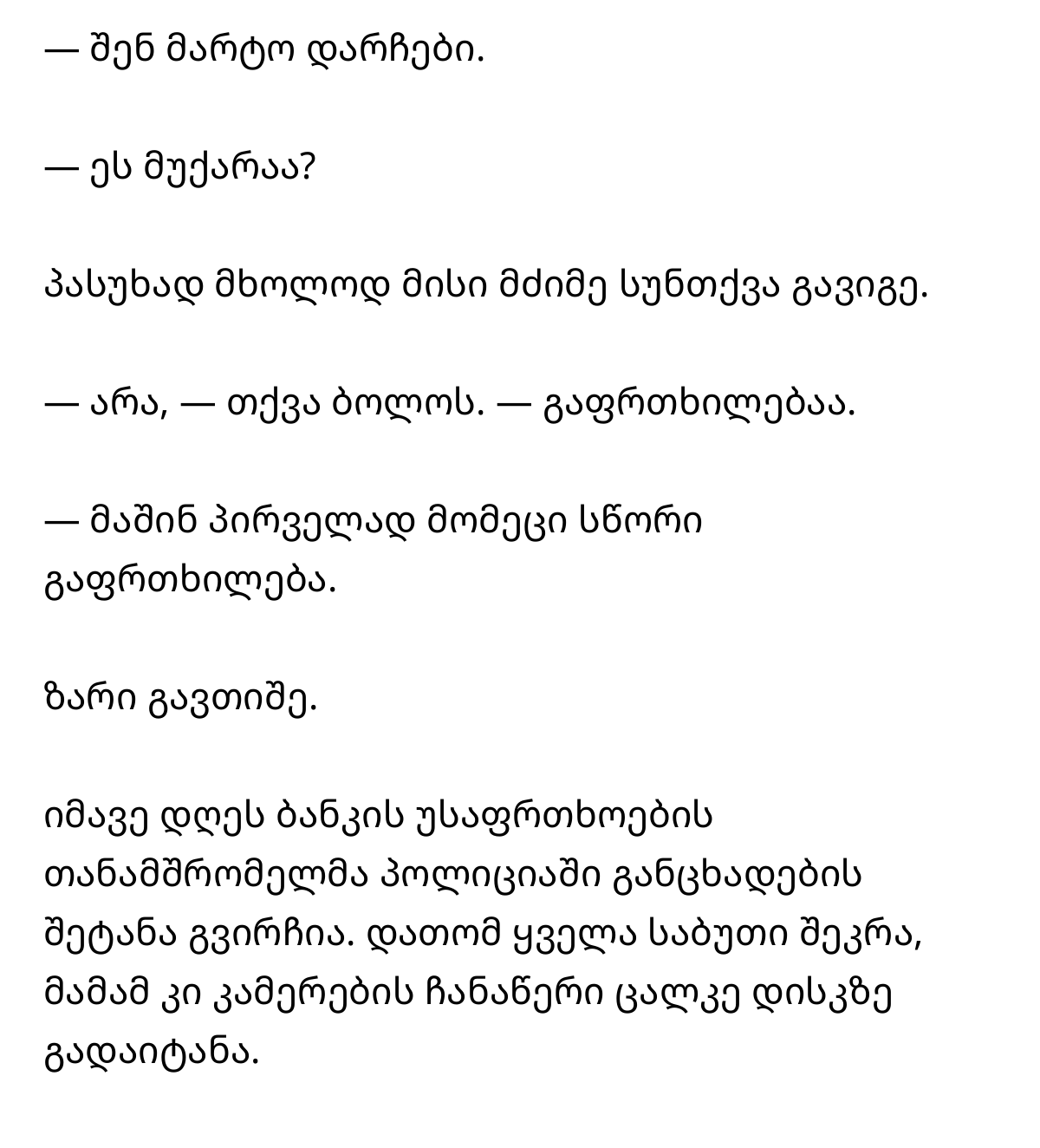
I ended the call.
That same day the bank security officer advised us to file a statement with the police. Dato gathered all the papers, and Father transferred the camera recording to a separate disk.
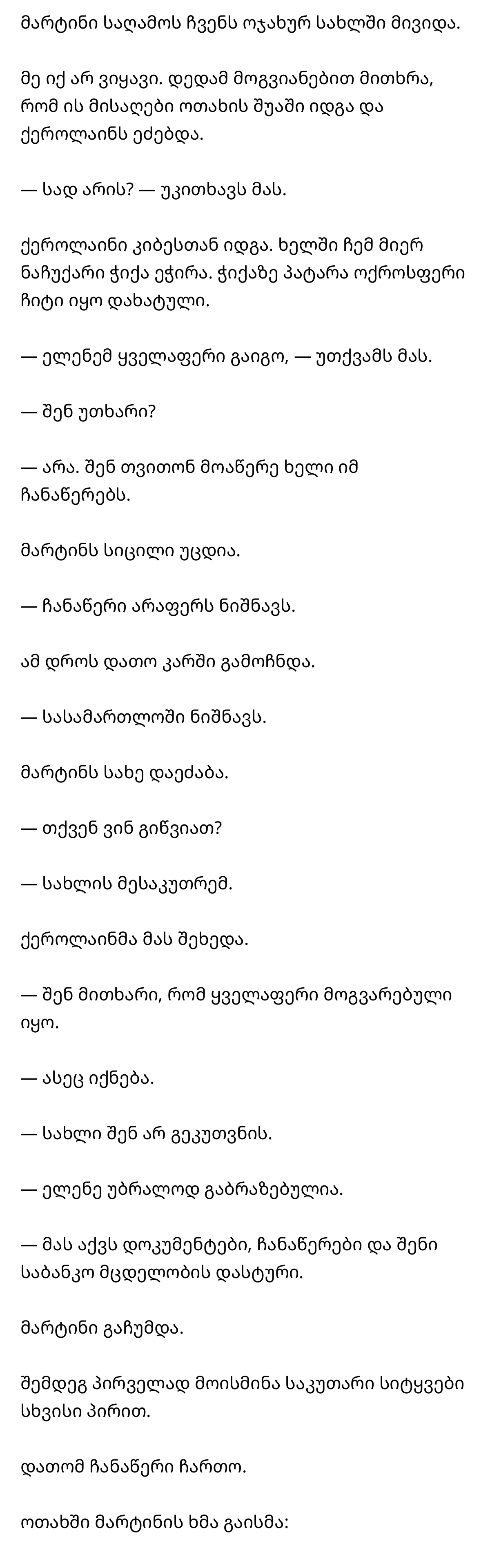

Martin went to our family house in the evening.
I was not there. Mother later told me that he stood in the middle of the living room and was looking for Caroline.
“Where is she?” he had asked.
Caroline was standing by the stairs. In her hand she held the glass I had given her. A small golden bird was painted on the glass.
“Elene found out everything,” she had told him.
“You told her?”
“No. You yourself signed those recordings.”
Martin tried to laugh.
“A recording means nothing.”
At that moment Dato appeared in the doorway.
“In court it means something.”
Martin’s face tensed.
“Who invited you?”
“The owner of the house.”
Caroline looked at him.
“You told me everything was settled.”
“It will be.”
“The house does not belong to you.”
“Elene is simply angry.”
“She has documents, recordings, and proof of your attempt to access her bank account.”
Martin fell silent.
Then, for the first time, he heard his own words from someone else’s mouth.
Dato turned on the recording.
Martin’s voice sounded in the room:
“Elene will give me everything. We just have to force her to feel guilty.”
Caroline’s voice followed:
“If the house remains ours, life without her will be easy.”
Martin stared at the screen.
“This is not the full conversation.”
“The most important part is recorded in full,” Dato replied.


Caroline put the glass on the table. The golden bird gleamed close to her fingers.
“You told me you loved me.”
“I love you.”
“No. You loved my sister’s house.”
Martin moved toward her.
“Are you going against me now?”
“You yourself brought me to this point.”
Caroline picked up her bag and opened the door.
“I will not live here anymore.”
“Where will you go?”
“Where my sister will no longer be part of your plan.”
That night Caroline called Mother. She was crying, apologizing, and saying that Martin had deceived her. Mother handed the phone to me.
“Elene, please listen to me just once.”
“I am listening.”
“I thought he loved me.”
“I also thought you were my sister.”
She began to cry.
“Forgive me.”
I was silent for a long time.
“I may forgive you someday. But forgiveness does not mean that I will return you to the same place.”
“We are still sisters.”
“By blood, yes. By trust—I do not know anymore.”
The following week I went to court. The hearing took place in a small room. There was dust on the windowsill, and a wooden gavel stood before the judge.
Martin initially kept a calm face.
“We bought the house together,” he said.
Dato presented the documents.
“The property belongs entirely to Elene. The defendant knew this and still tried to deceive her.”
Martin looked toward me.
“We were together for twelve years.”
I answered calmly:
“That is exactly why I knew when you were lying.”
They played the camera recording.
His voice sounded in the room.
“Elene will give me everything.”
Martin lowered his head.
Caroline did not come to court, but Dato read her written testimony. She confirmed everything: the length of the relationship, the deception about the house, and Martin’s plan to use my feeling of guilt.
The judge left the house as my property and rejected the claim submitted by Martin. The investigation into the attempted bank fraud continued separately.

It did not feel like victory.
It felt more like a room in which a window had finally opened.
When I left the court, Mother was waiting for me on the stairs.
“Are you all right?” she asked me.
“Now I am learning how to be.”
She hugged me. This time I did not turn to stone.
Three months later Martin took his belongings from the house. The room where his books had stood suddenly seemed very large. Only one photograph remained on the wardrobe shelf—our wedding photograph, with the corner of its frame broken.
I looked at the photograph for a long time.
Then I put it in a drawer.
Caroline moved to another city. Several weeks later I received her letter.
“If you ever want, let us start again.”
I did not send an answer.
Not because I was happy about her pain.
Simply, for the first time I did not want to sacrifice my peace for someone else’s regret.
Six months later I moved into a small apartment that was close to the house, but was my choice. In the mornings I worked in a library. In the evenings I called Mother. On Sundays I drank tea with Father and listened to him complain about the neighbor’s noisy dog.
Life returned slowly, almost imperceptibly.
One morning my little goddaughter, Ana, came to me. She sat at the table and drew a house on a sheet of paper. The house had two doors.
“Why two?” I asked.
“One is for you, the other for those who can come in.”
“And who can?”
Ana thought.
“Those who knock on the door and do not tell lies.”
I laughed. This time for real.

When the first winter snow came, I put small pots on the balcony. In the kitchen I kneaded dough according to Mother’s ravioli recipe. Martin’s footsteps were no longer heard in the house, I no longer waited for the phone to ring, and I no longer checked who entered through the door.
One evening he called me again.
“Elene, give me only five minutes.”
“For what?”
“I want to explain.”
“You have already explained everything.”
“I have changed.”
Outside the window, snow was falling silently on the street.
“Maybe you really have changed,” I told him. “But I am no longer the woman who had to stop her life to prove your change.”
“Do you still love me?”
For the first time this question did not hurt me.
“I loved you once.”
“And now?”
“Now I choose myself.”
He fell silent.
“We still have to talk about the house.”
“The house never belonged to you.”
“Elene…”
“Goodbye, Martin.”
I ended the call.
Then I took the small copper key from my pocket. I hung it on the door of my new apartment, not because it opened an old door, but so that I would remember: happiness is not a room given by someone else.
It is a door that you open with your own hand.
And that night, for the first time, I was no longer waiting for anyone.
Missed the beginning?
Related posts:
 My sister announced my divorce at a family dinner, but when my husband made me sign over the house, his face turned pale
 I found my first love freezing in Central Park with three babies, and when my mother saw them, her smile vanished
 I Overheard My Husband’s Secret Conversation at the Airport, but When He Mentioned Losing My House, His Companion Suddenly Turned Pale
 My husband gave flowers to his former lover, and I left the hall — behind the cameras, his smile disappeared
 My daughter-in-law emptied our yard in front of the guests, but her hands trembled when she heard one decision of mine
 I saw a new bandage on my niece’s shoulder at the camp, and on the way my sister ordered me to turn back — her voice suddenly cut off