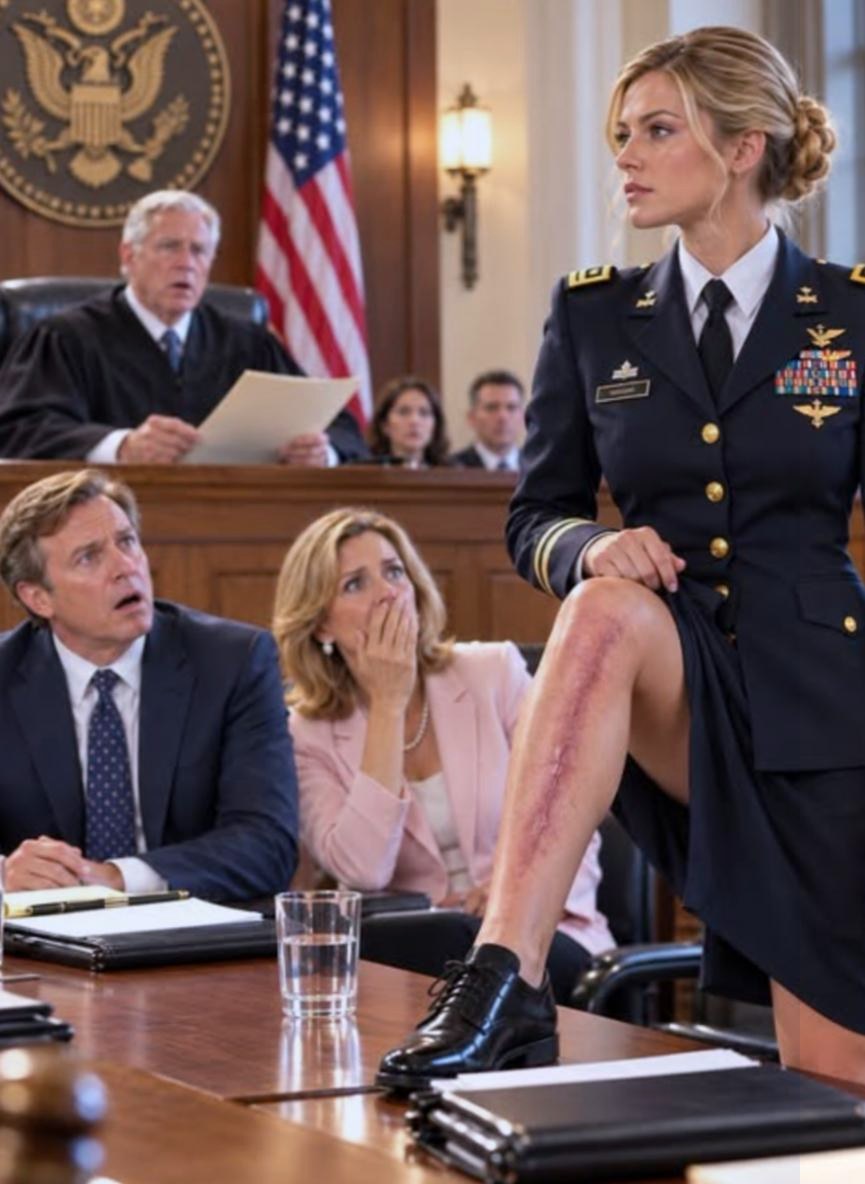

In the courtroom, my father laughed when he saw my military uniform, while my mother lowered her head awkwardly, as if I were still the shame of their family. I stood by the door, my knee hurting, heavy boots pressing against the marble floor, and the medals lined across my chest moving slightly with every breath.
Two days earlier, I was trimming azaleas at the small house near Norfolk when the mailman handed me a cream-colored envelope. My name was written on the envelope, and below it was the seal of the Portsmouth Family Court. Knox, my large dog, immediately stopped sniffing around the yard and stopped by the door.
I opened the envelope at the kitchen table.
Case number 4238B.
Plaintiffs: Robert and Margaret Carter.
Defendant: Evelyn Carter.
For several seconds I only stared at the paper. Then Knox placed his head on my knee.
“It seems,” I whispered, stroking him behind the ear, “they finally found another way to talk to me.”
It had been twelve years since I had returned home. After I completed training, my father never once came to see me. My mother sent me only one message: “We raised a daughter, not a soldier.”

I read it once.
Then I stopped waiting for their approval.
I served quietly, managing supplies, assignments, and people whose lives sometimes depended on a decision made in one second. Our convoy was blown up overseas. When I returned home, my knee had been reconstructed, my walk had changed forever, and scars remained on my body that I did not like talking about.
My grandfather left me the farm before he died. Since 2013, I had paid all the taxes, even when I was thousands of kilometers away. Now my parents claimed that I had abandoned the property and that they themselves had paid the expenses.
This was not a misunderstanding.
It was a lie that had a case number.
That evening, in the bedroom, I opened the dark wooden military chest standing at the foot of the bed. The smell of canvas and oil came out. Under the clothes lay the uniform, medals, and a small brass compass. On the back of the compass were engraved my friend Luis’s initials. He had served with me and never made it back.
I closed the compass in my palm.
“They want to see me?” I said quietly. “Then they will see what I became.”
The next morning, before going to court, I stopped by my grandfather’s farm. The oak was drying out, paint was falling from the walls, and one corner of the wooden porch had tilted as if it might collapse at any moment. Still, I clearly saw my grandfather, hammer in hand, building this house.


My parents did not build it.
When I entered the courtroom, the conversations stopped. An elderly cleaner looked at the medals and said quietly to me:
“Ma’am.”
My father tilted his head to the side.
“The uniform,” my mother muttered, as if the word itself were an insult to her.
My father snickered.
Judge Simmons leafed through the case papers.
“Mr. Carter, are you claiming that your daughter abandoned the property?”
“Yes, Your Honor,” my father answered confidently. “The house has been empty for years. We paid for everything.”
The judge looked at me slowly.
“Commander Carter, would you like to make a statement?”
I rose carefully. A sharp pain passed through my knee, but my voice did not change.
“Yes, Your Honor.”
The judge placed his hand on the cream-colored case folder.
“Before you answer, you need to see one thing. There is a document in this case whose existence your parents apparently did not know about.”
I looked at my father. His smile was no longer visible. The judge opened the folder, placed his fingers on the first page, and just then someone lowered the handle outside the door…

The door opened and a woman in a black dress entered the courtroom. She was holding a brown folder.
“I am attorney Hannah Blake,” she said. “Evelyn Carter’s representative.”
My father jumped to his feet.
“She didn’t have an attorney!”
“Now she does,” Hannah answered calmly.
My mother gripped her beads.
“Evelyn, what is all this?”
“I’m finding out now too, Mom.”
The judge picked up the new papers. My father’s face changed.
“Does this signature belong to your grandfather?” he asked me.
I looked at the paper and immediately recognized the long letters slanting to the left. I had the compass in my pocket; its round edge touched my thigh.
“Yes,” I told him. “But this signature should not have been here.”
Hannah looked at my father.
“You stated that you had taken care of the property for ten years. We have other evidence as well.”
“This is nonsense!” my father shouted.
The judge struck the gavel.
“One more word like that and I will have you removed from the courtroom.”
Hannah took a small memory card from the last pocket of the folder.
“There is a recording on this that changes everything,” she said.
The screen turned on. My father’s voice sounded, but the recording broke off in the middle of a sentence. Then my mother whispered: “If she finds this, we will all lose everything…”

A room appeared on the screen that I recognized immediately. It was the kitchen of my grandfather’s farm. My father stood in the frame, holding old keys, while my mother sat at the table, nervously twisting her fingers.
Hannah played the recording from the beginning.
“If Evelyn comes back, it will all be over,” my father was saying. “First we have to prove that she hasn’t been here for years.”
“But she pays the taxes,” my mother replied.
“No one will find out. We’ll change the receipts. We’ll tell the neighbors that we take care of the house.”
A heavy silence fell over the courtroom.
My mother gripped the chair.
“This recording is illegal!”
“You installed the camera yourselves,” Hannah told her. “In your grandfather’s old room. You probably forgot that the basement system was still working.”
Judge Simmons looked at the screen, then at my father.
“Continue.”
In the recording, my father scattered several receipts across the table.
“We’ll imitate the signature too. A week from now, the court will think that the girl abandoned the property.”
“She is no longer a girl, Robert,” my mother said quietly. “She is military.”
“That is exactly why she won’t come back. People like that follow orders, not interfere in family matters.”
The recording ended.

I looked at my father. For the first time in my life, I saw not anger but fear in his eyes.
“Why?” I asked.
He cleared his throat.
“It isn’t all as it seems.”
“That was your voice.”
“I was only protecting the house.”
“It is my house.”
The judge raised the document. It turned out to be my grandfather’s notarized will, which stated that the property belonged entirely to me and that my parents did not even have the right to enter it without my written consent. Another sheet confirmed that all the taxes had been paid from my account.
My mother began to cry.
“We just wanted to help.”
“Help that included fake receipts and a stolen signature?” Hannah asked.
My father could not find an answer.
The judge entered the recording, bank statements, and signature examination into the case materials.
“This request is no longer a property dispute,” he said. “There may also be a criminal offense here.”
The compass in my pocket touched my skin coldly. I thought the hardest moment had already passed.
Then Hannah’s phone rang. She looked at the screen and lost color.
“Evelyn, this call is not from the police,” she told me. “Someone has just broken into the farm and taken something from your grandfather’s basement…”
And before the courtroom could call security, my father looked at my mother for the first time as if he knew who was behind all of this…
ბაბუას სახლიდან წაღებულმა ერთმა ნივთმა ყველაფერი შეცვალა…
მე მეგონა, სასამართლოში ყველაზე მძიმე სიმართლე უკვე მოვისმინე. მაგრამ შემდეგ აღმოვაჩინე, რომ ეს მხოლოდ დასაწყისი იყო.
„მე უბრალოდ აღარ ვასწორებ შენს მიერ გაკეთებულს.“
ამის შემდეგ დარბაზი სრულიად დადუმდა.
👇 ისტორიის ფინალი უკვე გახსნილია
Related posts:
 My servant made my disabled daughter stand, but one question of hers silenced every voice in the room
 I helped an injured man in an abandoned building, but after my six words, the smile disappeared from his face
 My son’s life managed to save his sister, but on Hannah’s eighteenth birthday she opened a letter and a guest turned pale
 At the Family Gathering, My Husband’s Eight-Year-Old Daughter Was Denied a Place, but I Put Down the Keys and Her Mother’s Smile Immediately Disappeared
 My pregnant husband gave our honeymoon to another woman, but after my calm response his face turned pale
 My Father Was Fed by a Poor Woman at Night, but When I Followed Her Trail, a Stranger’s Face Suddenly Turned Pale