

I still had the phone to my ear when Ivane looked toward the window.
“Camila, do not go to the bank,” he said.
It was the first time my name sounded like a request and not a command.
“Why?”
Mother immediately intervened.
“Do not believe that man. Banks deceive everyone. This is a family matter.”
Father stood up.
“No. It is not anymore.”
A heavy silence fell over the room.

The next morning I went to the bank branch. Ximena was with me, and Renata was sleeping in the stroller. The clock on the wall showed nine fifteen. I was still holding the same folder, with traces of red pen visible at its corners.
The fraud department employee, Mr. Raul, placed the document in front of me.
“This loan was arranged seven months ago. The money was not credited to your account.”
“Whose account did it go to?”
He looked at the screen.
“Ivane Morales’s business account. The money was listed as your family investment.”
Ximena quietly exhaled.
“I did not write this,” I told him.
“We know. The signature was forged. Your old copy of your identity document and an income certificate obtained from your workplace were also used.”
“Who provided them?”
Raul turned over another sheet of paper.
“They were sent from your mother’s email address.”

Something froze in my heart, but I did not begin to cry. A strange calm came over me. As if all the numbers lost over four years had lined up on one line.
The bank employee advised me to file a report with the police and hire a lawyer. That same day I contacted my old lawyer, Mariana.
“If it is family, try talking first,” she told me.
“I tried talking for four years.”
“Then let us talk with documents.”
Three days later we gathered again at my parents’ house. This time Ivane had not come alone. With him stood his friend and business partner, Sergio. Right at the door I noticed his nervous hands—he was turning a key with his fingers.
“You are going too far,” Ivane told me.
“You went too far when you forged my signature.”
Mother pulled out a chair.
“Do you want to put your brother in prison?”
“I do not decide what follows from what he did.”

Father stood by the window. In his hand he held an old ceramic cup with a crack on its handle.
“Ivane, is all this true?”
Ivane lowered his head.
“I needed a loan. The bakery was drowning. Mother told me that Camila would help us anyway.”
“You did not ask me,” I told him.
“You would have refused.”
“Yes.”
That word fell into the room as if I had placed a stone on the table.
Then Mariana played the audio recording. For the first time everyone heard their own voice. Mother’s quiet laughter. Ivane’s words: “Camila cannot say no.” Then Mother’s answer: “Now that she has a baby, she will feel sorry for herself more easily and give us money again.”
Mother’s face grew tense.
Ivane covered his ears with his hands.
“Turn it off.”
“No,” Father said. “Listen.”
The recording continued.
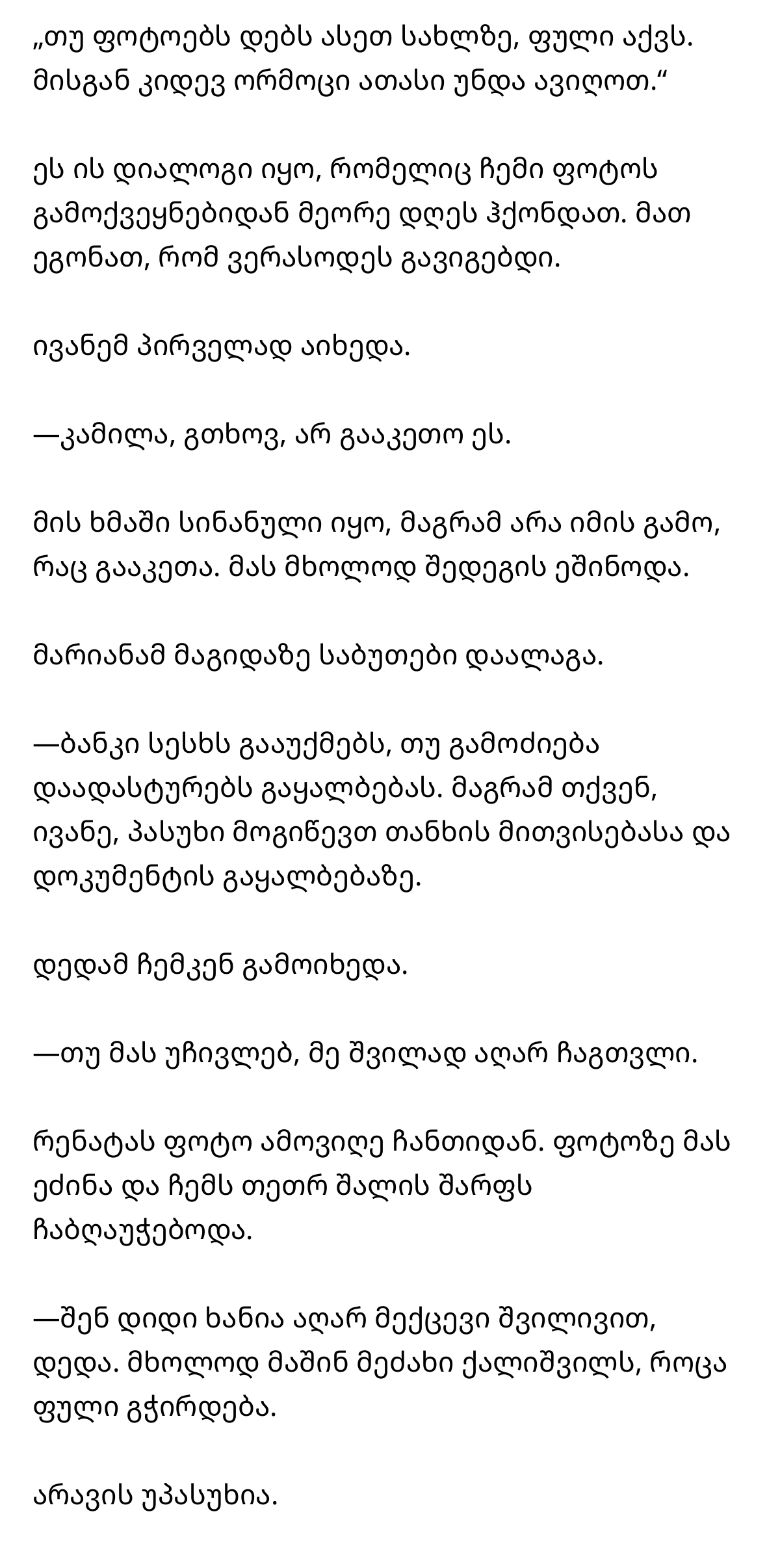

“If she posts photos of such a house, she has money. We should get another forty thousand from her.”
It was the dialogue they had had the day after I posted my photo. They thought I would never find out.
Ivane looked up for the first time.
“Camila, please, do not do this.”
There was remorse in his voice, but not because of what he had done. He was only afraid of the consequences.
Mariana arranged the documents on the table.
“The bank will cancel the loan if the investigation confirms the forgery. But you, Ivane, will have to answer for misappropriating the money and forging the document.”
Mother looked toward me.
“If you sue him, I will no longer consider you my child.”
I took Renata’s photo out of the bag. In the photo she was sleeping and clutching my white wool scarf.
“You stopped treating me like a daughter a long time ago, Mother. You call me your daughter only when you need money.”
No one answered.
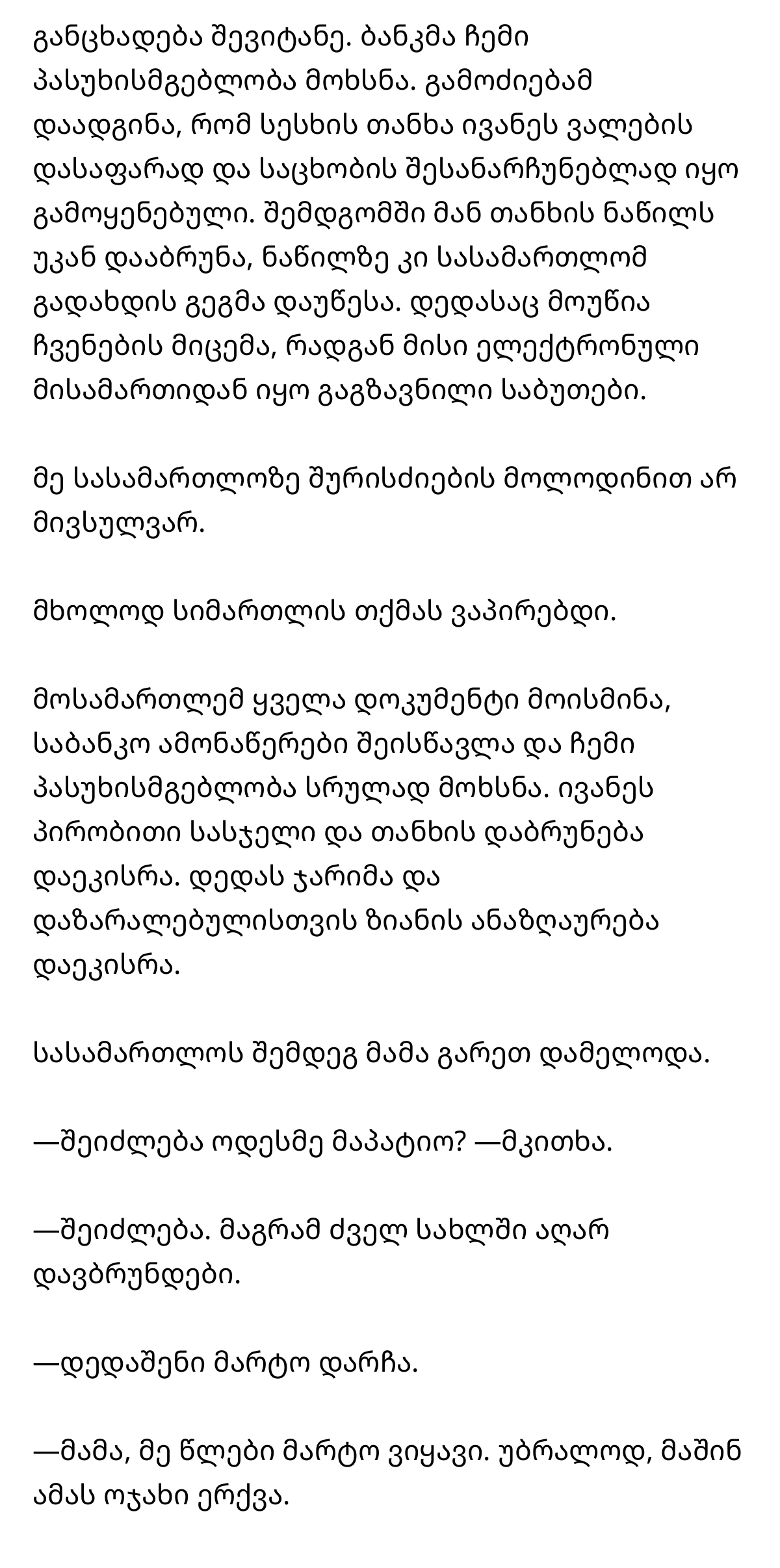


I filed the report. The bank released me from liability. The investigation established that the loan money had been used to cover Ivane’s debts and keep the bakery operating. Later he returned part of the money, while for another part the court imposed a payment plan. Mother also had to give testimony because the documents had been sent from her email address.
I did not go to court expecting revenge.
I only intended to tell the truth.
The judge heard all the documents, examined the bank statements, and completely released me from liability. Ivane was sentenced to probation and ordered to return the money. Mother was ordered to pay a fine and compensate the injured party for the damage.
After the trial Father waited for me outside.
“Could you ever forgive me?” he asked.
“Maybe. But I will not return to the old house.”
“Your mother is left alone.”
“Father, I was alone for years. It was simply called family then.”
He began to cry. And for the first time I did not try to comfort him.
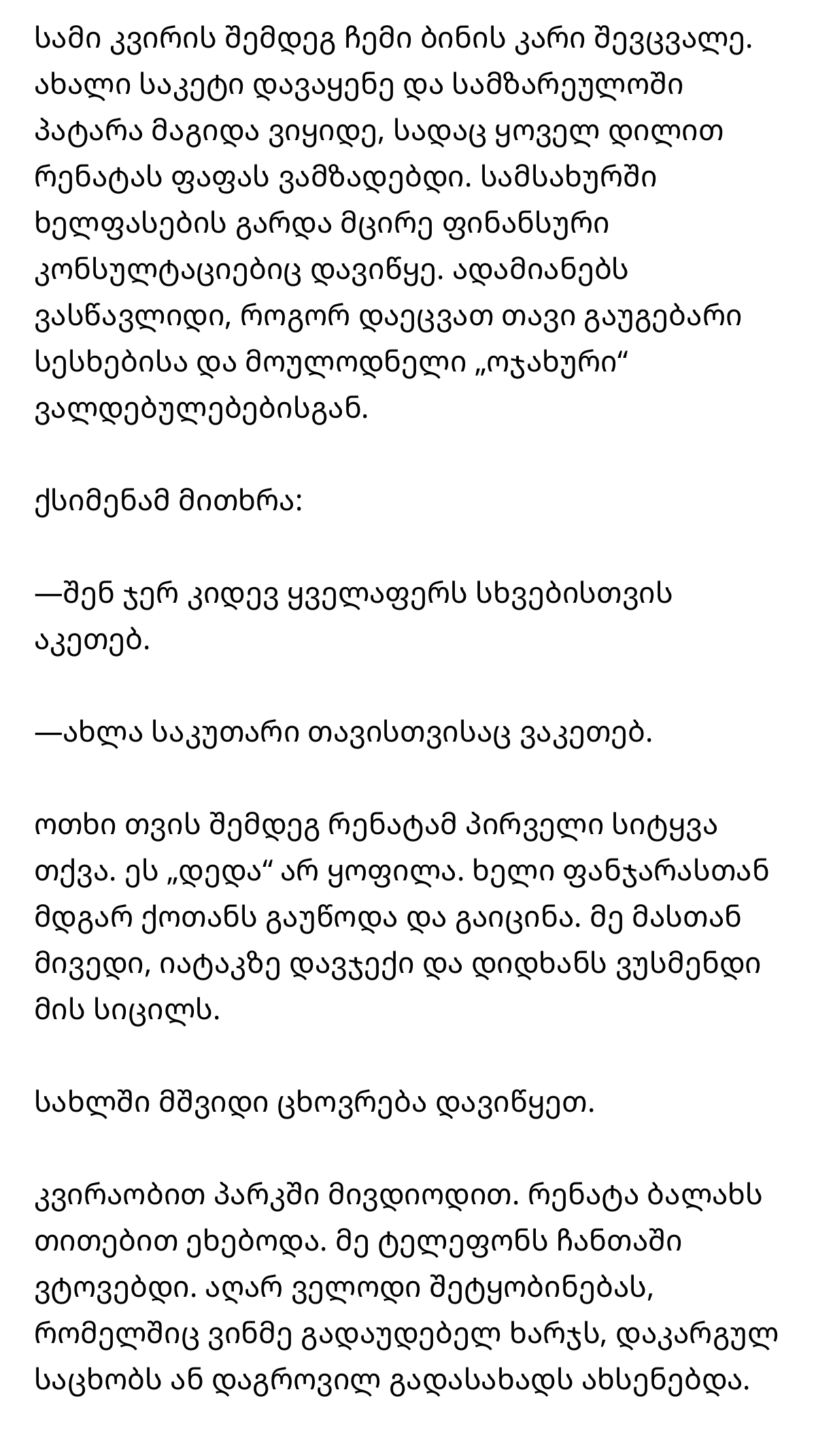

Three weeks later I changed the door of my apartment. I installed a new lock and bought a small table in the kitchen where I prepared Renata’s porridge every morning. At work, besides payroll, I also began giving small financial consultations. I taught people how to protect themselves from unclear loans and unexpected “family” obligations.
Ximena told me:
“You are still doing everything for other people.”
“Now I am doing things for myself too.”
Four months later Renata said her first word. It was not “Mother.” She reached toward the flowerpot standing by the window and laughed. I went to her, sat down on the floor, and listened to her laughter for a long time.
We began a peaceful life at home.
On Sundays we went to the park. Renata touched the grass with her fingers. I left my phone in my bag. I no longer waited for a message mentioning an urgent expense, a lost bakery, or an accumulated tax.
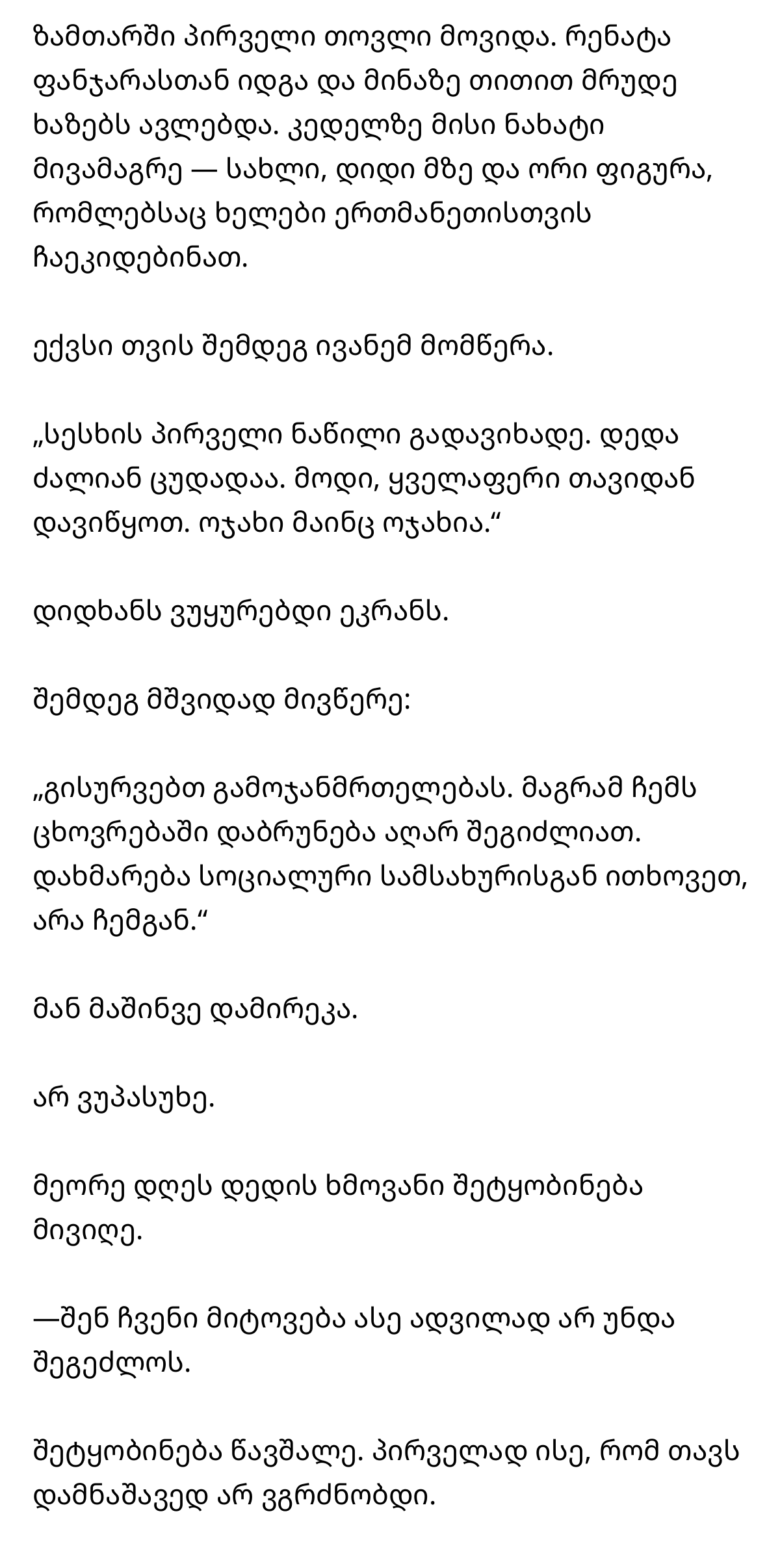

In winter the first snow came. Renata stood by the window and drew crooked lines on the glass with her finger. I attached her drawing to the wall—a house, a large sun, and two figures holding hands with each other.
Six months later Ivane wrote to me.
“I paid the first part of the loan. Mother is very ill. Come, let us start everything over again. Family is still family.”
I looked at the screen for a long time.
Then I wrote calmly:
“I wish you recovery. But you can no longer return to my life. Ask social services for help, not me.”
He called me immediately.
I did not answer.
The next day I received a voice message from Mother.
“You should not be able to abandon us so easily.”
I deleted the message. For the first time, without feeling guilty.
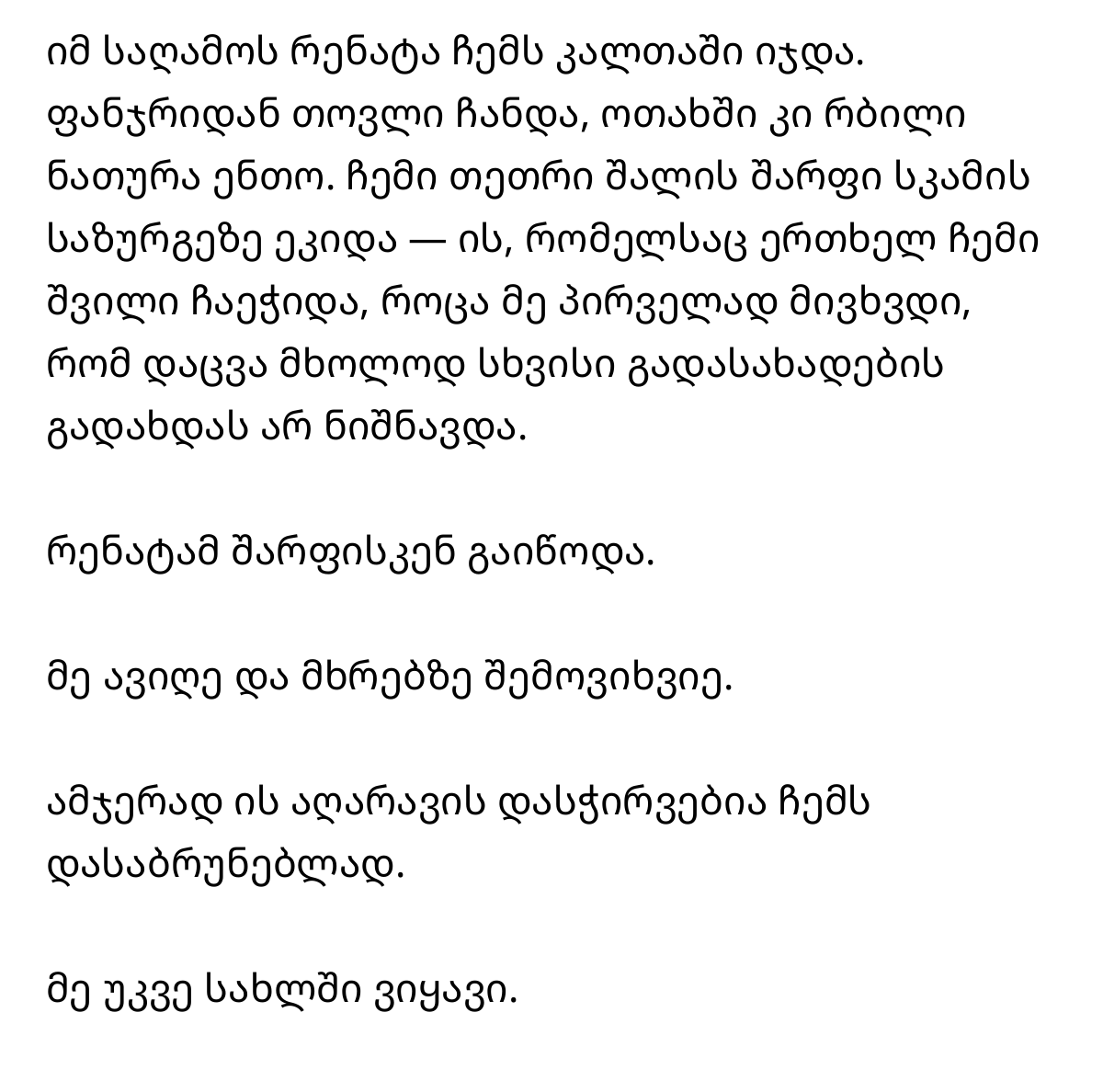

That evening Renata was sitting on my lap. Snow could be seen through the window, and a soft lamp was lit in the room. My white wool scarf hung over the back of the chair—the one my daughter had once clutched when I first realized that protection did not mean only paying someone else’s bills.
Renata reached toward the scarf.
I took it and wrapped it around my shoulders.
This time no one needed it to make me come back.
I was already home.
Missed the beginning?
Related posts:
 My mother did not invite me home because of the baby, but after seeing my photo she acted strangely and fell silent
 My fiancée failed to turn off her phone while humiliating the maid, and the next morning my father’s face turned strangely pale
 When Renata Humiliated Me in Front of Everyone, My Father Saw the Folder in My Hands and His Smile Immediately Disappeared
 At My Sister’s Wedding, My Father Poured Wine Over Me and Mocked Me, but the Man Who Entered the Hall Suddenly Turned Pale
 They Fired Me for Coffee, but a Few Hours Later the Director Could Not Hide His Strange Pallor at the Board Meeting
 At a Family Dinner They Put an Empty Plate in Front of Me, but as Soon as I Took My Bag, My Husband’s Face Turned Strangely Pale





