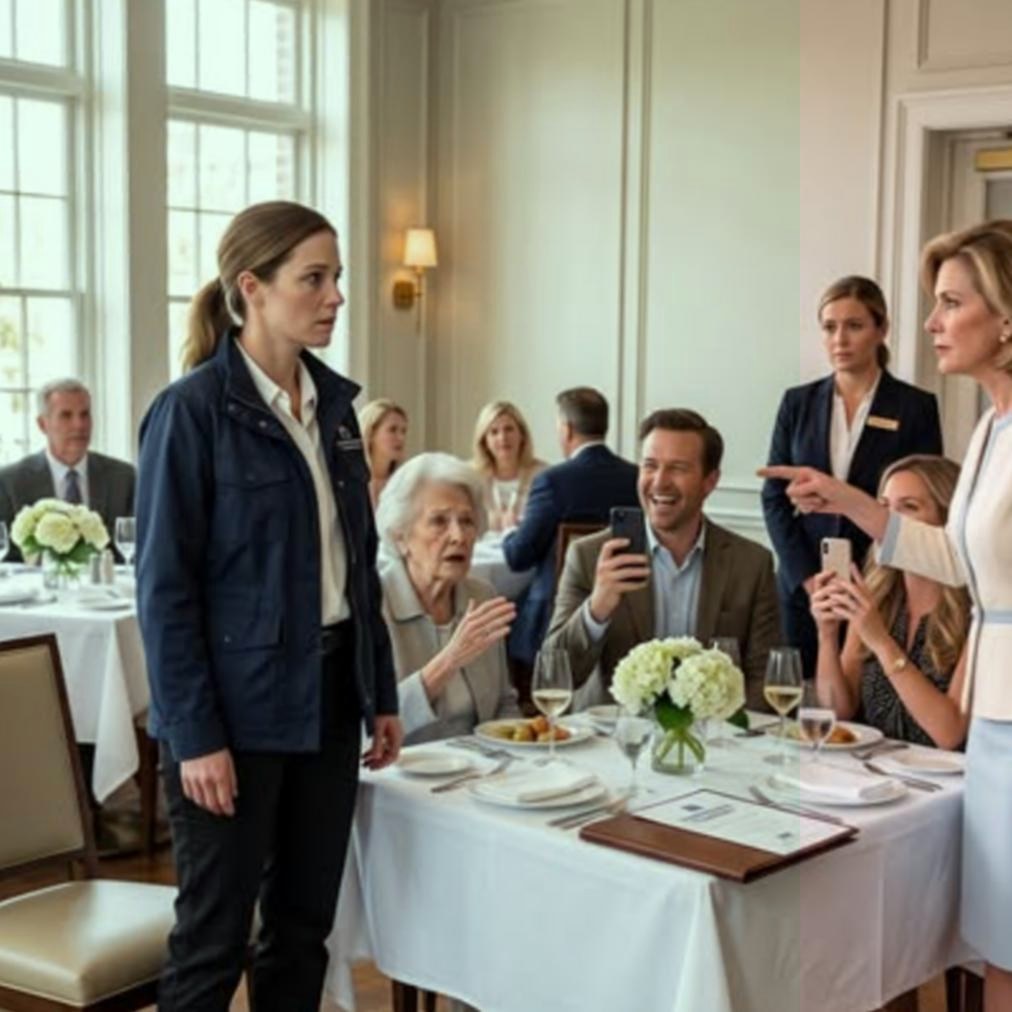



After the lawyer’s words, for several seconds I could not make a sound.
It was six o’clock in the evening in the office corridor. Beyond the windows Charleston’s sky was burning orange, while Grandma’s brass divider compass lay on the table. Its points touched each other and made a small, sharp sound.
“Whose voice is it?” I asked at last.
“Pierce’s and Nolan’s. The recording was made at a Harborside meeting.”
“Was Kendall there too?”
“No. But after you listen to the recording, you will probably understand why she filmed everything that morning.”
The lawyer sent me the file. First I heard Pierce’s voice.
“Villa will sign anyway. If she refuses, we will tell her that she is harming the family.”
Nolan snickered.
“She always needs someone to tell her that she takes herself too seriously.”
“And if she still does not agree?” another man asked.
Pierce answered:
“Then the document will already have been sent. Backing out will cost her more than signing.”
The recording ended.
I stared at the screen.
This was my family. People who used my name when they needed money and influence, and then called humiliation a joke.
“You understand that this recording proves their intention?” the lawyer told me.
“Yes.”
“Tomorrow morning the owners of Harborside will cancel the tender. Then they will also review the claims filed against you.”
“I do not want a court case.”
“You may not want it, but they may choose that path themselves.”


That same night Pierce called me twenty-one times.
I did not touch the phone during the first five calls.
On the sixth he left a voice message.
“Villa, this is not the way you think it is. Call me before the matter becomes official.”
On the seventh Mom called.
“Your brother was trying to save everyone,” she told me. “Your stubbornness is destroying the family now.”
“Not my stubbornness. His signature.”
“We will settle this at home.”
“You should have settled it at home the same day you seated me at the employees’ table in front of strangers.”
Mom fell silent.
“Do not speak to me like that.”
“This is the first time I am speaking to you without asking you to decide instead of me who I am.”
I ended the call.



The next day Pierce went to Harborside’s lawyers. He thought he would regain control of the meeting. On the table there was only one laptop and a glass filled with water.
“We want you to hear for yourself what you were saying,” the lawyer told him.
“This was taken out of context.”
“Then we will listen to the full recording.”
The file began playing.
“Villa will sign anyway.”
Pierce’s face changed.
“Backing out will cost her more.”
He lowered his eyes.
“That is not what I meant.”
“But that is what you said,” the lawyer answered.
Pierce covered his face with his hands. For the first time he heard his own voice against someone else’s silence. For the first time he could not blame it on Mom, my character, or circumstances.
Harborside removed Ashford’s company from the tender. His employer met with Pierce that same week.
“Is this a formal termination?” he asked.
“You violated procurement rules and appropriated a signature.”
“I still could not lose the project. Everything had already begun.”
“That is exactly why you made us lose trust.”
Pierce was fired.
The Heritage Circle withdrew the grant application. It turned out that several members of the board had not checked at all the text written by Mom. Mom resigned, and two members left as well, but the organization did not collapse. Six months later they hired a new director, who began publishing every amount spent on the apprentices’ program.



No one ever saw Kendall’s video either.
She was not fired from the agency, but two clients turned away from her. Three months later I met her in a café. She had put the phone in her bag and for the first time did not say that she wanted the meeting “just for a conversation.”
“I turned people into material,” she told me. “You most of all.”
“I can forgive you, but I cannot trust you yet.”
“That is fair.”
It was the first honest answer I had heard from her.
Nolan left the luxury real-estate agency. He moved to another company, where clients did not come because of the family name. Several weeks later he took Grandma to physical therapy and did not publish a single photograph about it.
Pierce, meanwhile, found a job at a small construction company in Colombia. He had a lower salary, the executive title was no longer written on his business card, and he was selling the big house.
Two months later I received his letter.
“I thought that rules should be managed by smart people. Now I understand that I was forcing others to carry my risk. You were one of them. I am sorry.”
I wrote only this:
“Thank you for saying it.”
Nothing more.
I did not see Mom for four months. Then she called me herself and asked me to meet her at a small diner. Not at the Belvedere. Not at the club. In an ordinary place where the cups were different from one another and the tables showed stains.
Mom looked much smaller there.
“When I was a child, my father lost his job twice,” she told me. “My mother cleaned houses along the coast. All my life I was afraid that someone would see poverty in us.”
I listened silently.
“When you chose work that resembled the life I was trying to escape from, I thought you were rejecting everything I had built.”
“That explains your behavior,” I told her. “But it does not justify it.”
Mom lowered her head.
“I know.”
It was not a great reconciliation. Nor a hug. Nor a suddenly changed family.
But for the first time Mom did not turn her fear into my guilt.



One year later Grandma came to my new workshop. The Harborside project was finally renewed under other conditions, and I received the work, now with a direct contract, on my terms and with my signature.
The workshop walls were brick. In the morning there was the smell of wood, dust, and coffee. The number of employees had grown from thirty-two to forty-one. Every Monday I met new apprentices and told them that work clothes do not diminish a person’s dignity.
My daughter, Mia, was five years old and waited for me in the office in the evenings. Once she left a sheet of paper on the table. On it was drawn our building, and beside it a woman holding a large divider compass.
“That is you, Mom,” she told me.
“Why do I have such a large divider compass?”
“Because you put everything to the right size.”
I laughed. Then I looked at the drawing for a long time.
Grandma gave her old brass divider compass back to me. I would touch her initials with my fingers whenever I had a difficult decision to make.
One December morning the first snow fell. Mia stood by the window and counted each flake. I put on my work jacket, but this time there was a new inscription on its chest: “Harborline — Restore, Do Not Hide.”
A message from Mom appeared on the phone.
“Can we start again? This time I will come to your workshop.”
I did not answer for a long time.
Then I wrote:
“You can come if you do not demand that I return to my old role.”
Her reply was only one word: “I’ll try.”


This promise was not a repair. But I no longer needed her to change perfectly for me to live peacefully.
That evening I hung the jacket on the chair. Mia sat on the floor and colored the drawing of Grandma’s divider compass. I put the brass tool on the windowsill, where the light of the snow fell.
For years I thought that I had to prove my worth to my family.
Now I knew: some doors must be left in order to enter your own home.
The divider compass shone quietly.
For the first time, I did not make myself smaller anymore.
Missed the beginning?
Related posts:
 On Grandma’s Birthday, Mom Seated Me at the Employees’ Table, but One Stranger’s Call Erased Her Smile
 The Video Sent on Our Wedding Anniversary Revealed My Husband’s Betrayal, but One Reflection Suddenly Erased His Smile
 Rowan seated a secretary in my place and told me, “Remember your place” — but he turned pale at the sight of my calm smile
 A Flat Tire Stopped Me at a Desert Diner, but When the Waitress Heard My Name, the Color Drained from Her Face
 My Father Was Fed by a Poor Woman at Night, but When I Followed Her Trail, a Stranger’s Face Suddenly Turned Pale
 On the third day after my C-section, three children were left at my door, but after the call my husband’s face turned pale