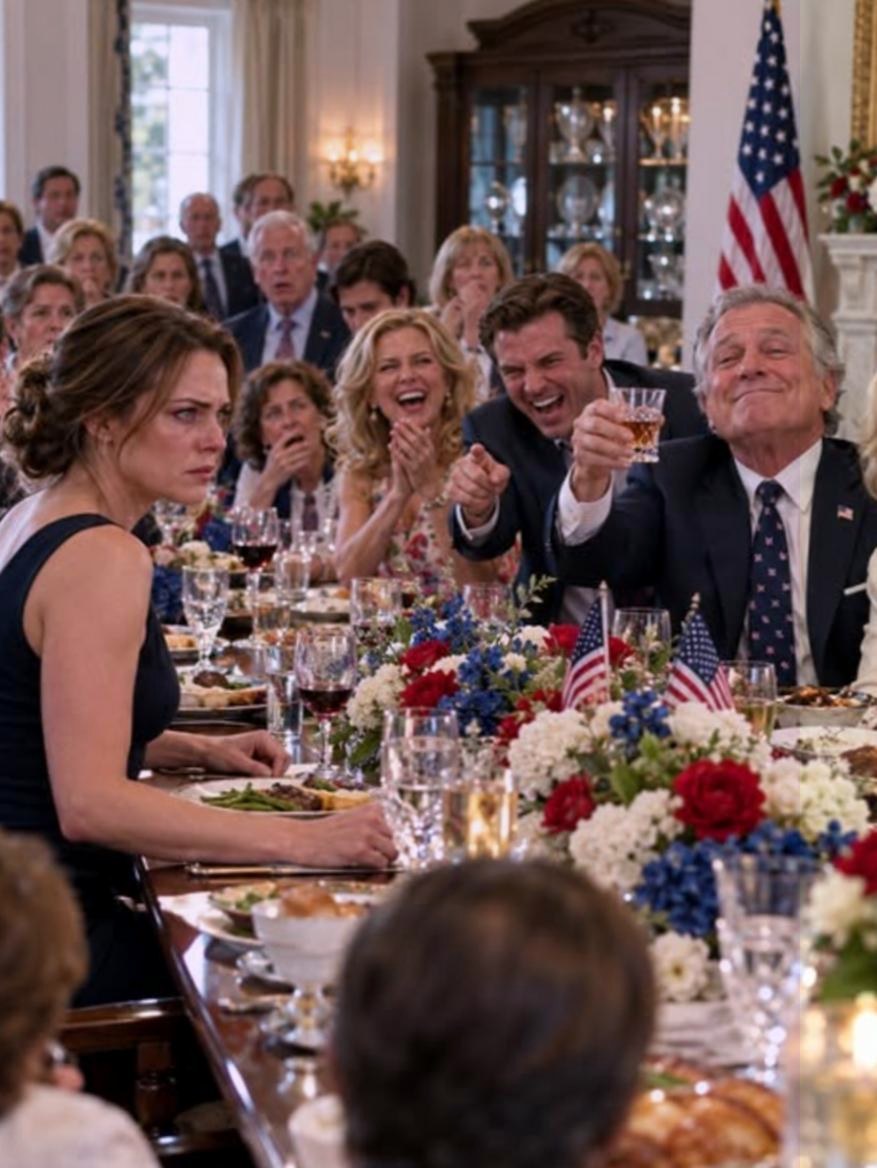

Nora’s last words remained in the room for a long time.
For the first time, I did not feel fear.
Only cold.
“We’re going to the house today,” I said.
“Not without the police,” Nora replied. “And this time you will not go in alone.”
Daniel took out his phone.
“The bank has temporarily frozen all the accounts. Father can no longer withdraw money in the employees’ names.”
My father called me at that very moment.
“Meren, this is a misunderstanding,” he said.
For the first time I heard not anger in his voice, but panic.
“No, Dad. These are your signatures.”
“Landon did some things on his own.”
“Yesterday you said everything was under your control, didn’t you?”
He was silent.
“Come back and let’s resolve this.”
“Resolve what? My stolen money or the debts taken in my name?”
“Family does not turn against one another.”
“Family does not use one another.”
He ended the call.

That same day, Nora obtained a temporary protection order from the court. A police officer, two investigators, and the three of us arrived at the Caldwell house in the evening.
The Father’s Day lights still hung in the yard. Some were off, while others swayed in the wind like small glass balls.
Landon opened the door for us.
“You cannot come in here,” he said.
Nora handed him the document.
“The judge has already decided that.”
Landon looked at the paper and his face changed.
“Meren, what do you want?”
“My documents.”
“You are destroying this family.”
“You destroyed it the moment you stole my signature.”
Father stood in the living room. In his hand he held the same heavy crystal glass with which he had turned my “mistake” into a toast one week earlier.
“All of this is happening because of you,” he told me.
“No. All of this is happening because of the choices you made when you looked away from me.”
The investigators opened the study of the house. Papers lay on Father’s desk. In one of the drawers they found an old brown folder, and beside it there was the smell of burnt paper.
Father took a step.
“Those are private documents.”
“That is why we need them,” the investigator said.
Inside the folder was the first contract for the founding of my company. I had executed it when I was twenty-two. The document clearly stated that all patents, code, and shares belonged only to me.
Behind it they found a second sheet. It was a plan written in my father’s hand: transferring part of my shares into the family company, as if I were returning his help.
At the bottom of the sheet it said: “Meren will not resist us. She only wants the family to accept her.”

Father lost his voice.
Landon looked at the sheet and stepped back.
“This was your plan,” he told Father.
“You asked me to resolve everything!”
“I did not ask you to steal your own sister’s signature!”
Their argument stopped in the room when the investigator played the video recorded on the computer. Everyone heard Landon’s voice: “She’ll pay anyway. She has done that all her life.”
Father sank into the armchair.
“I didn’t say that,” he whispered.
The video played again.
His own voice returned to the room.
“She’ll pay anyway.”
Father buried his head in his hands. Landon leaned against the wall. Mother, who was standing by the door, looked directly at me for the first time.
“Forgive me,” she said.
I could not answer immediately.
The police did not arrest my father and Landon that evening, but an investigation against them officially began. Forgery, fraud, embezzlement of company funds, and false financial statements were combined into one case.
Their lawyer contacted me the next morning.
“If you withdraw the complaint, a family settlement may be reached.”
“Are your clients willing to admit the truth?”
“They are ready to negotiate.”
“Then tell them that I no longer bargain with my dignity.”

The lawyer ended the call.
Then the real chaos began.
Suppliers called Father. Employees demanded answers. Landon went to the bank, but security did not open the door for him. Mother sent me dozens of messages, sometimes apologizing, and sometimes telling me that I had left the family without support.
I did not answer a single message.
A week later, testimony began in court. I sat calmly in the courtroom. Father stood opposite me and no longer looked like the man who had confidently raised his glass in the yard.
The judge requested the video.
Father heard his own words again.
This time there were not thirty-five guests there. No lights, no laughter, no protective smile from Mother.
Only his voice.
“My biggest mistake.”
Then Landon’s laughter.
The judge finally established that my signatures had been forged, ordered the family company to return the entire amount to me, and imposed criminal liability on Father and Landon. Mother remained as a witness. She sold the house and used the money received to save some of the employees.
I was not happy about their punishment.
Strangely, that day I felt only tiredness.
When I left the house, my old room was empty. Only a small mark remained on the wall, where the shelf for my computer had once hung. In the desk drawer I found the copper charm shaped like an old train ticket that I had lost in childhood.
When I picked it up, I understood why leaving that house had hurt me for so many years.
I was not leaving the house.
I was leaving the role they had invented for me.

Three months later I moved to Charlotte. The new office of Verity Draft Systems was a small, bright room, where trees and a bicycle path could be seen from the window. Every morning I drank coffee with the employees. No one asked me why I had a mark on my face. They asked me how we should improve the program.
My life slowly returned to ordinary sounds.
The quiet tapping of the keyboard.
Rain on the window.
Preparing new recipes on Sundays.
The first snow, which settled on the branches of the trees in front of the office.
One evening Nora brought my little niece, Ellie. The girl drew a house on a sheet of paper. Small people stood at the windows, and an enormous yellow sun was in the sky.
“Is this your house?” I asked.
“No,” she answered. “This is the house where no one is hidden.”
A lump caught in my throat.
“It is a very beautiful house.”
“Will you live there?”
“Yes. But first we have to build it.”

A few weeks later Father sent me a letter. It contained only one sentence: “I want you to listen to me at least once.”
I held the letter in my hand for a long time.
Then I gave it to Nora.
“Should we send an answer?” she asked me.
“No.”
“Are you sure?”
“For the first time, I am.”
I no longer missed my father. I missed only the father I had never had. I learned the difference between these two things late, but I learned it nevertheless.
That night I returned to my desk. I placed the copper charm beside the computer. Its edges were worn from the years, but the small train on it was still clearly visible.
Snow began outside the window.
I turned on the screen, opened a new project file, and for the first time in my life did not pay anyone to have a place of my own.
The train was already moving.
Missed the beginning?
Related posts:
 On Father’s Day, Dad declared my existence a mistake in a toast, but seven days later his smile disappeared
 My Father Was Fed by a Poor Woman at Night, but When I Followed Her Trail, a Stranger’s Face Suddenly Turned Pale
 After My Husband’s and Daughter’s Funeral, My Mother Asked Me for the Insurance Money, but the Bag on My Table Suddenly Erased Her Smile
 A Flat Tire Stopped Me at a Desert Diner, but When the Waitress Heard My Name, the Color Drained from Her Face
 An Unknown Man Humiliated Me in Front of Everyone, but the Restaurant Owner Looked at Me Only Once — and His Smile Immediately Disappeared
 My Breakup Message Reached the Most Dangerous Man in the City, but When He Saw My Necklace, His Face Changed