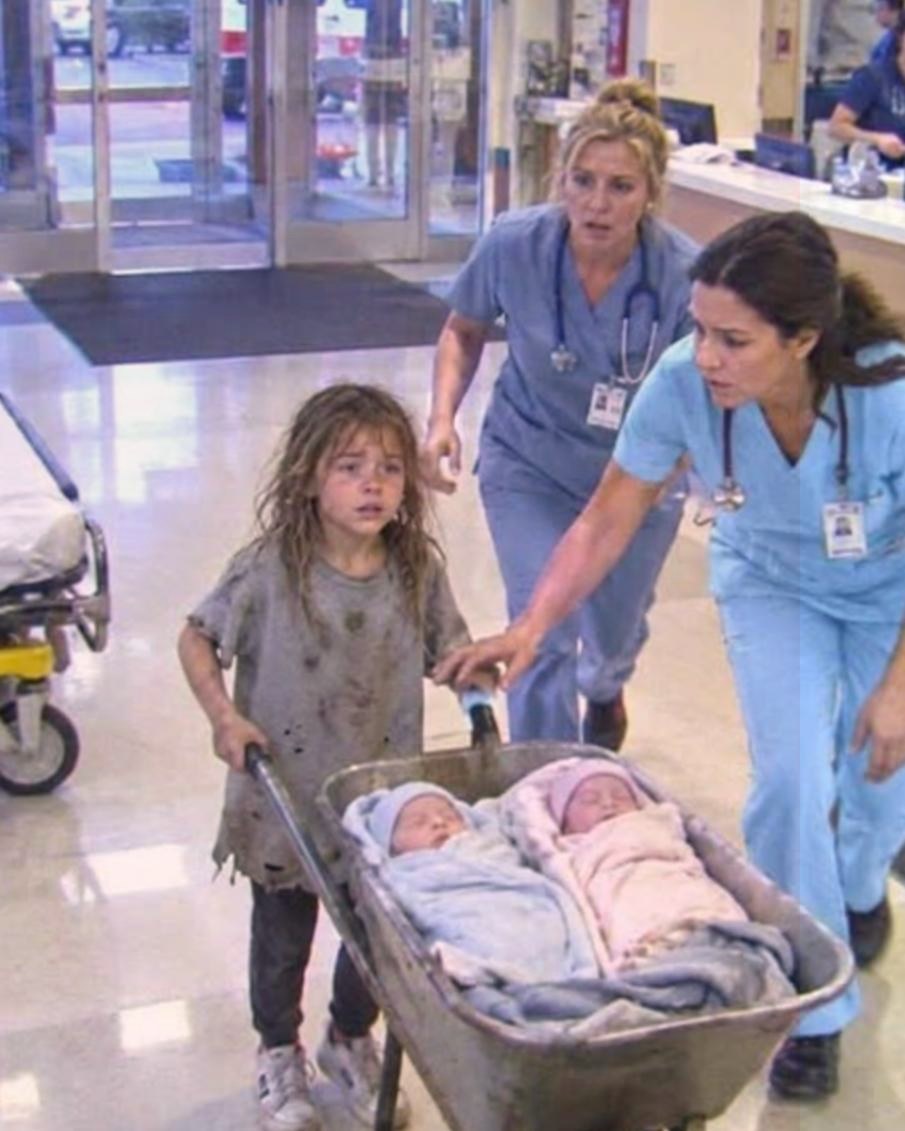

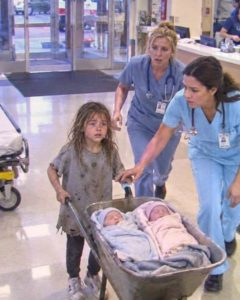
The emergency-room receptionist immediately locked the door when a six-year-old girl rolled in a wheeled cart with two newborns. And I wanted only one thing — for someone to wake Mother.
That morning I stood in the corridor of the city hospital and dried my hands on my large, faded T-shirt. Sweat had soaked me on the way, but the shirt still frightened me, because Mother used to tell me to cover my neck in the cold. And around my neck hung a small house key on a thin brown strap. Mother had said not to lose it.
The cart’s wheel squeaked every forty or so steps.
It squeaked on the village road.
It squeaked on the downhill slope.
And now on the hospital’s shining floor.
The receptionist raised her head and at first probably thought a child had come in with a toy cart. Then she saw my hands, gripping the handles with all my strength, and looked at the two small bundles I had wrapped in towels of different colors.
One baby whimpered.
The other was silent.
Very silent.
“Where is Mommy, sweetheart?” the woman asked me.
My throat hurt. I had said almost nothing for three days, but I answered anyway.
“She is at home. I couldn’t wake her.”

The receptionist’s face changed.
“How long have you been unable to wake her?”
I raised three fingers.
The woman pushed the chair back and jumped up.
“You mean three days?”
I nodded.
Two nurses immediately came to me. One held a white blanket, and the other had a voice as soft as Mother’s when she put the twins to sleep at night.
“May we pick up the babies?”
My fingers gripped the handles even tighter.
“Both?”
“Both, Nino. We will keep them together. I promise.”
I did not know how she knew my name. Perhaps it was written on the old school inscription on my shirt, which was still visible. For several seconds I did not move. Then I let go.
The nurse picked up Luka, and the other woman held Lia against her chest. Her little hand was pressed to her cheek. Luka’s lips looked blue to me, while Lia was breathing so weakly that I stopped breathing too and waited for her chest to move.
“Nino, you need a doctor too,” the nurse told me.
“Mother first.”
“We will go to Mother too. Where is the house?”
“I know the way.”
“The address?”
I did not understand that word. I knew the mailbox, the bridge, the large oak, and the long road that led to the house. But I did not know the name of the street.
“There is a yellow box with a black bird drawn on it. Then two turns. Then an oak that has no branch on one side.”

The receptionist picked up the phone.
“Let’s send a team to the village of Khevnari. The child says her mother has been unconscious for three days.”
They sat me on a chair. My feet could not reach the floor beneath it. My bare soles swung in the air, while in the pocket of my shirt I held Mother’s small sewing scissors. I had found them on the way and taken them because I was afraid to remain alone at home.
“How did you bring the babies?” asked the policeman who came in a little later.
“With the cart.”
“Who helped you?”
“No one.”
Such silence fell in the room, as if everyone had become frightened at once.
The nurse knelt beside me.
“Why didn’t Mother wake up in three days?”
“I poured water on her. I made porridge too. I shook her shoulder. But she was sleeping very deeply.”
“Weren’t you afraid?”
I looked at my palms. The handles had reddened both my hands, and in one place the skin had split.
“I was afraid, but Lia had stopped crying.”
At that moment the emergency doctor rushed in. He was holding the key that I had taken off my neck. His face was tense.
“We opened the door of the house,” he said. “We found Mother in the living room. But something there is very strange.”
The policeman immediately turned around.
“What happened?”
The doctor did not answer. He came to me and held the key with both hands.
“Nino, was anyone else in the house?”
I shook my head.
“No. Only us.”
The doctor took a small plastic bag from his pocket and placed the object inside it on the table. It was a small red recorder, one I had never seen under Mother’s bed.
The policeman looked at the recorder.
“Did you find this in the house?”
“By the bed,” the doctor answered. “And we have not listened to the last recording yet.”
The policeman reached toward the device. His finger had almost touched the button when heavy footsteps sounded at the end of the corridor and someone said my name…

A tall man appeared in the corridor. I recognized him. It was Irakli, Mother’s old friend, who had often come to us during the last month.
“Nino, why are you here?” he asked me.
I stood up from the chair.
“Mother is at home.”
Irakli looked at the doctor.
“The child misunderstood. Marika is simply sleeping.”
“For three days?” the policeman asked sternly.
“She was taking medicine. She probably lost consciousness.”
There was fear in his voice, but he was not looking at me. The glass of his watch was broken, and there were black grease stains on his fingers.
The nurse looked toward the twins’ room.
“Luka is already breathing better. Lia still needs help.”
Irakli put his hand on my shoulder.
“Come on, let’s go home.”
I stepped back.
“I have to wait for Mother.”
The policeman took a step in front of him.
“You will enter the house with us. Nino will stay here.”
Irakli’s face went pale.
At that same moment the doctor switched on the red recorder. At first only the clinking of glass could be heard, then Mother’s quiet voice.
“If Nino comes to the hospital, tell her to find the paper hidden under the key. Don’t believe Irakli…”
The recording suddenly stopped.
Irakli looked toward the door.
“It’s edited,” he said.
The policeman put a hand on his wrist.
“Then remain calm.”
And I realized that Mother was not simply asleep. But still no one could say what she had hidden under the key…

The air in the doctor’s room was heavy. The clock hanging on the wall showed four, but I had lost my sense of time long ago. One small wheel from my cart lay on the floor — it had broken on the way and the nurse had tied it with a tissue.
The policeman placed the recorder on the table.
“Let’s play it again,” he said.
Irakli stood by the door and touched the broken glass of his watch with his thumb.
“This child did not understand what her mother was saying. Marika was ill. Perhaps she recorded it herself and then forgot.”
“I recognized Mother’s voice,” I said.
“You are little, Nino.”
“But I’m not deaf.”
The policeman looked at him sternly.
“Do not call her that again.”
The recorder switched on again. For several seconds only heavy breathing could be heard. Then Mother said:
“Irakli, if you are listening to this, know that I will no longer remain silent because of you. I transferred money in Nino’s and the twins’ names. I changed the house documents too. You will no longer have access either to the children or to the account.”
Irakli leaned against the chair.
“That is impossible.”
In the recording Mother’s voice trembled, but the words were clear.
“You took my card. You forced medicine on me so that I would forget everything. You prepared the last dose. If something happens to me, the police should check the kitchen glass and the messages on your phone.”
No one moved in the room.
It was as if a stone had fallen from my heart, and immediately another, larger stone had pressed down on it. Mother knew. Mother was afraid. And still she had left me alone that night.
“I was helping her,” Irakli whispered. “Marika is sick. She invented all of this.”

The doctor opened the door.
“Mother has regained consciousness,” he said. “She is asking for you by name, Nino.”
I ran into the corridor. Marika lay on a white bed, an oxygen mask on her face and adhesive tape on her wrist. Her eyes were half open.
“Mother!”
She raised her hand. Her fingers moved with difficulty.
“The key… did you keep it safe?”
I showed her the strap hanging around my neck.
“I didn’t lose it.”
Tears appeared in Mother’s eyes.
“You saved me.”
“I only brought the cart.”
“No. You saved everyone.”
The doctor quietly nodded to the policeman. Irakli was already being held by two officers. He came toward Mother’s bed, but the policeman blocked his way.
“Marika, he had your phone and bank card,” the policeman said. “We now have a search warrant.”
Irakli looked at me for the first time.
“Nino, tell them I did nothing bad.”
I held Mother’s hand.
“He said she was simply sleeping.”
Mother lowered her eyes.
That evening the doctor told me that a strong sedative had been found in Mother’s medicine. They found a glass in the kitchen with Irakli’s fingerprints. And on his phone there was a message sent during the minutes of Mother’s last recording: “Tomorrow I will finish everything.”
I thought everything was over now.
But at eleven at night the hospital telephone rang. The policeman listened, then looked at Mother, and his face changed.
“Marika, the bank is telling us that money has already been withdrawn from the children’s account this morning…”
იმ წერილში ერთი წინადადება ყველაფერს ცვლიდა…
ფინალში გავიგე, რატომ ეშინოდა დედას ასე ძალიან. მაგრამ ყველაზე მძიმე პასუხი სასამართლოს გარეთ დამხვდა.
„შენი ბრალი არასოდეს ყოფილა.“
მე პირველად აღარ ვიტირე.
👇 ისტორიის ფინალი უკვე გახსნილია
Related posts:
 I took my mother from the house, but when my brother opened her room with a duplicate key, the color drained from his face
 Part 4 — They Banned a Six-Year-Old from Entering the Hospital, but the Receptionist’s Smile Immediately Disappeared at the Squeak of the Wheel
 I was having lunch with my wife when the sheriff poured a cold cocktail over my head and suddenly stopped laughing when he saw my composure
 At the altar, the groom insulted my father, but the commander who entered the hall looked at his family and froze
 My daughter-in-law rented my mother’s lake house for a party, but after my calm response my husband stopped speaking
 She left me alone in the mountains nine months pregnant, but when an unknown man appeared, Rafael lost his composure for the first time