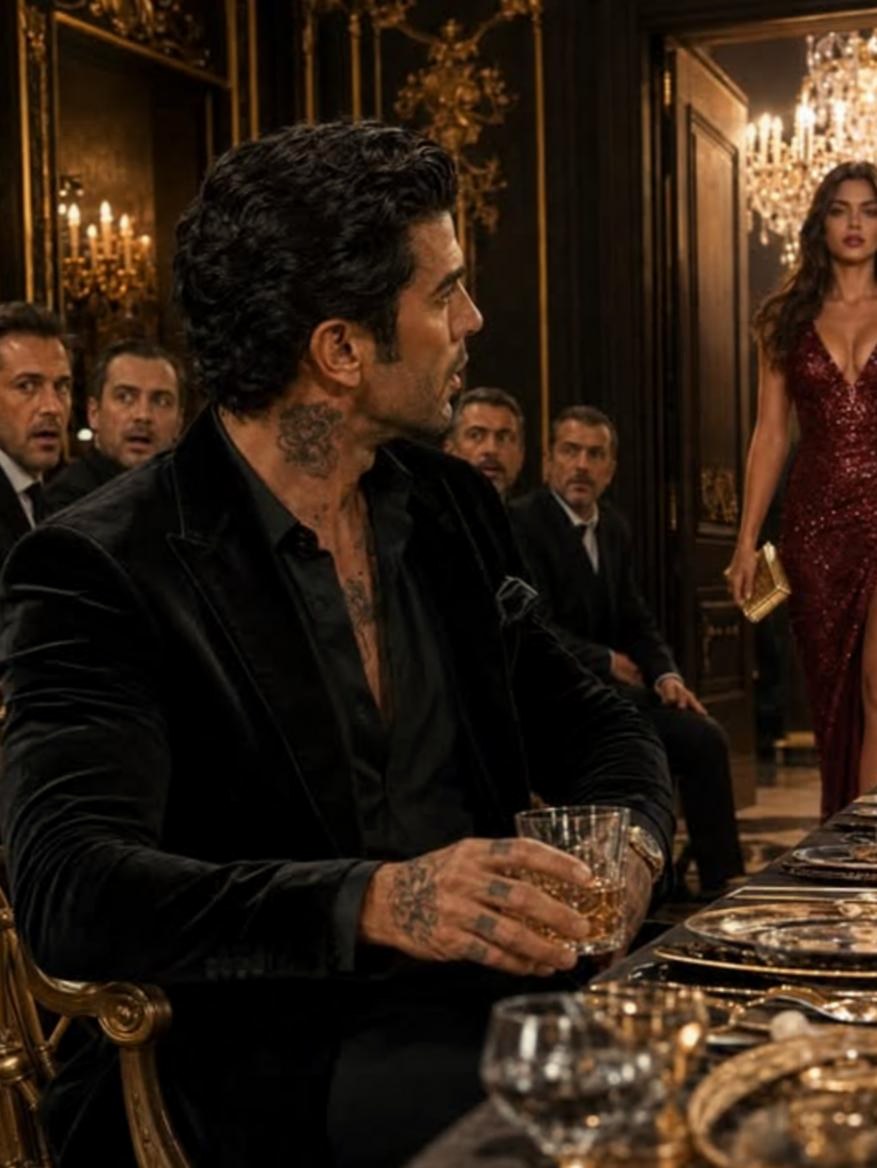

Marco was the first to realize that the threat spoken on the phone was not accidental.
“No one leaves here,” he said.
His voice no longer sounded like the voice of the man who had joked about my glasses a short while earlier.
The investigator reached for his weapon.
“Mr. Bellini, hands on the table.”
“My mother is at home,” I told him.
Luka looked toward me.
“Tell me the address.”
“I am not asking for your help.”
“This is not help. This is my crime.”
He said the words as if he had admitted himself for the first time.
The chief took the phone from me, transferred the call to a special device, and amplified the last noise. On the other end, the creaking of a door, heavy breathing, and a car engine could be heard.
“We already have the address,” he said. “The team is going there.”
Marco stepped back.
“I have nothing to do with this threat.”
I looked at him.
“Your man was on the phone.”
“Prove it.”
I pressed the recorder.
For several seconds, Marco’s voice was heard again in the restaurant. The recording was from a meeting that same morning.
“If the woman goes against Luka today, we will frighten her with her mother. Everyone will return to their place.”
Then Marco’s laughter was heard.
Hearing his own laughter, he lowered his head.
This was the hardest moment for him. Not because the others had heard it. Because for the first time he heard his own voice the way I had heard it for six years—cold, confident, and completely emptied of regret.

“It is edited,” he said quietly.
“Do you deny your voice too?” I asked.
“I am not going to prison because of some secretary.”
“I am no longer a secretary.”
The investigators put handcuffs on him.
Luka stood in place and said nothing. When they prepared handcuffs for his hands, he turned toward me.
“Evelyn, I did not know about your mother.”
“I believe you.”
“I did not start stealing Marco’s money.”
“But you created a place where he could do it.”
Luka lowered his eyes.
“You can use everything against me. Just find your mother.”
“The court will take that into account too.”
“And you?”
I did not have an answer to that question immediately.
I had spent six years beside this man. I knew when he was afraid, when he was lying, and when he was trying to save himself with remorse. But for the first time I realized that saving him was no longer my responsibility.
“I choose myself,” I said.
That same night my mother was found safe. The neighbor managed to call the police, while the man who had gone to her house was arrested in the yard. Mother was taken to the hospital only for an examination. Her wrist was bruised, but her life was not in danger.
I arrived at her bedside at four in the morning.
“You are late,” she told me.
“I know.”
“Are you still working with those men?”
I shook my head.
“Never again.”

Three days later Luka’s lawyer came to my new apartment. Coffee was boiling in the small kitchen, while raindrops fell against the window.
“Mr. Moretti wants an agreement,” he said.
“What does the agreement involve?”
“Changing your testimony. In exchange, he will provide your safety, your job, and a large sum of money.”
I laughed, although I felt no joy.
“Do I need my safety from him?”
The lawyer looked away.
“He says that he did everything for you.”
“Then tell him to do one thing for me for the first time.”
“What?”
“Stop trying to return to my life.”
In the following months the investigation revealed everything. Marco was found guilty of embezzlement, threats, and a smuggling network at the port. Luka chose to cooperate, but still could not escape prison; his crime was that he knew the truth and chose silence.
Once in the courthouse corridor I heard my own voice again. The lawyer turned on a large screen and played the recording.
“Close the page, Evelyn.”
Luka was sitting in that courtroom too.
I saw his face when he heard his own order. He lowered his head as if the words had pressed down on his shoulders only now.
I did not look toward him.
After the trial his office was emptied. For six years a small glass jar stood on my desk, in which my mother kept dried lavender. On the night I entered the restaurant, I had the jar in my bag.
Now it stood on the windowsill in the empty room.
Beside it only my old gray jacket remained.
I did not take it.
Those clothes no longer needed my protection.

Four months later I opened a small consulting office in a seaside city. I helped companies check the movement of money. Every morning at seven I opened the windows, brewed coffee, and arranged the folders on my desk by color.
My mother came to me three times a week.
One day my little nephew, Niko, entered the office and placed a drawing before me.
“This is you,” he told me.
In the drawing stood a woman with large glasses, a black dress, and a golden moon in her hand.
“Why do I have such large glasses?” I asked.
“Because you see everything.”
I laughed.
“Sometimes seeing everything is difficult.”
“Then close your eyes.”
That evening the first snow fell. White flakes fell on the street lamps as if the city were slowly forgetting the noise.
When I returned home, I found a new message on my phone.
From Luka.
“I am no longer asking you to return. I only want you to know that then, at the restaurant, I saw for the first time who you were.”
I looked at the screen for a long time.
Then I wrote a reply.
“You saw me then, when I had already left.”
I sent the message and turned off the phone.
I went to the mirror. I was still wearing my glasses. My hair fell over my shoulders. The black dress hung in the wardrobe, while Niko’s drawing lay on the desk.
I took the ivory bookmark from my pocket. The golden moon glittered in the light of the snow.
For six years this small object had protected me between the pages. Now I put it in my new folder—on the first page.
There was only one sentence written there:
“This life is mine.”
Missed the beginning?
Related posts:
 Before our fifth anniversary, I overheard my husband’s secret conversation and his laughter suddenly stopped
 For three years he told me that he would never walk again, but when his laughter returned home, it froze my husband in place
 My Former Billionaire Husband Left Me Because of the Children, but He Saw the Twins in a Restaurant and Lost the Color in His Face
 I was bathing Dante’s mother at home when Luka’s unexpected question silenced the entire room
 My son brought his beloved home, but when I saw her, the serving spoon fell from my hand and Tyler suddenly fell silent
 When the Mafia Boss Joked About My Plain Appearance, My Face at Dinner Made His Laughter Suddenly Disappear