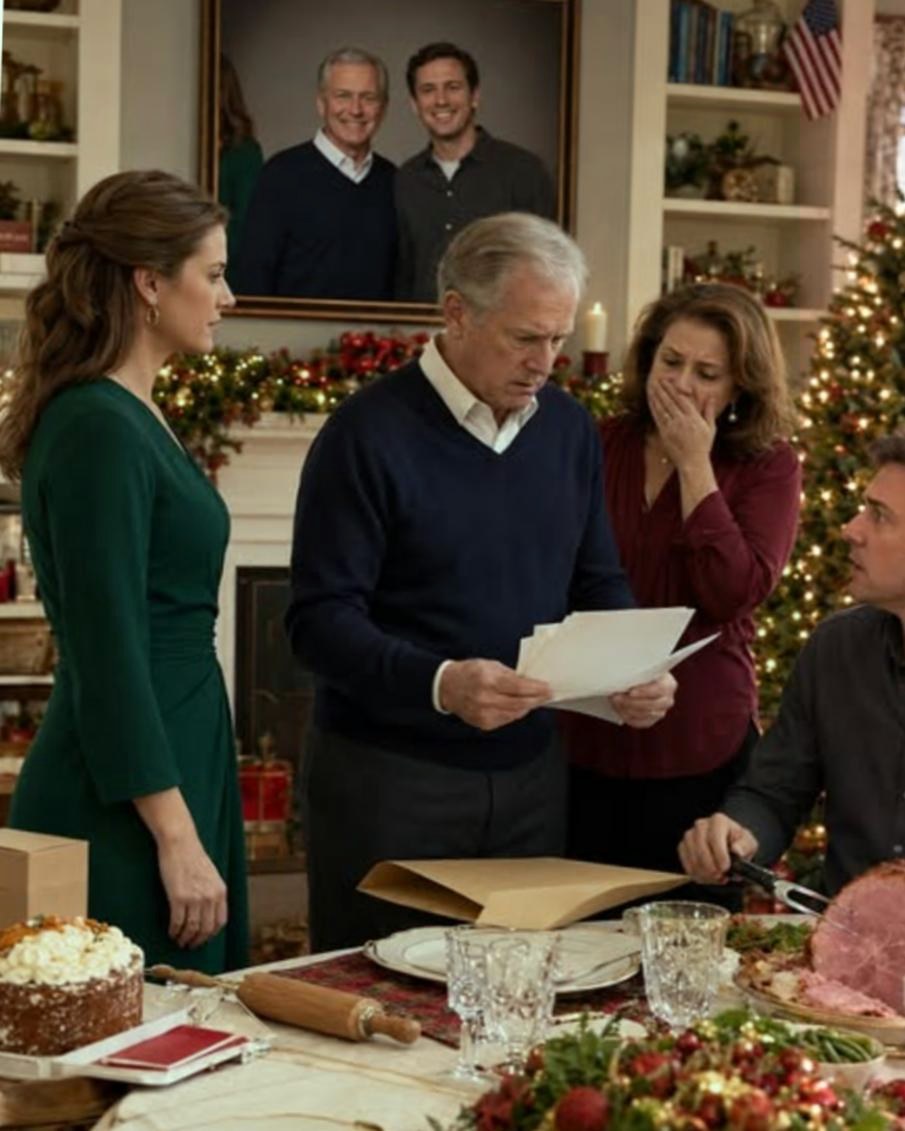

Nina’s last words remained in the room, as if someone had opened a door and let cold air in.
For the first time Father could not say anything.
His phone rang.
Once.
A second time.
A third time.
The bank’s number was on the screen.
“Answer it,” I said.
“Not now.”
“Now is exactly when you should answer.”
He ended the call.
A new message came immediately. Then another. The bank was asking to verify the documents and was scheduling a meeting for the next morning before the bakery opened.
Evan stood by the window. His face was as pale as Father’s had been a few minutes earlier.
“Dad, what did you sign with the bank?”
“Nothing that will damage the business.”
“Why is there a loan in my name?”
“It was for the development of the bakery.”
“I did not ask what it was for. I asked why I did not know.”
Father looked at him.
“Because you do not understand business yet.”
Evan smiled bitterly.
“But you still declared me the future.”

Mother could no longer stop crying. She was still holding the paper on which she had placed her signature years earlier. The edge of the paper had cut her finger, and a thin red line appeared.
Nina closed her bag.
“Claire, you also need to be at the bank tomorrow morning. Before you confirm anything, all the documents must be checked.”
Father immediately turned toward her.
“She is my daughter. This is an internal family matter.”
“No, Mr. Hart. Using her signature is no longer an internal matter.”
Father moved toward me.
“Claire, think. If you do not back down now, we will all lose everything.”
“You have already lost my trust. The rest is the result of your decisions.”
“You will regret this.”
“Probably. But not in the way you think.”
That night I went home alone. Only the low hum of the refrigerator could be heard in the apartment. I put the small brown notebook on the kitchen table. Its pages were whitened with flour, and its corners had become rounded. Everything I had ever created was written there, before Father declared my work a family inheritance.
In the morning we went to the bank.
There was a glass table in the meeting room, and a glass filled with water in the middle. The bank representative, Mrs. Beridze, arranged the documents in order.
“It says here that the bakery’s main commercial asset is twelve recipes, the use of which Claire confirms.”
“I have not confirmed anything,” I said.
Father raised his voice.
“That is technical wording.”

Mrs. Beridze removed her glasses.
“Technical wording accompanied by your signature and the mention of Claire’s name.”
“My signature is not the problem.”
“The problem is that Claire’s signature is not there.”
Mother lowered her head.
Nina opened her copy.
“Moreover, this document says that the recipes are the bakery’s property. This directly contradicts the current agreement.”
Father struck the table with his hand.
“My money is invested in this bakery!”
“Money does not give you the right to declare someone else’s work your own asset,” Nina said calmly.
Mrs. Beridze gathered the papers.
“At this stage the loan will be suspended. We will also transfer the documents to the bank’s legal department.”
It was as if the chair had been pulled out from under Father.
“You cannot close my business.”
“We are not closing anything. We are simply no longer financing something whose ownership could not be proven.”
Just then Nina put her phone on the table and turned on a recording.
Father’s voice rang through the room, clear and calm:
“Evan will be the future. Claire will stay in the kitchen. Customers do not care who bakes; what matters is that the brand remains in the family.”
Mother’s quiet laughter could also be heard in the recording.
Father’s face changed.

“Where did you get this?”
“From the meeting at which you told me that my share would be considered later,” I answered. “Nina advised me to save everything.”
Father heard his own voice and lowered his eyes. For the first time he heard what he had been saying to others for years. The words sounded much crueler in the room than they had in his mouth.
“I did not say it like that,” he said quietly.
“That is exactly how you said it.”
As we left the bank, Evan caught up with me at the door.
“You are right,” he told me.
“That is not enough.”
“I know. I just realized for the first time that in the future I was also needed only in the picture.”
Three days passed. Work at the bakery continued, but it was as if every room had lost its voice. The employees walked silently. My cakes still stood in the display case, although every label had a countdown on it.
On the fourth day Father came to me.
“I found a buyer,” he told me.
“Who?”
“A local pastry chain. They will buy the bakery if the right to use the recipes remains.”},{
“It will not remain without my consent.”
“You will receive money.”
“How much?”
He told me the figure.
With that amount, it would have been possible to rent a new small bakery and work peacefully for several years. Earlier I probably would have agreed. But now I already knew that money is sometimes only control wrapped in another form.
“No.”

“Why?”
“Because I do not want to give someone else permission again to use my name to prove their future.”
Father sat down on the chair.
“You are destroying the family.”
“I did not start the family. I only stopped letting you think that disappearing myself in its name was acceptable.”
During the ninety days, I handed over everything necessary to the employees. I created a new menu for them, taught them other recipes, and personally explained to each of them that none of it was their fault.
On the final morning, my office was almost empty. Only the small brown notebook remained on the shelf. Flour dust danced in the strip of sunlight entering through the window.
The old family photograph still hung on the wall, but the silver frame was gone. Someone had replaced it. Now I was visible in the picture too, although I no longer wanted to remain there.
I put the notebook in my bag.
When I returned home, I closed the kitchen door and, for the first time in five years, did not set the alarm for four forty.

In the following weeks I moved to a small town near a river. I rented an old brick shop there. On the window I wrote my name: “Claire’s Oven.”
On the first morning I sold only six cakes.
The seventh customer tasted the orange cake and told me:
“I remember this taste from somewhere.”
“It comes with me,” I answered.
Little by little the shop filled up. Former employees sometimes visited me. Evan came alone once, holding a small wooden toy in his hand.
“Mother asked me to give you this,” he told me.
“What is it?”
“Her letter.”
There were many apologies in the letter, but the most important thing was only one sentence: “Now I understand that we were always asking you to come back and never asking why you were leaving.”
I did not answer immediately.

Several weeks later Evan came again. This time he was accompanied by a little girl, his five-year-old daughter, Lile. The child put a sheet of paper on the counter. Three figures were drawn on it, and between them was a large round cake.
“Are these grandmother, grandfather, and father?” I asked.
“No,” Lile told me. “That is you, Auntie. You make the best cakes.”
The child’s answer struck me more strongly than a court. No one was trying to cut away my place. No one was telling me that I was an excess edge.
In spring, the court declared the bank documents invalid. Father had to sell the bakery, although he covered his debt only with his own property. Mother began working at the city library. Evan opened a small workshop and started a business in his own name for the first time.
I was not happy at the court.
I simply sat quietly and listened to each door close—the doors I had spent years trying unsuccessfully to open.
At the end of summer Father sent me his final letter.
“Claire, if you are ever ready, let us start again. I still have the bakery’s old sign. Maybe it will be useful for your shop. Come, let us talk as a family.”

I looked at the screen for a long time.
Then I wrote:
“I am not returning your things. I am not returning my life either. I wish you to find a path that is no longer built on me.”
I wrote nothing more.
A week before the first snow of autumn, I attached a small paper star to the shop window. I left Lile’s drawing beside it. On the counter lay the old brown notebook, whose pages had been whitened with flour.
In the morning I set the alarm for seven.
I turned on the oven.
The first cake was orange and cardamom again.
But this time its smell belonged to no one’s future.
It was mine.
Missed the beginning?
Related posts:
 They Cut Me Out of the Family Photo and Called My Brother the Future of the Bakery, but My Calm Reply Made Dad’s Hand Tremble
 My husband brought home newborn twins and demanded I disappear, but when he opened the envelope I left behind, his smile vanished
Mi suegra exigió que me arrodillara en mi comedor, pero cuando tomé una carpeta del gabinete, mi esposo dejó de sonreír
Soțul meu a intrat cu secretara și doi bebeluși, iar soacra mi-a întins un cec înainte să-i dispară zâmbetul
My husband brought home newborn twins and demanded I disappear, but when he opened the envelope I left behind, his smile vanished
Mi suegra exigió que me arrodillara en mi comedor, pero cuando tomé una carpeta del gabinete, mi esposo dejó de sonreír
Soțul meu a intrat cu secretara și doi bebeluși, iar soacra mi-a întins un cec înainte să-i dispară zâmbetul
 Six days after giving birth, my husband declared me a kidnapper of my own child, but when I placed the red folder down, the lawyer’s smile disappeared
 Mein Mann ließ mich bewusstlos vor der Notaufnahme liegen, doch als die Ärztin lächelte, verlor seine Mutter jede Farbe