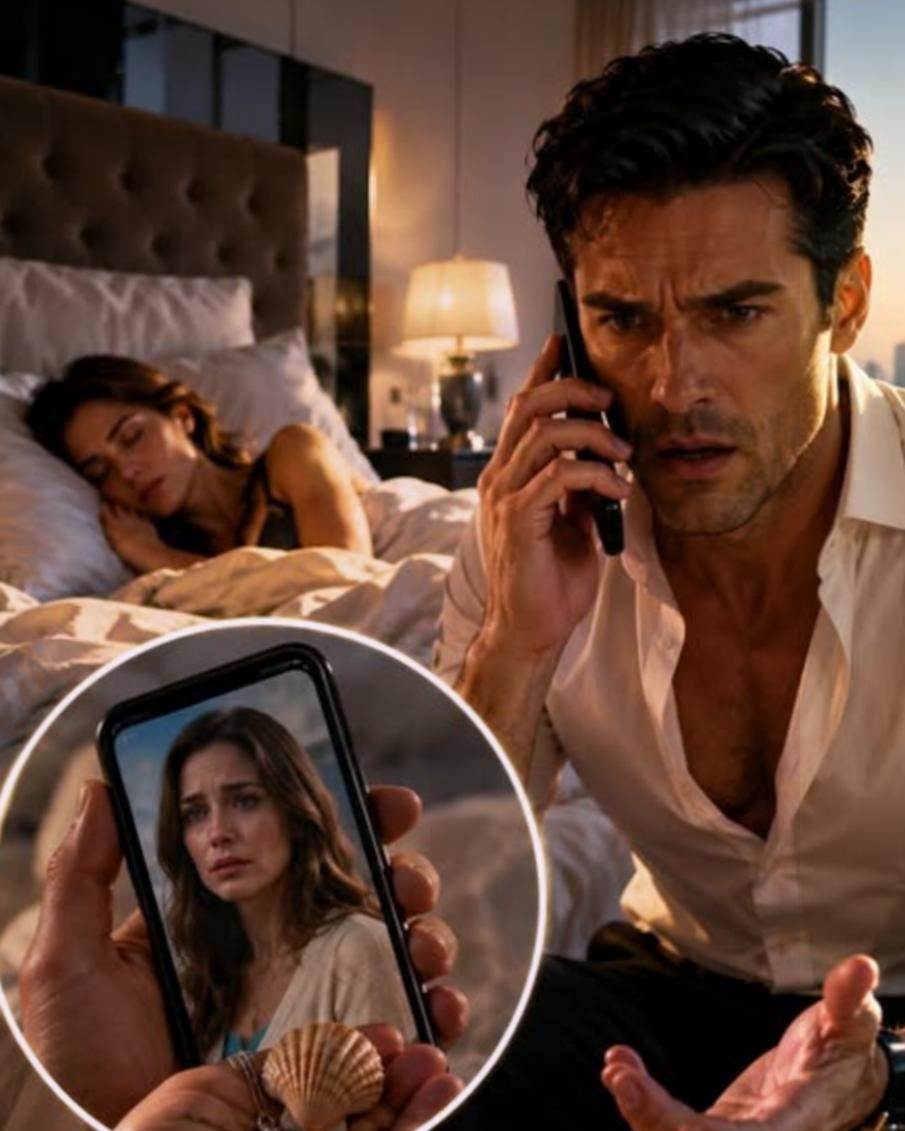

I arrived at the harbor by ten o’clock at night. The rain had stopped, but the wooden pier was still wet, and every plank creaked quietly beneath my feet.
Clari was not there.
Only one lamp was lit beside the old warehouse facing the sea. Under it, the person Nina had sent was waiting for me—Detective Sarah Miller.
“Did you come alone?” she asked.
“As she requested.”
“The phone?”
I took it from my pocket and handed it to her. Sarah turned it off, put it in a sealed bag, and nodded.
“Now do you know why she did not want to meet you face to face?”
“Because she is afraid of me.”
“Not only of your power. Also that she will believe you again.”
That answer was heavier than any accusation.
We entered the warehouse. Inside was the smell of salt, wet wood, and motor oil. A small sound device lay on the table. Beside it was the copper compass with the seagull scratch.
Sarah turned on the recording.
Clari’s voice sounded again.
“If you came this far, Daniel, it means that for the first time you did what I asked you for years—stopped and listened.”

I closed my eyes.
“I did not leave you because of Vanessa. Nor did I want money or half of your company. I left because while being with you I could no longer hear my own voice. Every time something hurt me, you called it a problem. Every time I told you the truth, you called it drama.”
Only the sound of the waves could be heard in the warehouse.
“The divorce documents were delivered to your office four weeks earlier. The legal department handed them to your assistant. She signed for receipt, and you did not even ask what they were. That too was an answer. You did not run away from me. You lived as if I would be everywhere, even when you no longer saw me.”
I lowered my head. It was the truth.
The next morning my assistant, Laura, came to the office. She was crying.
“I told you that there were documents from Clari’s lawyer,” she told me. “You answered, handle it yourself, I do not want to get involved in anything.”
I did not remember this. But I remembered Laura’s voice. That day too I had not listened to her.
Sarah continued the recording.
“I am not asking you to feel guilty. Guilt is often another form of love toward oneself. You only have to do what you could not do then: leave my life undisturbed.”
The recording ended.

Then my phone, which was in Sarah’s bag, lit up several times. She looked at the screen.
“Your board is requesting an emergency meeting. Julian has already testified. A financial investigation has begun.”
Then a second call came in. It was my lawyer.
“Mr. Whitman,” he said, “I advise you to resign as chief executive immediately.”
“You are my defender.”
“I was. Now you will need an independent criminal lawyer.”
The call ended.
In the morning I went to the company. Everyone stood silently in the corridors. My photographs hung on the walls—awards, deals, opening ceremonies. Everywhere I was smiling as if success existed without people.
In the boardroom they played my recording.
My voice could be heard.
“Do not tell Clari anything. The less she knows, the better.”
Twelve people were sitting in the room.
And for the first time I heard my own voice through someone else’s ears.
“That is not me,” I said, although I knew it was.
“That is exactly you,” the chairman answered.
“I do not behave like that.”
“You behaved like that even when you thought every rule had been created for you.”

That same day I left my position. The accounts were frozen. Julian admitted that he had begun transferring the funds on my instructions, although later he also took his own share. The investigation examined both cases. I accepted responsibility and transferred a large part of my personal property into the employees’ fund.
It was not a heroic gesture.
I simply could no longer lie that money was more valuable than those people.
The hardest thing, however, was returning home.
Clari’s room was empty. Only one wooden hanger remained in the closet. In the corner of the mirror stood her small photograph—from the honeymoon, before the black rocks, with her hair tousled by the wind.
She had not taken the photograph.
Probably because she knew I would eventually need to see who she had been before she became only a shadow in my life.
In the desk drawer I found an old letter. I recognized Clari’s handwriting immediately.
“If you ever remain alone in this house, do not try to fill the emptiness with furniture. First understand why it appeared.”
That night I did not call her for the first time.
Nor the next day.
Nor one week later.

Three weeks later I received a letter from Maine. The return address on the envelope read “Whitman and Tide.” Inside there was only one sentence:
“We opened the first room for the families who lost their homes because of your old decisions.”
At the bottom, a small child had been drawn. He was holding a compass.
Below it was written: “Clari taught me this.”
During the following months my life changed quietly.
I sold the penthouse in the city center and rented a small apartment by the river. In the mornings I made coffee myself. I no longer added sugar. Clari used to tell me that one should taste the bitterness of coffee, not hide it.
Three days a week I helped the foundation’s employees organize financial reports. At first they spoke to me cautiously. Sometimes they did not speak to me at all.
I deserved that.
One morning a small boy, Luka, came to my desk. His mother had moved into a new apartment with the foundation’s help.
“Are you Clari’s friend?” he asked.
“No,” I answered. “I am her former husband.”
The boy lowered his head.
“Clari says that people can change.”
“They can.”
“Did you change?”

The first snow could be seen through the window. White flakes fell onto the surface of the river and immediately disappeared.
“I am trying,” I told him.
Luka handed me a drawing. It was a small house, with the sea beside it and a yellow sun in the sky. A compass hung on the door of the house.
“It is so you do not forget the way,” he told me.
Months later Clari wrote to me once more. This time the message was short.
“If you want, you may come to the center’s opening in spring. Only as a guest. Do not tell me that you are coming for me.”
I looked at the screen for a long time.
Earlier I would have run without thinking at such a letter. On the way I would have bought flowers, invented an apology, and convinced myself that my longing was more important than her freedom.
Now I wrote only one answer.
“I will come if it will be peaceful for you. If not, I will not come. You no longer owe me the task of calming me.”
Clari replied the next day.
“Thank you for leaving me a real choice for the first time.”

I did not go to the opening. Not because I no longer cared. Because I understood: her new life would not become better because of my presence.
That evening I stood by the window of my apartment. Luka’s drawing lay on the table, and beside it was the copper compass that Sarah had finally returned to me.
I ran my finger over the seagull scratch.
Once I thought the compass pointed the way toward me.
Now I knew it reminded me of something else: sometimes the person you lose does not give you the direction of your return—he shows you where you must stop.
I left the compass on the table and opened the window.
The smell of the sea did not reach here.
But for the first time I no longer needed it to come.
I had not lost the way anymore.
It simply no longer led toward Clari.
Missed the beginning?
Related posts:
 Cleri Quietly Finished the Divorce, While I Woke Up in Another Woman’s Bed — One Sentence from the Lawyer Made Vanessa Go Pale
 Mia madre mise un prezzo al mio posto in famiglia durante la cena di Natale, poi mio padre smise improvvisamente di sorridere
 Mio marito cacciò nostra figlia diciottenne mentre ero via, ma quando tornò con una neonata il suo volto impallidì
 A születésnapi torta után három koporsóba került, de amikor az anyám felnyitotta a fedelet, Julian arca elsápadt
 Soțul meu a refuzat să-și recunoască fiica în salonul de maternitate, iar când am zâmbit, mâna lui a început să tremure
 Rowan seated a secretary in my place and told me, “Remember your place” — but he turned pale at the sight of my calm smile