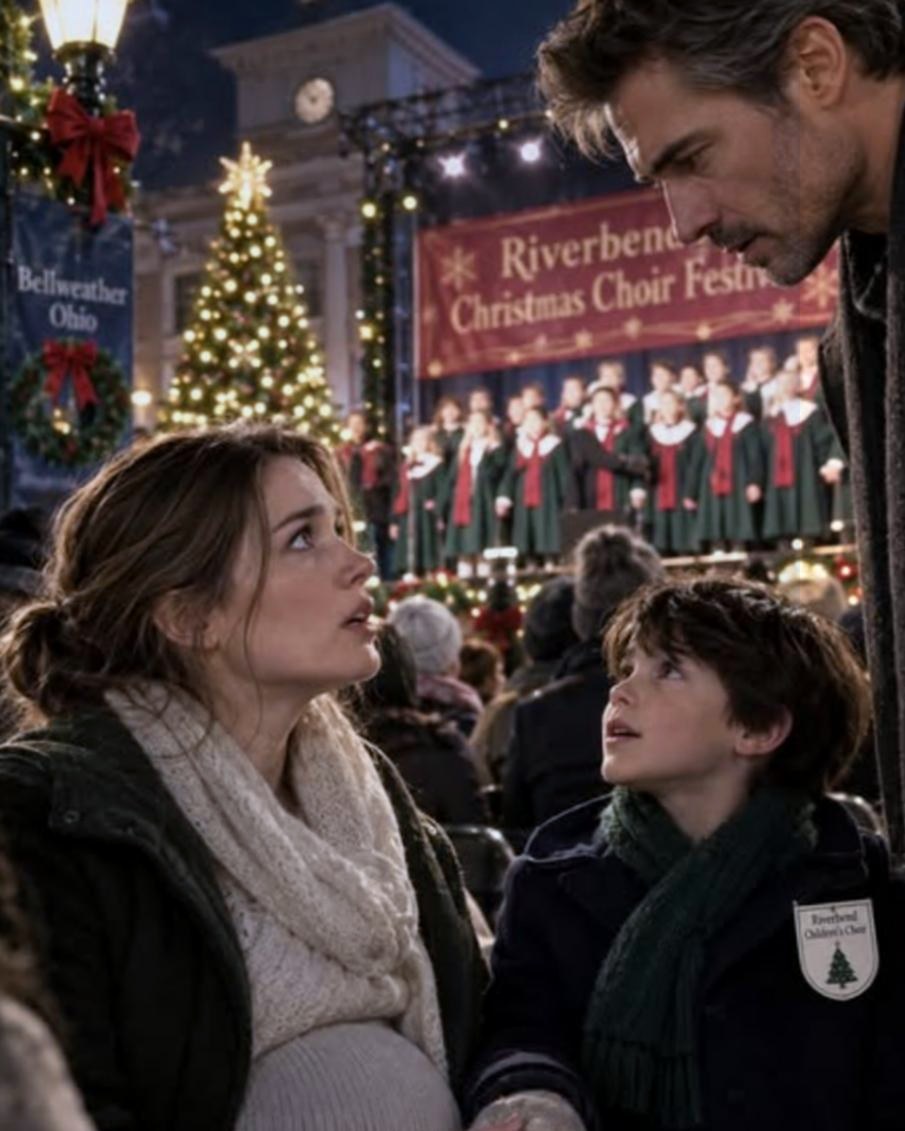

Grant had not come alone.
Two shadows stood beyond the door.
Julian immediately turned off the room’s light. Elinor moved to the window and lifted the curtain slightly.
“It is Grant,” she whispered. “His lawyer is with him.”
My phone rang again.
This time the call was from the police station.
“Mrs. Ellison?” a man’s voice asked me. “Are you nearby? A complaint has been filed in your name. Please do not leave the place and do not hand any document to anyone.”
“Who filed the complaint?”
“Grant Hall’s lawyer. They claim that you stole copyrighted material and threatened Mr. Mercer’s family.”
Julian closed his eyes.
Grant still believed that he would frighten everyone.
But this time his lie no longer existed only in words. It was recorded on the memory card, stood in the bank documents, and now was officially creating its own trail in the police system.
“I have recorded everything,” I said into the phone.
“Excellent. Send me a copy. And do not open the door.”
Grant knocked from outside.
“Mara, this is the last opportunity,” he said. “By tomorrow everything will be over.”
Julian looked toward the door.
“Do you think you will convince me again this time?”
“You still do not know what Mara did then.”
Julian played the first file of the recording on his phone and spread the sound through the room.
“Mara, wait outside. I need to talk to Julian.”
Outside, Grant fell silent.
Then his own voice was heard.
“People do not care about the truth. People want a story.”
The movement behind the door stopped.
For the first time Grant heard himself as we heard him. Silence continued for several seconds.
Then he said quietly:
“This recording is illegal.”
“Even if it is, you still cannot erase it,” I answered. “And you cannot erase the fact that you opened an account in my name.”
“You have no idea how many people I will destroy if this is published.”
“No, Grant. You have no idea how many people will save themselves if you can no longer deceive anyone.”
Julian opened the door.
Grant stood on the threshold. It was the first time in twelve years that I saw him. His hair had turned completely white, but his smile remained the same—too confident and too cold.
Beside him stood a young lawyer holding a thick folder.
“This is a family matter,” Grant said.
“No,” I said. “This is forgery, fraud, and threats.”
The lawyer looked at Grant.
“You told me that the recording did not exist.”
“It is edited.”
Julian turned the screen toward him.
“Then why can your voice be heard there threatening my career?”
For the first time Grant could say nothing.
The police arrived ten minutes later. The flashing lights of their car reflected as red patches on the steam of the window. Grant tried to call someone on the phone, but his lawyer stepped aside.
“At this stage I am no longer remaining your representative,” he told him. “You hid a financial account from me.”
Grant grabbed his arm.
“I will pay you.”
“You already paid. With lies.”
The police officer made him let go of his hand.
I was not happy when I saw the handcuffs. I felt only exhaustion. The kind of exhaustion you carry for years and suddenly realize that at last you can put it down.
The next day a temporary hearing took place in court. Grant’s lawyer tried to say that I was emotionally unstable and that the pregnancy confused my decisions.
My lawyer did only one thing.
She played the recording for the judge.
The words scattered through the courtroom.
“The child will be sufficient leverage for him.”
Grant’s face became gray.
The judge immediately rejected the petition filed for custody of the child and prohibited Grant from contacting me until the investigation was finished. His financial accounts were frozen. Then it became clear that for years he had maintained similar accounts in the names of six other young musicians.
Julian did not give up the copyright. On the contrary, he publicly admitted that I was a co-author of the song and that he had to return the money received from Grant.
But the main thing was something else.
Three days later Julian asked to meet me.
We sat in a small café in a library. It was snowing outside. There was hot tea on the table, and a circular water stain remained under the cup.
“I do not know how to fix this,” he told me.
“You cannot fix twelve years.”
“I know.”
“Then do not try.”
He lowered his head.
“I want a paternity test when the child is born. Not so that I can demand anything from you. I simply need to know the truth.”
“You will know the truth.”
“And if I am her father?”
I looked out the window. Snowflakes moved around the street lamps.
“Then she herself will decide when and how to meet you. That right belongs neither to you nor to me.”
Julian exhaled heavily.
“That is fair.”
“No. It is simply safe.”

Two weeks later my little girl was born. I named her Lea. When the nurse placed her on my chest, her fingers gripped my thumb as if she already knew the whole world and was waiting only for me.
The test confirmed that Julian was her father.
He did not ask for a first meeting. He sent me a letter, and it contained only one sentence: “When you are ready, I will be here.”
This time he truly kept his word.
Four months later Lea met him for the first time. Julian held a small wooden toy that had neither a sound nor a bright color. It was simply smooth and fit well in a child’s hand.
“I brought this for you,” he told her.
Lea took the toy and immediately put it in her mouth.
Julian smiled.
“Apparently musical criticism started early.”
I laughed. For the first time beside him, so that pain did not stop my laughter.
Weeks passed.
Grant’s case went to court. He admitted to forging the accounts, because the recordings and bank data left him no possibility of resistance. Julian closed the music foundation and created a small program for young therapists in its place.
I did not return to work at the same school. I opened a small center on the other side of the city, where I helped children overcome speech difficulties. Children’s drawings hung on the wall. In one of them three people stood in the snow: a tall woman, a little girl, and a man wearing a very large hat.
Lea drew it when she knew only how to choose colors.
“Who is this?” I asked.
She pointed at the man.
“Music.”
“Is music a person?”
Lea shrugged.
“When it sings, yes.”
That evening, when I returned home, Julian’s letter was waiting for me in the mailbox. This time he did not ask for a meeting, but wrote that Grant’s lawyers were trying to reach an agreement and that perhaps part of the money received from the song rights belonged to me.
At the end was one sentence: “If you want, let us return together to that old studio.”
I looked at the sheet for a long time.
Then I answered: “I can return to the song. I cannot return to the past.”
That was my refusal.
And my freedom.
Several days later Julian brought a small piano to the center. It did not look new. There was a thin scratch on a white key, and the left leg wobbled slightly. But its sound was clean.
Lea sat on the floor and shook the wooden toy.
I was arranging books when Julian played the first four notes.
Exactly the four that Theo sang in that Christmas square.
This time my breathing did not stop.
Lea raised her head.
“Again,” she said.
Julian looked at me.
I nodded.
He played the fifth note too.
Outside, the first snow was falling. On the windowsill lay half of that old menu on which, twelve years earlier, I had written the first words of our song in blue ink.
The paper was faded at the edges, but the text could still be read.
I no longer kept that sheet to prove a lost love.
I kept it to remind myself: I had never sold my voice.
And that evening, when Lea said “Again” once more, I opened the window.
Snow came inside.
And for the first time the house was truly mine.
Missed the beginning?
Related posts:
 My Former Partner Accused Me of Selling the Song on Stage, but One Calm Question from Me Would Drain the Color from His Face
 Two Hours Before the Wedding, the Groom Threatened My Family, but the Sound of the Helicopter Drained the Color from His Face
 After my warning at the billionaire’s negotiation, the lawyer ordered the guards to remove me, but his smile suddenly disappeared
 My husband gave me a choice in front of the family, but one message suddenly erased his smile
 I Moved into the Mafia Boss’s Mansion to Save My Brother, but His Six Words Froze My Blood
 They Offered Me Twenty-Eight Million for the Disappearance of Eight Years of Marriage, but the Message That Appeared on My Phone Screen Made Grant Pale