
At the moment when Mr. Reynolds called my mother a liar in front of the whole class, I was holding her photograph in my hand and could not make a sound.
In the photograph, my mother, Rachel Miller, stood on a sunlit military airfield. Behind her was a gray fighter jet, and to the side was a small ladder, on one step of which my mother’s left boot rested. She wore dark glasses, and on her flight suit she had one distinctive item—the small red leather bracelet on which my initials were embroidered.
That day, Heroes Week was being held at Northwood School. Every student had to say who their hero was. Some came out wearing a firefighter’s helmet, while others brought a medal their grandfather had brought back from the war. When my turn came, I pressed my notebook to my chest and went to the board.
“My hero is my mother,” I said. “Her name is Rachel Miller. She served in the air force and flies an F-22 fighter jet.”
The first laugh was started by the boy sitting near the windows.
Then the others joined him.
Someone began imitating the sound of an airplane.
Mr. Reynolds raised his eyebrows and leaned against the desk.
“An F-22? Your mother?” he repeated. “Lucas, perhaps today we should tell somewhat more believable stories.”
“It is true, sir.”
“Of course,” he snickered. “And probably your father works on the moon.”
The class laughed again.

My ears burned as if they were on fire, but I did not move. Years earlier, my mother had taught me not to make myself smaller because of someone else’s mockery. On the night when a neighbor mocked my secondhand shoes, my mother was washing dishes in the kitchen and told me:
“People who need to humiliate others often feel emptiness inside themselves. Do not enter their emptiness.”
So I remained silent.
But that was not enough for Mr. Reynolds.
“An ordinary job is nothing to hide,” he said. “Not everyone needs an invented hero to feel like an important person.”
“Invented.”
That word hurt me more than the laughter.
In the evening, I was writing the report with my mother. She stood by the sink with foam on her hands, while I was reading her sentences. When I was correcting the grammar, my mother looked over my shoulder.
“Write the title correctly,” she told me. “Heroes are always real people, even if others cannot see them.”
“Everyone laughed at me today.”
My mother turned off the water and dried her hands on a white towel.
“Then tomorrow let them see with their own eyes what they cannot believe today.”
“How?”
She only smiled, but gave no answer.


By the next day, almost the whole school already knew my story. As I was walking toward the cafeteria, someone called to me:
“Lucas, does your mother park a fighter jet on the supermarket roof?”
I did not turn around. I was still holding that same notebook. On its cover I had attached the small copper star my mother had given me, which lightly rattled with every step.
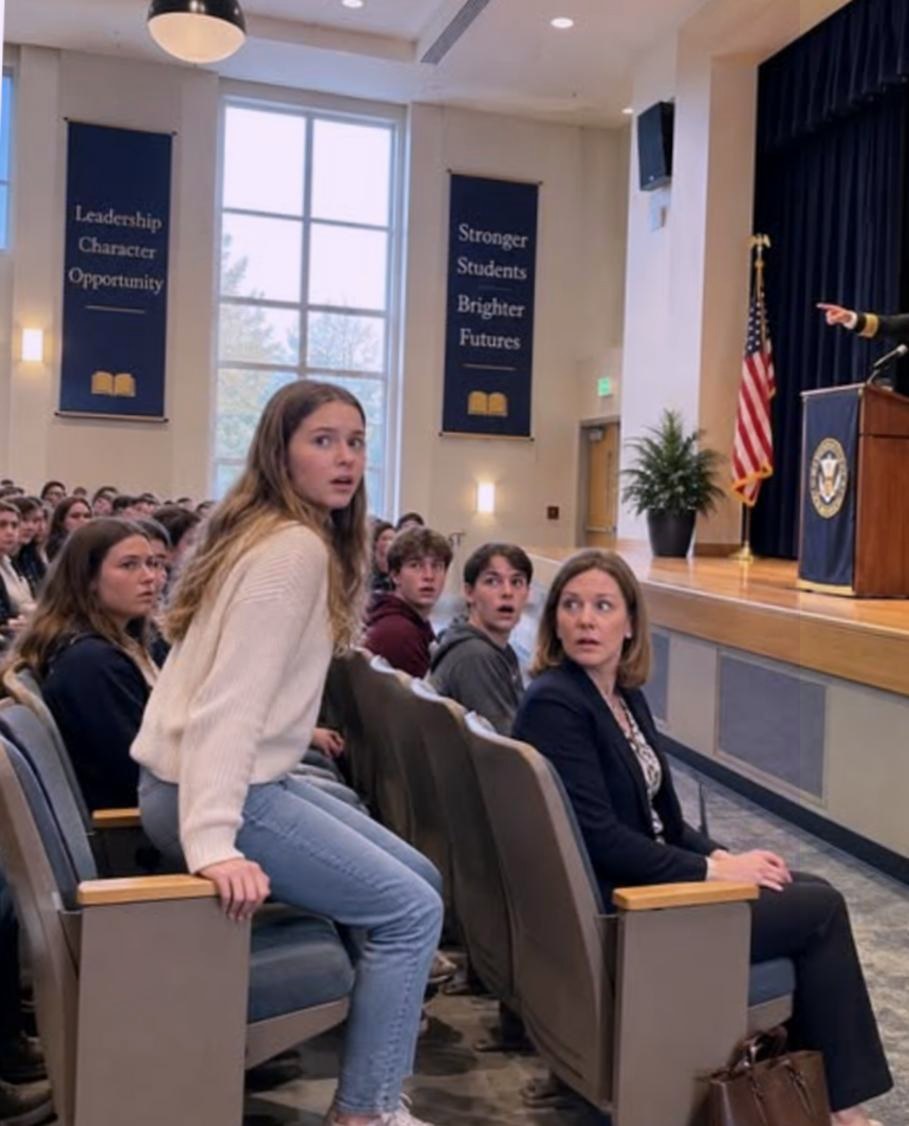
That same evening, almost a thousand students filled the school. Teachers stood along the walls of the hall, while firefighters, police officers, and military personnel sat near the stage.
Everyone immediately paid attention to the main guest.
Admiral William Carter was a tall, silver-haired man. Whenever someone spoke loudly in the hall, he would only look once, and the noise would stop.
I was sitting in the third row and trying to merge with the back of the chair.
Director Harris went up onto the stage. Beside him, the admiral took the printed program and slowly ran his eyes down the participants’ names.
Then his finger stopped on one line.
On my name.

The admiral raised his face and began searching the rows of the hall. When his gaze stopped on me, my stomach tightened. He looked at me as if he saw in me not a student, but a person lost long ago.
Mr. Reynolds first looked at him, then at me. His confident smile disappeared.
The admiral read the program once more, pushed his chair back, and stood up.
The hall became silent in one second.
He did not even look at the director. He simply walked toward me and stopped at the microphone.
“Lucas, do not get up from your place,” he said.
Then he leaned toward the director, pointed to my name on the program with his finger, and quietly said something to him. The director first looked at the paper, then at me, and then at Mr. Reynolds.
Mr. Reynolds swallowed heavily.
The admiral put his hand into the inside pocket of his jacket and took out a dark green folder. His fingers touched the folder’s clasp, but he stopped for one second before opening it…
The admiral slowly opened the folder’s clasp, and such silence fell over the hall that I could even hear the ticking of the clock hanging near the stage.

Mr. Reynolds moved his back away from the wall.
“Admiral,” Director Harris said, “perhaps we could discuss this later?”
“No, Director,” Carter replied. “This must be discussed precisely now.”
There was such firmness in his voice that the director immediately fell silent.
The admiral took one photograph from the folder and placed it by the microphone. From a distance, only black and white patches could be seen. He looked around the hall.
“Here is the person some of you mocked today,” he said. “And here is her child, who did the simplest thing: told the truth.”
I gripped my fingers on the chair so tightly that my nails dug into my skin.
“Lucas, can you come up onto the stage?” he asked me.
My knees became heavy.
“Why?”
The admiral looked at me for several seconds.
“Because your mother wanted this day to no longer be hidden from you.”
A whisper spread through the hall.
“Your mother?”
“The admiral knows his mother?”
Mr. Reynolds even lowered his head.


I got up from the chair and walked toward the stage. The wooden floorboards creaked under my feet, and I held the notebook in my hand. The copper star still rattled, and in that small sound I found a strangely great amount of courage.
When I went up onto the stage, the admiral extended his hand to me.
“I am William Carter.”
“I know.”
An almost imperceptible smile appeared near his lips.
“I know about you too.”
“From where?”
He did not answer. Instead, he took a folded sheet of paper from the folder and handed it to the director.
The director read it. His face changed.
“Is this an official document?” he asked.
“With a seal, a signature, and a military archive number,” Carter said. “If you want, you can read it aloud.”
The director held the paper as if he were holding something heavy.
Mr. Reynolds took one step forward.
“I only evaluated a student’s presentation. All of this is overly dramatized.”
The admiral looked toward him.
“You publicly called Lucas a liar.”
“I did not use that word.”
“You said that he brought an invented hero.”

Mr. Reynolds’s face tightened.
“I did not know who his mother was.”
“You did not need to know that,” Carter replied calmly. “Humiliation of a child never becomes justified merely because a teacher does not know something.”
This time nobody in the hall laughed.
The admiral leaned toward me.
“Your mother was supposed to be here today.”
My heart began beating quickly.
“Why isn’t she?”
Carter held his breath before answering.
“Because her mission is not finished yet.”
“Did something happen to her?”
“No. But she is where speaking on the telephone is impossible.”
The director said quietly:
“We received an invitation to speak only generally about her service. We did not know that…”
“You did not even check,” Carter interrupted. “The letter lay in your mail for three weeks.”
Mr. Reynolds nervously straightened his tie.

“This is a school event, not a military briefing.”
“That is precisely why I came,” Carter said. “Children need to see that the truth does not always come loudly. Sometimes it comes home tired, prepares food, and corrects a child’s homework.”
At these words, my mother’s face appeared before me: wet hands, a white towel, the red leather bracelet with my initials.
The admiral pointed toward the paper.
“It says here that Rachel Miller carried out one of the most difficult combat missions four years ago. She brought three aircraft out safely, but she never spoke publicly about it.”
“Why?” I asked.
“Because the pilot beside her was my son.”
A heavy breath was heard in the hall.
Carter lowered his eyes.
“He was lost during the mission. And your mother did not want to return until she was certain that the boy was alive.”
Mr. Reynolds muttered quietly:
“This cannot prove that she really is a pilot.”
The admiral took a small memory card from the bottom of the folder.
“Then listen to this.”

The director signaled to the technician. The screen lit up. A few seconds later, the heavy roar of an airplane engine sounded in the hall, and then a clear woman’s voice:
“Carter, I am on your left wing. Do not turn. I will get you home.”
My skin was covered with goosebumps.
It was my mother’s voice.
The admiral closed his eyes, as if at that moment he were again in that sky.
Then the recording stopped.
He turned the microphone toward me.
“Lucas, your mother asked me to tell you one thing if you ever doubted her: ‘Your existence was her greatest return.’”
I could not say anything.
Then the admiral’s telephone rang.
He looked at the screen and the color left his face.
“What happened?” I asked.
Carter let the call go unanswered. Less than two seconds passed before the telephone rang again. This time he turned the screen toward me.
It seemed that the call was coming from a military airfield.
At last the admiral answered and said only one word:
“Tell me.”

His face changed immediately.
Then he looked toward me and quietly added:
“Rachel’s aircraft has lost communication…”
Rachel’s aircraft had lost communication, and at that moment the hall seemed to fall underground.
The admiral pressed the telephone to his ear.
“Tell me the last coordinates,” he said. “No, I do not need an assumption. Exact data.”
I stood beside him and held the notebook so tightly that its corner broke. The copper star rubbed against my fingers.
“Is it my mother?” I asked.
Carter placed his hand on my shoulder.
“We do not know yet.”
“But you said it was Rachel’s aircraft.”
“I said her communication was lost. That is not the same as being lost.”
Director Harris stepped away from the microphone. The whole hall looked at his face, but he no longer had words.
Mr. Reynolds stood at the edge of the stage and seemed to be trying to become invisible.
The admiral looked into the folder once more. From it he took a sealed envelope. My name was written on the envelope by hand.
“For Lucas, only when he is ready,” it said.
I recognized my mother’s handwriting.

“Is this for me?” I asked.
“Yes.”
“When did she write it?”
“Last night.”
It seemed to me that the air disappeared from the hall.
“Then why didn’t she give it to me?”
Carter looked me in the eyes.
“Because she hoped she would be able to tell you everything herself.”
“Everything what?”
The admiral looked at the director.
“There is no longer a reason to hide the truth from Lucas.”
Then he opened the envelope.
Inside were three sheets of paper, a small military badge, and my mother’s photograph. In the photograph she was young, much younger than now. Two pilots stood beside her, and one of them resembled Admiral Carter.
“Four years ago,” he began, “my son Daniel and Rachel flew on the same mission. The task was to protect a civilian aircraft whose engine had failed and which had ended up dangerously close to a hostile zone.”
Everyone in the hall listened, holding their breath.
“Daniel’s aircraft was damaged. He could have escaped, but Rachel turned her fighter back. She found Daniel in the clouds, covered him with her wing, and led him to a safe corridor.”
“And then?” I asked.

“Then her own aircraft ran out of fuel. Rachel made an emergency landing on a military strip in the desert. She was out of communication for three hours. When they found her, her leg was broken and her shoulder bruised, but her first question was: ‘Is Daniel alive?’”
The admiral looked at the photograph.
“My son survived. Rachel refused the medal and asked me not to use her name publicly. She did not want you to become ‘the admiral’s son’ at school.”
“But you still knew me.”
“I have known you since your birth, Lucas. I even keep your first photograph.”
My throat tightened.
“Why didn’t you come to our house?”
Carter said nothing for a long time.
“Because your mother asked me to leave you an ordinary childhood. She was afraid you would grow up in the shadow of military service.”
Mr. Reynolds suddenly muttered:
“All of this… I did not know.”
The admiral looked toward him.
“That was precisely your problem. You did not know and still mocked him.”
Mr. Reynolds lowered his head.
“Lucas, I apologize to you.”
For the first time, his voice no longer sounded confident.
I looked at him. The whole class was waiting to hear what I would say.
“Your apology is accepted,” I told him, “but what you said still happened.”

The director lowered his eyes.
The admiral took the last sheet of paper from the envelope.
“This is Rachel’s statement. She officially requested that you attend the family briefing about her mission, because today she is supposed to leave for her final training assignment.”
“Final?”
“Temporarily final. She was offered a new duty. But this morning the weather changed unexpectedly.”
The telephone rang again.
This time Carter answered and listened silently for several seconds.
A tension appeared on his face that I had never seen before.
“Are the rescuers ready?” he asked. “Do not tell me you are waiting for permission. I am taking responsibility myself.”
The call ended.
“Carter,” the director said, “what is happening?”
The admiral looked toward me.
“Rachel activated an emergency signal. Her aircraft is in the mountains, but the pilot’s location is unknown.”
I stepped forward.
“I have to go with you.”
“No.”
“She is my mother.”
“And precisely for that reason I cannot put you in danger.”
“You said she saved others because she did not leave them behind. I cannot leave her here.”

The admiral lowered his eyes. Then he took one more small object from the folder—a damaged communications badge.
“They found this in Rachel’s aircraft,” he said. “But the aircraft is empty.”
Someone in the hall exhaled.
“Then where is my mother?” I asked.
Instead of answering, Carter looked at a new message that had arrived on the telephone.
His eyes widened.
“This is impossible,” he whispered.
“What does it say?”
He turned the screen toward me.
The message contained only a few words: “The backup signal has activated. The pilot is not in the cockpit. A second voice is being detected.”
The admiral looked toward me and, for the first time, was clearly frightened.
“Lucas, your mother did not carry out this mission alone…”
ადმირალმა ეკრანზე დედაჩემის ბოლო შეტყობინება ჩართო…
მეგონა, სიმართლე უკვე ვიცოდი. მაგრამ ყველაზე დიდი საფრთხე სწორედ მაშინ გამოჩნდა, როცა დედაჩემის სახლი დაცარიელდა.
„შენ იყავი ჩემი დაბრუნების ადგილი.“
იმ წამს მივხვდი, რომ ნამდვილი გამარჯვება მშვიდად სუნთქვა იყო.
👇 ისტორიის ფინალი უკვე გახსნილია
Related posts:
 When I Named My Mother a Fighter Pilot, the Class Mocked Me, but a Few Hours Later the Teacher’s Smile Froze on His Face
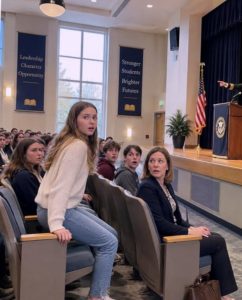 Part 4 — When They Mocked My Mother’s Truth in the School Hall, the Admiral Saw My Name and Immediately Turned Pale
 My Six-Year-Old Daughter Quietly Warned Me Before I Flew Away, and the Smile Suddenly Disappeared from My Wife’s Face
 My family asked me not to wear the uniform, but when I entered the hall, my father’s face suddenly went pale
 My family did not invite me and my children for Christmas, but Rachel looked at me in front of my door and suddenly turned pale
 When my husband spoke about me in English to his family, I understood everything and watched his smile disappear