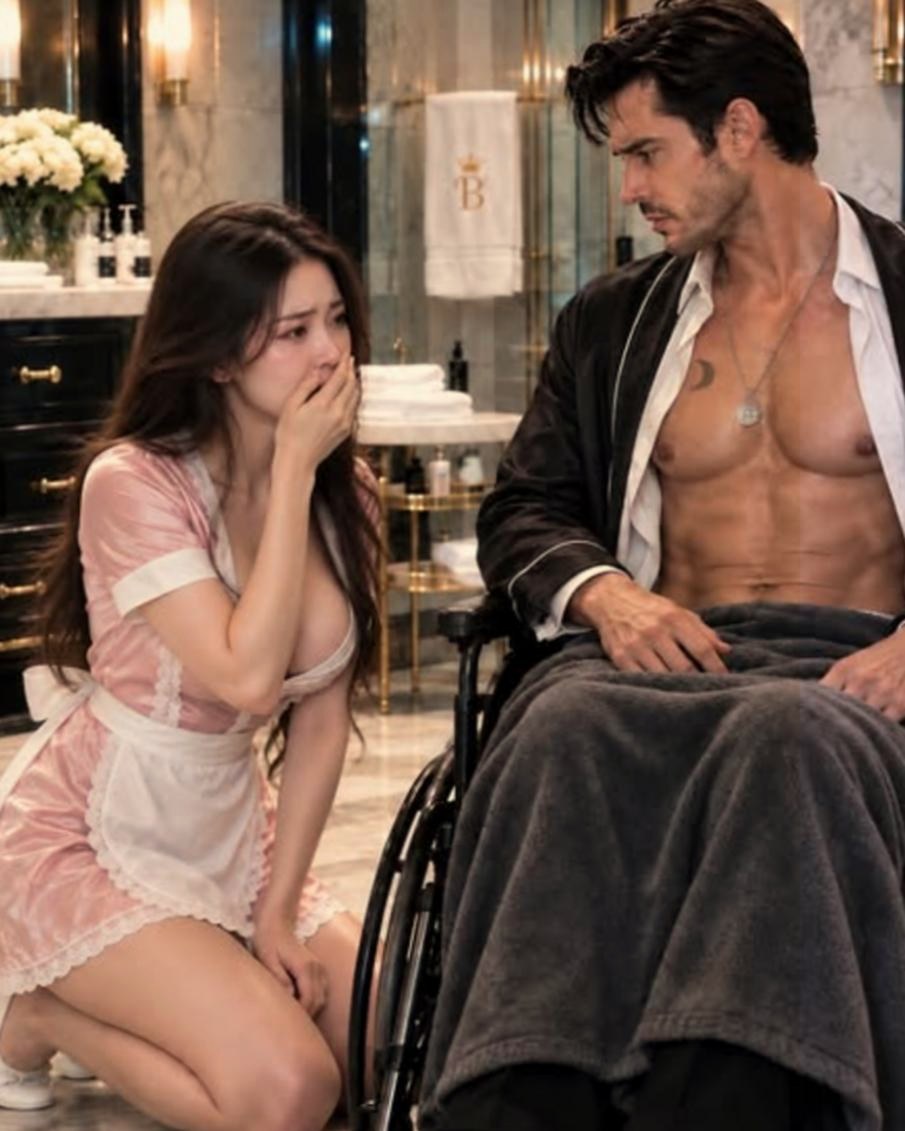

Victor’s last words were still hanging in the air when I ran toward the door.
“I am going to my son,” I said.
“You cannot go,” he replied.
“Get out of my way.”
Victor brought the phone to his ear.
“Tell security not to start the car.”
Daniel gripped the wheelchair control lever.
“Victor, if you obstruct her, you will never enter this house again.”
“You no longer decide anything.”
“I still decide whom I trust.”
Laura took the recorder from the table and pointed it toward Victor.
“Your voice is on the recording. You yourself tell Daniel’s mother that you could find the child and then silence him.”
For the first time Victor lost his smile.
“It is edited.”
“Then explain it to the police,” Laura said.
“The police?”
“I have already called them.”
Victor looked toward the door. A few minutes later the sound of a siren came from outside.

His face became gray.
I stood behind Daniel’s wheelchair and pushed it toward the door.
“Take me to the clinic,” he told me.
“You will not be able to drive a car.”
“But I know who can.”
Laura called the house driver. In ten minutes the car appeared in the yard. I was still wearing wet shoes, but I no longer cared. I covered Daniel with a blanket. It was the same blanket that had been on the chair in his room and on whose edge a small circle was embroidered with silver thread.
Victor tried to block the way.
“Daniel, you do not have a doctor’s permission.”
“My son is in the clinic,” he replied. “For the first time in my life I will decide myself where I should be.”
The police officers entered at exactly that moment.
“Victor Hale, we have several questions for you,” one of them said.
“This is a conspiracy!”
“You will say that in court.”
Victor was put in handcuffs. I did not celebrate his pain. I simply was not going to save him at the cost of my own life anymore.
At the clinic Brandon lay with an oxygen mask. His small hand was lost in the doctor’s hand.
“Mom,” he barely said.
I knelt beside him.
“I am here.”
Daniel stopped at the door. Even taking one step toward the boy was difficult for him, as if all twenty years had been tied to his legs.
“This is your father,” I told Brandon. “He came very late, but he came.”
Brandon opened his eyes.
“Are you the man who gives my mother a job?”
Daniel’s lips trembled.
“I am the man who could not find you for a very long time.”
Brandon looked at him for a while.
“Did you find me now?”
“Now.”

Several hours later Daniel’s lawyer, Mrs. Mirian, came to the clinic.
“Daniel, you must sign a temporary statement. The company accounts will be frozen until the investigation is completed.”
“I will sign.”
“And the matter of inheritance must also be discussed.”
Daniel shook his head.
“Let us discuss my family first.”
After Victor’s arrest, his words became decisive evidence for the court. His mother’s recording, the old letter, the forged clinic records, and the genetic conclusion matched one another. Daniel’s mother was dead, but the shadow of her crime pursued the living. Victor was charged with fraud and organizing a kidnapping.
Several weeks later Daniel asked us to gather at his house.
A large screen stood on the living-room wall. I thought they would show us new legal documents.
But Mirian turned on a recording.
Victor’s voice sounded.
“If the woman returns, the boy may appear too. We must separate both of them from Daniel before the company slips out of our hands.”
My body recognized that voice immediately. They were the words he had said that night when Daniel’s mother came to me at the station and told me that Daniel was dead.
Daniel watched the screen.
“I had this man beside me for twenty years,” he said.
“You did not know,” I answered.
“But do you know what all this meant to me?”
“I know what it meant to me.”
Daniel lowered his head.
“They told me that you had left me.”
“And they told me that you had died.”
For the first time, both of us heard our own past through someone else’s voice.
That evening I entered Daniel’s old room. The bed was untouched. On the small table by the window lay one photograph—a young Daniel, photographed before the storm, with the same chain around his neck.
Everything else had been taken away.
The room was empty, but in its emptiness stood twenty years of abandonment.

I took my small copper pendant from my pocket. The bird’s wing still shone faintly.
Daniel stopped at the door.
“You still had this?”
“Even after everything.”
“Why?”
“Because I wanted, at least once, to know where the truth was.”
He lowered his head.
“Do you know now?”
“Now I know. But the truth cannot bring back the lost years.”
“I can make the remaining years better.”
“You can try. But I will no longer be your debtor.”
Daniel smiled for the first time in such a way that there was neither power nor anger in his smile.
“I deserve that.”
“No,” I said. “It simply has to be this way.”
Brandon recovered. Three weeks later he left the clinic and asked a new question about his father every day. Daniel answered everything he could, and what he did not know, he honestly admitted.
Emma showed him her broken doll.
“Can you make it a new leg?”
Daniel carefully took the doll.
“I can try.”
“Mom says trying is not enough.”
Daniel looked toward me.
“Your mother is right.”

Two months later I rented a small apartment on the north side of the city. The ceiling no longer leaked. There was always bread in the kitchen, and milk, apples, and medicines in the refrigerator.
I enrolled in courses in elderly care. For the first time in my life I was studying not to save someone, but to have my own choice.
Brandon returned to school. Emma put a drawing on the wall of the room: four people stood in the snow, and above them a large sun was drawn.
“This is us,” she told me.
“Four?”
“Me, Brandon, you, and that man in the wheelchair.”
The first snow came at the end of December. Brandon stood by the window and counted the snowflakes. Emma clutched the old doll to her chest.
That evening I received a message from Daniel.
“I want us to live together again. This time no one will separate us.”
I looked at the screen for a long time.
Then I wrote back:
“Thank you for finally choosing the truth. But I have already built a life in which I no longer wake up in fear. You will be in our lives if you respect this. However, I will not go back.”
I did not wait for his reply.
I took the small copper pendant off my neck and placed it on the windowsill. The bird’s wing sparkled in the light of the snow.
For twenty years I thought it tied me to the past.
In reality, it brought me there until I learned to fly.
Missed the beginning?
Related posts:
 On the morning after the wedding, my husband threw a greasy cloth in my face and called me a servant, but after my calm smile, his mother turned pale
 Hunger Forced Me to Become the Caregiver of a Paralyzed Billionaire, but When I Opened His Shirt, He Looked at Me and Turned Pale
 The Husband Did Not Call at His Mother’s Funeral, but When His Lawyer Opened the Folder, Brandon’s Smile Disappeared
 For Christmas, my mother-in-law gave my child a cheap candle, but when the red box was opened, her smile disappeared
 I Noticed a Hungry Girl at the Hotel Entrance, but When I Learned Her Mother’s Name, the Chef’s Smile Froze on His Face
 A karácsonyi asztalnál a sógornőm egy gyertyát adott a lányomnak, aztán egyetlen mondattól megmerevedett