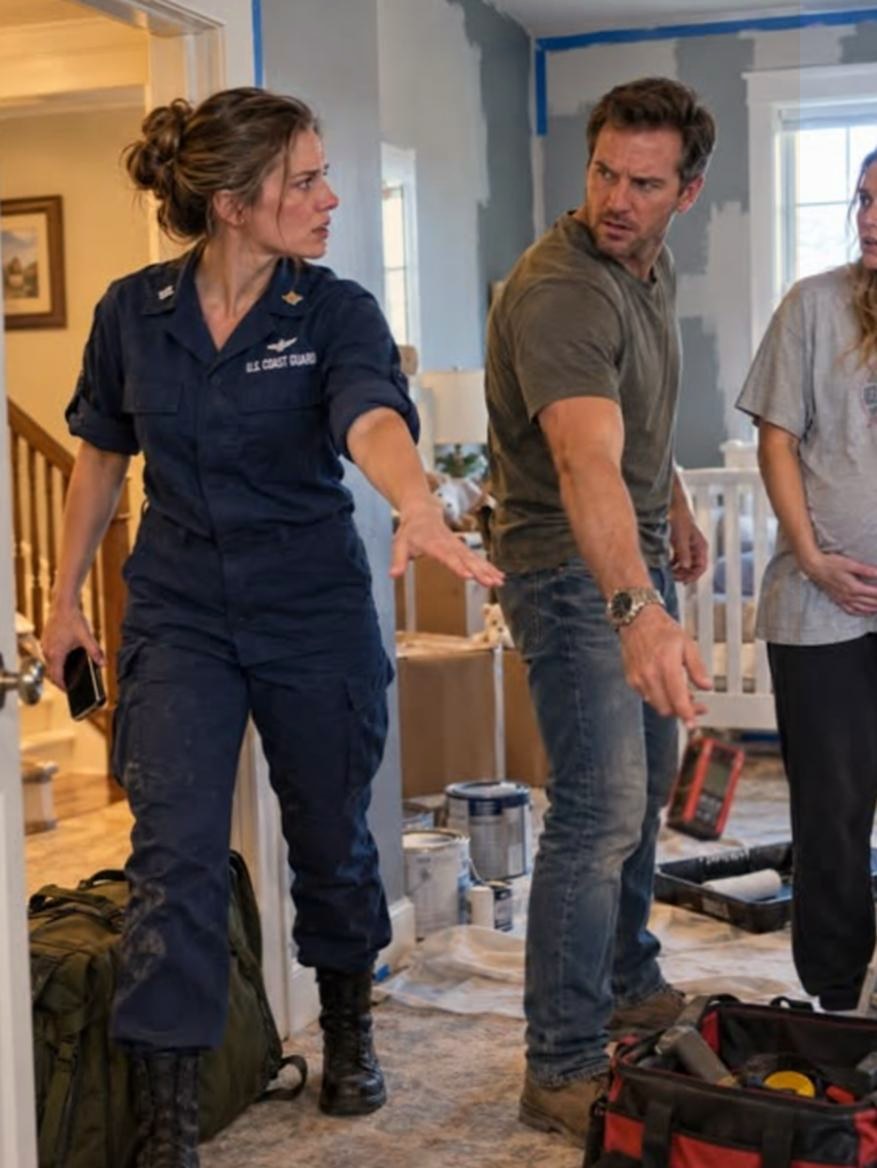

When I returned home, my Coast Guard award was lying by the hallway wall, while the sound of a child’s room being arranged could be heard from the upper floor.
The award itself had been taken down from the wall. I put my bag beside it and immediately noticed the small item that I carried with me on every mission — a brass compass with cracked glass. It had always lain by the entrance, in a wooden bowl. Now the bowl was empty.
The smell of paint and lavender hung in the house. Dishes were piled in the sink, while ultrasound photographs were attached to the refrigerator with lemon-shaped magnets. I had spent eight weeks at sea, controlling fuel delivery in a storm, and when I returned home I wanted only a shower and sleep.
My family thought differently.
Harper’s silver car stood by my garage as if the house already belonged to her. On the rear window it said: “Little Sterling is coming soon.” The window of the upstairs guest room was open, although I had locked it when I left.
In the room, my younger sister, Harper, stood on a ladder and was attaching tape near the ceiling. Her husband, Chase, was drawing red lines on the wall with a laser measurer.
“If we put the bed in the corner, the changing table will fit too,” she said.
Neither of them noticed me until I put the glass on the dresser.
“Oh, you’re back,” Harper said as if I had come as a guest. “Chase thinks gray is too cold for a nursery. We also have to manage to move the boxes by Friday.”
“The boxes?”
She put her hand on her stomach.
“We’re moving in here. Mom said that you were going to leave again next year anyway.”
Chase put the measurer into his pocket.
“We don’t want to keep throwing money away on an apartment in the city. You have four rooms.”
I had four rooms because for years I had worked on missions, saved money, and finally bought the house alone. That did not mean I had four gifts for relatives.

“Who gave you permission?” I asked.
Harper furrowed her brows.
“Mom said it wouldn’t be a problem.”
My mother, Evelyn, had thought all her life that my strength was free shelter for everyone. In childhood, she turned my room into Harper’s dance hall, and my first car into her “urgent need.” My father, Thomas, usually sat silently and used silence as agreement.
Even now Chase stood in my house as if the walls were part of his business.
“Am I supposed to throw my pregnant sister into the street?” Harper asked.
“I still don’t understand how your pregnancy is connected to my mortgage.”
Her smile disappeared.
I took out my phone and looked at the screen. It was six twenty-four in the morning.
“You have thirty minutes to collect your things and leave the house. If you stay, I’ll call the police.”
Chase narrowed his eyes.
“You’ll regret this, Naomi.”
“Maybe. But first you regretted not asking me.”
They began packing their things. The tape fell onto the floor. Harper put a box down so that its corner struck my cracked compass. The wooden bowl overturned, the compass rolled across the floor, and stopped exactly in front of my shoes.
After they left, I locked the door and picked up the compass. The crack in the glass seemed to have become longer.
But I still had no answer: who had thought my house could be given up?


That evening my mother called me. Her voice was calm, too calm.
“Come to dinner on Sunday. We need to talk about what you have done now.”
On Sunday, at my mother’s house, roasted meat, wine, and a sealed envelope were waiting for me on the table. Chase put his hand on it and said quietly to me:
“Before you open it, there is one thing you should know…”
His hand reached toward the envelope…
Chase pulled the envelope toward himself with his fingers, but I put my hand on it.
“First tell me why my address is in your business documents.”
My mother put down her glass so that wine spilled onto the table.
“Naomi, don’t start this in front of Harper.”
“It was precisely because of Harper that you started everything.”
My father looked at his plate. Harper’s eyes filled with tears.
“You can’t stand the baby.”
“I’m not opposing the baby, but your secret plan.”
Chase opened the envelope. There were several sheets inside, but he showed me only the first page.
“This is temporary financial confirmation. You are losing nothing.”
“Then why didn’t you ask me?”
“Because we knew you would refuse,” my mother said.
That was the first honest sentence of the evening.

After returning home, I changed all the passwords, locked the mailbox, and froze the credit accounts. On Monday I discovered that Chase’s company had requested an eighty-five-thousand-dollar loan based on my house. On the application, my house was listed as his primary residence.
My mother had received three official letters while I was at sea. She had handed none of them over to me.
On Tuesday I went to a lawyer. He examined the documents for a long time and finally asked me:
“Is this signature yours?”
I looked at the sheet.
“No.”
At that moment I realized that the matter was no longer only about taking away a room. But the lawyer’s next question froze my blood:
“Then whose voice is in this recording?…”

The lawyer, Mirian, closed the door of the small room and placed a black recorder on the table. Rain struck the window, while I held my cracked compass in my palm.
“The bank’s compliance department sent us this recording,” he said. “During the review of the application, they asked Chase for additional confirmation.”
He turned on the recorder.
First Chase’s voice was heard.
“The house is in the family. Naomi is at sea for months and will give us consent if her mother explains to her that this is temporary.”
Then my mother’s voice was heard, calm and confident.
“Naomi always gives in at the end. When she finds out about Harper’s pregnancy, she won’t resist us anymore.”
Something caught in my throat. This was their conversation on the day when they were painting in my room.
But the recording continued.
“The signature?” Chase asked.
“Transfer it from an old document. She won’t notice anything until the money is approved,” my mother answered.
Mirian turned off the sound.
Such silence fell in the room that I could hear every tick of the wall clock.
“This is an illegal signature,” he said. “And the deliberate improper use of your address. If the loan had been approved, the creditor could have made a claim against your house.”
“Could they have sold my house?”
“Not directly, but a process of seizing property in exchange for the debt would have begun. That is exactly why they wanted to move in here quickly. They had to show that Chase lived here.”


That evening I went to my parents. Harper was sitting on the sofa, her hands wrapped around her stomach. My mother met me at the door.
“There was no need to run to a lawyer,” she told me.
“You forged my signature.”
Harper lost color.
“Mom told me you had agreed.”
“Did you see this?” I asked Chase.
He came out of the kitchen and for the first time was no longer smiling.
“It was only a temporary formality.”
“In my name?”
“I was doing it for the family.”
“No. You were covering your own debts.”
My mother took my hand.
“If Chase goes bankrupt, Harper and the baby will be left on the street.”
“That is exactly why you should have called me, not signed in my name.”
Mirian prepared a statement for the police and sent a notice to the bank. I thought I already knew the hardest truth.

Then my phone rang. The number was unfamiliar.
“Mrs. Vance?” a man asked me. “I am the person who approved this loan. You should know that your family members did not fill out only one application.”
I went to the window.
“How many were there?”
The man exhaled.
“Three. And on one of them your house is already listed as collateral. But that is not the worst news. The deadline expires tomorrow morning…”
სასამართლოს კართან ჩეისმა უკანასკნელად დამიძახა…
მეგონა, სიმართლის აღმოჩენა დასასრული იყო.
მაგრამ ყველაზე მძიმე გადაწყვეტილება ამის შემდეგ მივიღე.
„ნაომი ყოველთვის ბოლოს ნებდება.“
ჩეისმა პირველად ვეღარ გაიღიმა.
😱 გაიგე, რას მალავდნენ ისინი →
👇 ისტორიის ფინალი უკვე გახსნილია
Related posts:
 My Father Dropped My Military Medal into Mashed Potatoes, but the General Who Came to the House Suddenly Turned Pale
 Minha futura sogra exigiu meu código bancário, mas quando meu noivo bloqueou a porta, o sorriso dela desapareceu
 Part 4 — My Pregnant Sister Was Arranging a Nursery in My House, but One Question from Me Made My Mother’s Smile Disappear
 Part 4 — My Father Dropped My Military Medal into Mashed Potatoes, but the General Who Came to the House Suddenly Turned Pale
 I took my mother from the house, but when my brother opened her room with a duplicate key, the color drained from his face
 On the Morning of the Wedding, My Family Left Me in an Empty Church, but Harper’s Smile Disappeared from Her Face at the Sight of the Groom’s Gift