

…I ended the call and stared at the phone for several seconds. Maisie was lying beside me and moving her feet on the white carpet, as if nothing in her world had changed.
But in my world, everything was already changing.
The next morning the lawyer, Nika, invited me to his office. Beyond the window, Seattle’s rain came down on the glass in thin lines. My documents lay on the table, and beside them was a small wooden box.
“This box came from the bank archive,” he told me.
“What is inside?”
“The thing your mother has been trying to hide for years.”
In the box were an old copy of a birth certificate, a hospital record, and one letter. At the end of the letter was the name of an unknown man — Aleksandre Meladze.
Nika calmly explained to me that Aleksandre was my biological father. My mother had had a relationship with him before marriage, but when she learned that she was pregnant, she married another man and recorded her husband as the child’s father.
“Why did this return now?” I asked.
“Because Aleksandre legally left an inheritance before his death three years ago. Your parents knew this. They knew that you were the sole heir.”
I laughed. The laugh resembled pain more than anything else.
“Is that why they helped me, so they could get money from me?”
“More precisely, that is why they tried to keep control over you.”
Nika told me that my mother had hidden the inheritance notice. They had access to my old mail because, when I was a child, Mother herself received letters sent in my name. Aleksandre’s estate was neither unimaginably large nor fairy-tale-like, but it was enough to begin a new life for me and Maisie.
The most painful thing, however, was not the money.
In the letter Aleksandre wrote that he had tried to find me all his life. The last sentence said: “If she ever reads it, tell her that her existence was never a mistake to me.”

That day I did not go to Mother again. Nika called them and officially informed them that all financial connections were terminated. Kylie’s accounts were frozen. The bank began investigating the false loan. Father called Nika the next day and asked him not to continue the case.
Nika refused him.
“I am not your lawyer,” he told him. “I am protecting your daughter’s interests.”
Mother sent me twenty-two messages.
“We simply made a mistake.”
“You ruined my birthday.”
“Family does not take family to court.”
Finally she wrote: “Come alone. Do not bring the child.”
That sentence finally ended everything.
For the first time I recorded my voice. I put the phone on the table, placed Maisie in my lap, and said:
“Mother, I am no longer going to carry your debts, lies, and shame. If you want to talk to me, tell me the truth and respect my child. Otherwise, do not contact me again.”
Then I sent it.
Two hours later Nika told me that Mother and Kylie were at the police station for questioning. Father was waiting outside, holding an old leather bag. When they showed them the camera footage in which Kylie entered together with a bank representative, Mother tried to deny it.
“I did not say that,” she said.
The investigator played the recording.
Her own voice was heard: “If Jenna is left alone, in the end she will offer us money herself.”
Silence fell in the room.
For the first time Mother heard her own words through someone else’s ears. Her hands fell onto her knees.
“I did not mean it that way,” she whispered.
But the words no longer mattered. They had already been said. Already recorded. Already turned into part of my life.

That same week I went to my parents’ house to collect my things. My old photograph no longer hung on the wall in my childhood room. The bed was empty. On the bookshelf there remained only a rectangle of dust where a small music box had stood for years.
And on the windowsill I found my silver pendant — a small moon-shaped one that Father had given me on my fifteenth birthday. I had given it to Mother so that she would “keep it safe.”
I picked up the pendant. It was cold.
“Will you take it?” Father asked from the doorway.
“Yes.”
“Your mother is not a bad person.”
I looked at him.
“Maybe she is not. But she could not become a good mother for me.”
He lowered his head. This time he did not argue with me.
Three months later Maisie was already six months old. With the money inherited from Aleksandre, I bought a small apartment in a quiet neighborhood of Seattle. Every morning I saw the neighbor’s maple from the kitchen window. A baby crib stood by the wall, and on the table was the yellow mug Vanessa had given me.
I was still working, but I also started a small consulting business. I helped people organize financial documents. Probably because I now knew very well how dangerous it is to hand the keys to your own life to others.
Maisie crawled on the floor and put everything into her mouth. Once she reached my old silver pendant too.
“No, little one, this is not food,” I laughed and carefully took the pendant from her hand.
She complained angrily.
“I know, I know. You also love everything you are forbidden.”

That evening the first snow came. Maisie crawled to the window and watched the white flakes with wide eyes.
“Look, Mommy,” I said quietly. “This is the life that we will choose ourselves.”
My mother made her last attempt six months later. She sent me a letter. Inside there was only one sentence: “Could you at least come on Thanksgiving, only this time alone?”
I held the letter in my hand for a long time.
Then I wrote back: “No. I will never be alone again.”
There was neither anger nor revenge in these words. Simply truth.
That evening I put Maisie to sleep and placed the pendant on the windowsill. The small moon shape shone in the light of the snow. This object had once belonged to the past left behind in their house.
Now it was in my house.
And for the first time, I too was where they truly waited for me.
I locked the door.
The moon belonged to no one anymore.
Missed the beginning?
Related posts:
 My Mother Did Not Invite Me to Her Birthday with My Child, but Her Face Lost Color When She Read My Reply
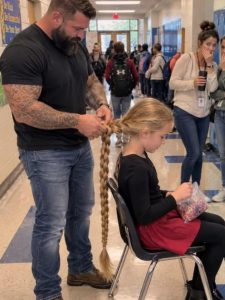 In the Concert Corridor, Everyone Turned Against Goldie’s Father Over His Daughter, but One Sentence from the Girl Silenced the Hall and Made Her Father Go Pale
 Grandmother Did Not Include My Child in the Family Photo, but One Message Suddenly Erased Her Smile
 Part 4 — Grandmother Did Not Include My Child in the Family Photo, but One Message Suddenly Erased Her Smile
 Part 4 — In the Concert Corridor, Everyone Turned Against Goldie’s Father Over His Daughter, but One Sentence from the Girl Silenced the Hall and Made Her Father Go Pale
 My Mother Spilled My Daughter’s Soup on the Floor and Threw Us Out of the House, But Dad’s Face Suddenly Changed