
As soon as I left the school administrator’s office, I called Elene.
“It came,” I told her.
“What came?”
“The document Mother said yesterday we should not disclose. My mother is listed as Nika’s guardian.”
Elene was silent for several seconds.
“Do not move. I am coming right now.”
Nika was sitting on a chair in the hallway. The school psychologist stood beside him, holding a bottle of water. He was still wearing the orange fox bracelet, only now its corner was peeling off.
“Mom, can Grandma take me away?” he asked.
I felt such coldness in my heart, as if I had opened a winter door.
“No, my child. No one can take you away without my consent.”
“But it says so on the paper.”
“Sometimes they lie on paper too.”
My mother appeared at the end of the hallway. She held a leather bag and wore the same stern expression with which, in childhood, she had called all my tears excessive.
“Mariam, let’s go home and talk calmly.”
“You should talk here. At the school where you demanded to take my child away.”
“I was offering help.”
“Bringing a false document against a child’s mother is not help.”
My mother looked around.
“Be careful. Do not accuse your mother in front of people.”
Elene arrived then. She was holding a folder.
“This too you should learn in front of people,” she said.
She took out a consent signed by my mother. The document said that I supposedly constantly missed Nika’s school meetings, neglected the child, and was giving the responsibility for his upbringing to his grandmother.
“This is a lie,” I said.
“I know,” the administrator answered calmly. “That is why we checked. Every teacher wrote that you attend every meeting. The child’s doctor also sent records.”
My mother looked at Elene.
“You collected this too?”
“No. The school collected it. I only kept what you asked them to delete.”
Then my mother’s lawyer called. She immediately answered the phone.
“Hello, everything has gotten out of control,” Mother told him.
The reply was so clear that we also heard several words.
“I warned you, a signed guardianship document means nothing without a court decision. Now you face the risk of liability for an illegal statement.”
My mother looked at the wall.
“You are my lawyer. Protect me.”
“At this stage I advise you to distance yourself from me. I will not sign another statement.”
The call ended.
For the first time my mother said nothing.

And suddenly I heard her voice—not now, but from yesterday’s audio recording. “Do not leave Mariam’s son in. People will forget soon.”
The photographer had played this voice for everyone, but now I heard it differently. For the first time I understood what my mother’s attitude sounded like when she was sure that no one would oppose her.
“I’ll deal with him.”
She herself had said these words.
She herself had recorded them.
She herself had believed that no one would hear Nika’s voice.
Three days later I went to my mother’s house to collect my things. Elene opened the door because Mother no longer answered me.
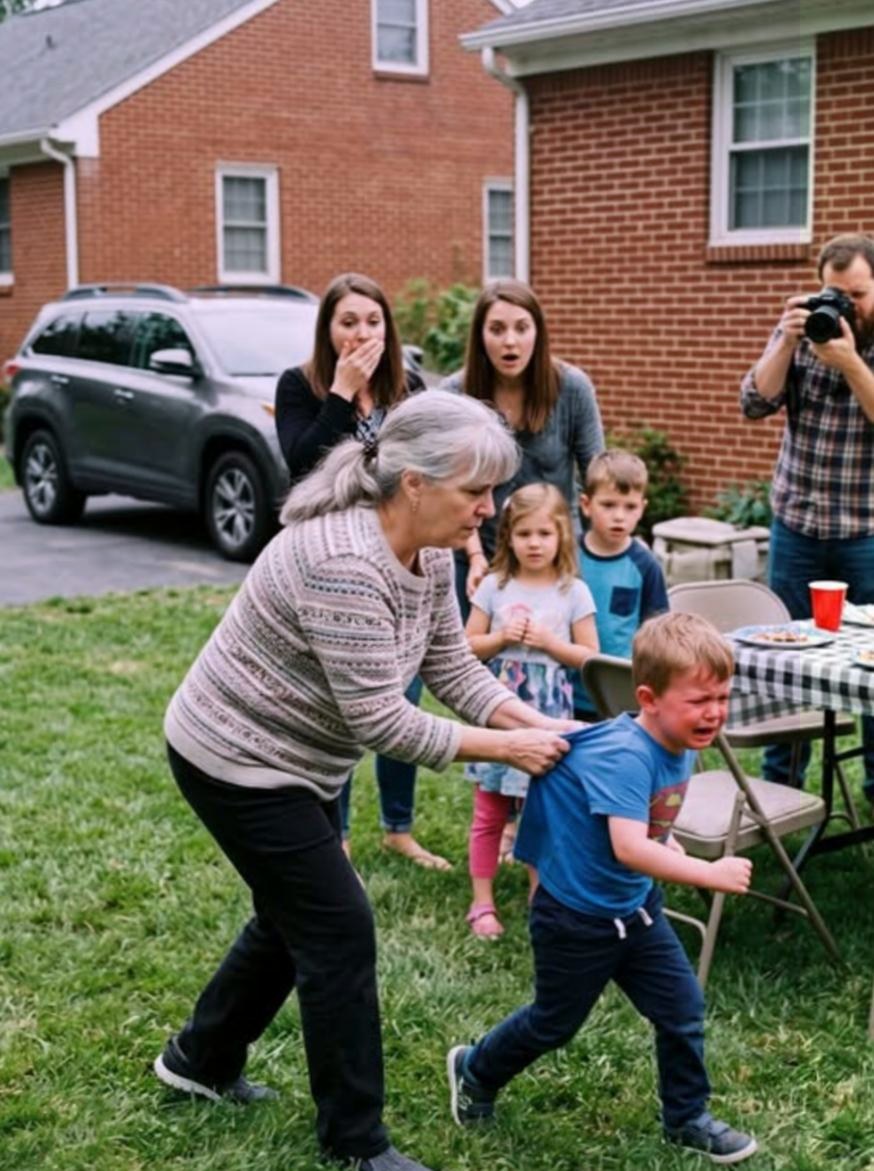
Dozens of frames hung on the wall in Nika’s room. In some were Elene’s children. In some were my mother and my sister’s family. In one frame only half of our old photograph remained.
Nika’s place had been cut out white.
His small wooden car lay on the table. The one he had taken everywhere in childhood. My mother had never begrudged money for the car, but she had always begrudged space for Nika.
I took the frame.
“I’ll take this.”
Elene nodded.
“Take it. But if you want, take everything. There is nothing here anymore that obliges you to return.”
My mother stood at the door.
“Are you really going to abandon your mother like this?”
I turned toward her.
“I am not abandoning you. You have been trying for a long time to make me and my child not exist in your life.”
“I preserved the family.”
“A family where a child has no place in a photograph is not preserved; it is hidden.”
My mother’s eyes lit up.
“One day you will realize that you were too strict.”
“Maybe. But on that day Nika should no longer wait for you to begin choosing him.”
She did not answer me.

When I left the house, I was holding the frame in which Nika’s place had been left as a white spot. A wind rose in the yard, and a small scrap of paper fell from the back of the frame onto the floor.
In my mother’s handwriting it said: “Only the desired grandchildren.”
This was the last evidence we needed. The lawyer submitted the documents to the school, the child-protection service, and the court. My mother’s right to remain alone with Nika was suspended. An investigation began for false statements and the use of a signature.
I was not happy.
Not even when relatives demanded an apology from my mother. Not even when her old messages accumulated in the family group and everyone saw how many years she had hidden the truth.
I wanted only one thing: for Nika not to believe anymore that someone else’s cruelty was his fault.
Two months later we moved into a small apartment on a quiet street in a seaside city. In the mornings, the smell of cinnamon rose from the bakery downstairs. I began working in a library and walked to pick Nika up from school every evening.
Nika still entered large rooms slowly. At birthdays he first watched the door. In photographs, he initially stood to the side.
One evening I saw him drawing in the kitchen.
“What are you doing?” I asked.
“A new family photograph.”
Four people stood on the paper. Me, Nika, Elene, and her children. He was drawing small suns above everyone’s head.
“Where is Grandma?” I asked carefully.
Nika stopped the pencil.
“If she wants, she can come herself and apologize.”
“And if she does not come?”
“Then I will not draw her in the photograph either.”
There was no anger in his answer anymore. There was only a boundary.

Four months later I received a letter from my mother. It was short.
“Come alone. I will explain everything. I also have a gift for Nika.”
I read the letter to the end, then put it in a drawer.
That same evening the telephone rang.
“Mariam,” my mother’s voice was weak. “I want to see him.”
“He may want that too, but the meeting will happen only when you acknowledge responsibility.”
“But I did apologize, didn’t I?”
“No. You said that we were all excessively sensitive.”
Silence fell.
“You are my daughter,” she said at last.
“I know. That is why I waited for you to treat me like a mother at least once.”
“And what are you doing now?”
“I am protecting my child.”
“From me?”
“From your choices.”
I hung up.
I went to the window. The first snow was falling. Nika stood in the yard and raised his hands to catch the snowflakes. The same orange bracelet was still visible on his wrist, only now the fox picture had almost faded.
He looked up at me.
“Mom, will you take a photograph of me?”
“Of course.”
“This time let everyone be visible.”
“Everyone who wants to be with you.”

Nika smiled at me and came up the stairs. I took my phone, but before taking the photograph I noticed his old bracelet. He was no longer wearing it. Nika had placed it on the windowsill and put on a new, simple bracelet.
I put the old orange fox into a frame—beside the photograph in which Nika stood in the middle for the first time.
This time I cut no one out.
I took the photograph.
Nika stood in the center.
Missed the beginning?
Related posts:
 Grandmother Did Not Include My Child in the Family Photo, but One Message Suddenly Erased Her Smile
 My husband gave flowers to his former lover, and I left the hall — behind the cameras, his smile disappeared
 My mother-in-law diminished my motherhood every day, but when I repeated her words, Artyom’s face suddenly turned pale
 Before our fifth anniversary, I overheard my husband’s secret conversation and his laughter suddenly stopped
 My daughter-in-law emptied our yard in front of the guests, but her hands trembled when she heard one decision of mine
 A few days after giving birth, my husband put divorce papers in front of me in the kitchen, but his face changed after my calm answer