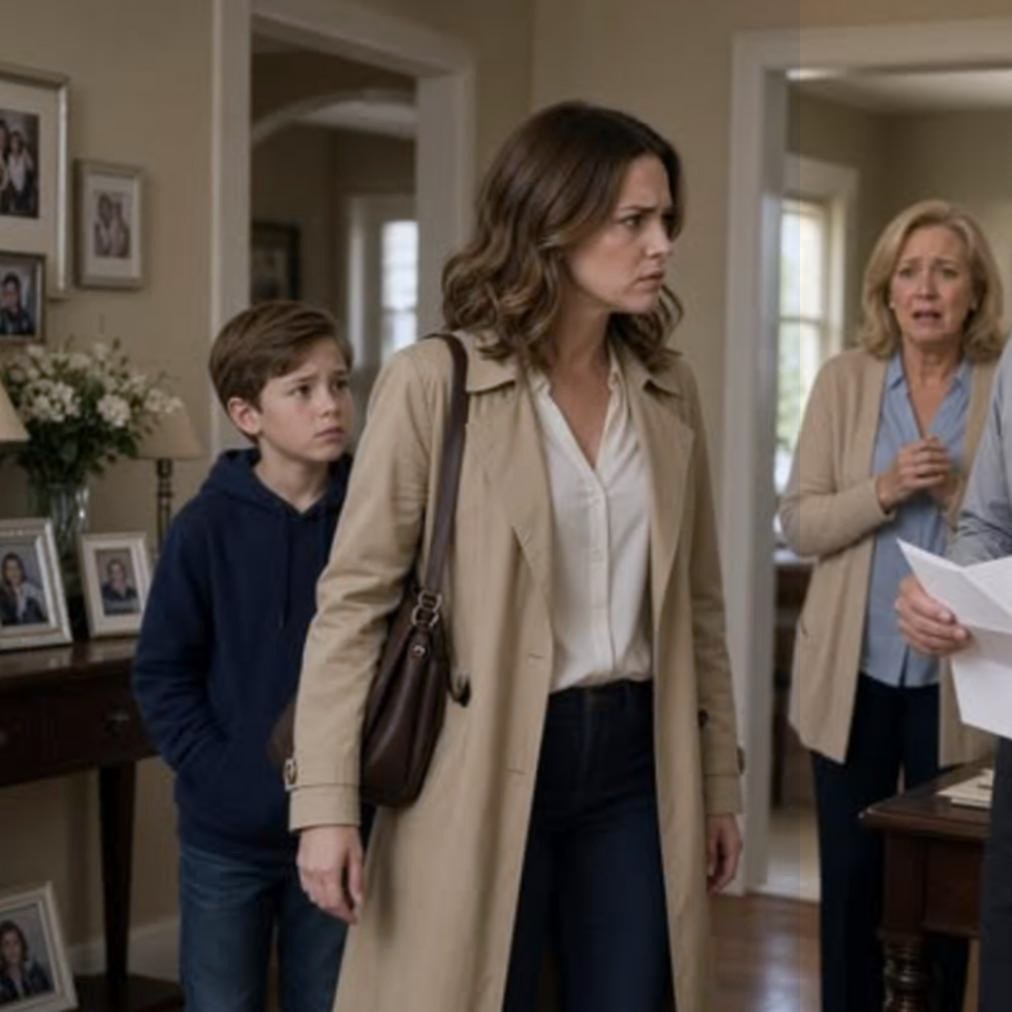

At the sight of that name, Robert lowered his head as if a heavy stone had been placed on his neck.
“This is impossible,” he said.
Rachel turned the sheet toward him.
“The money was transferred to the same account for six years.”
“I did not know about this account.”
“The account is in your name,” I said.
My father looked at me.
“I did not open it.”
“But you took the money.”
Rachel calmly added:
“The account was opened using the identity details that were used in the trust-fund case. Its owner in the documents is Emma Harper, although the video recordings show that you yourself are the person disposing of the money.”
Mother grabbed the chair.
“Robert, you told me this was only for Jason’s debts.”
“Be quiet.”
“You told me the money would be returned.”
“Diane!”

Noah stood beside me. His face was pale, but his hand was no longer trembling.
The investigator took out a card.
“Mr. Harper, from this moment on, please do not touch any documents or any electronic devices.”
My father immediately reached for the phone.
“I will call my lawyer.”
“I already called him,” Rachel said. “He refused to represent you.”
My father looked at her, frozen.
“What?”
“He told me he has a conflict of interest. Several years ago, he himself warned you that concealing the conditions of the trust created a criminal-law risk.”
My father went to the window. Snow was beginning to fall outside. His fingers gripped the curtain so tightly that his knuckles turned white.
Rachel turned on the recording.
First there was a rustling in the room, then my father’s voice from ten years earlier.
“The clinic or the street. The choice is simple.”
Mother’s voice followed.
“If you keep the baby, do not bring her into our house again.”
Then my young voice was heard, frightened but firm.
“One day you will regret forcing me like this.”
The recording fell silent for several seconds.
My father slowly turned around.
“I did not say it like that.”
Rachel turned the sound on again.
“Grandmother’s trust fund exists. If you do this, they will check everything.”
“You are a child. You own nothing.”
My father could no longer bear hearing his own words. He covered his face with his hand.

And I felt something strange: not victory, but exhaustion. For ten years I had wanted one sentence from him—“I was wrong.” Now that sentence changed nothing.
The investigator also looked at Mother.
“Mrs. Harper, you are listed as a witness on these documents.”
Mother stopped crying.
“I did not know it would go this far.”
“But you knew that Emma was thrown out of the house and that Noah did not exist in the documents.”
Mother lowered her eyes.
“Yes.”
That one word sounded the loudest in the room.
That same evening, the trust-fund account was frozen. The company’s accountant sent over all the transfers. It turned out that, besides Jason, money had also been transferred to Robert’s personal account. For years my father had used this money to pay for a second apartment in another city. A woman whose name appeared in the documents lived in that same apartment.
Her personal secret did not interest me. But this was exactly what appeared in Grandmother’s recording: Robert had used part of the money not to save the family, but for his own double life.
The next day the bank suspended the lawsuit. On the third day, the prosecutor’s office opened a case for document forgery and fraud.
I came to court, but I did not look toward my father even once.
Before the hearing, he called to me in the corridor.
“Emma, please. I am your father.”
I stopped.
“That is precisely why I believed you.”
“I will return the money to you.”
“I am not talking about money.”
“I will transfer the house into your name.”
“The house you threw me out of?”
His voice broke.
“I was young then. I behaved badly.”
“You were forty-two then. I was nineteen.”
He lowered his head.
“I am Noah’s grandfather.”
“Being a grandfather is not a word. It is an action.”

I walked away.
The court appointed a new trustee for the trust. The house and the business shares remained in the trust after the audit. It turned out that my grandmother’s conditions had been clearer than my father thought: part of the inheritance was protected for me and my direct descendants. I gave up the house.
I did not want a place where my child’s existence had been hidden.
My share remained in the trust, and the company’s new manager told me that its income would cover Noah’s education. I set only one condition: no child should ever again have their own name hidden in documents.
Mother signed an agreement and moved away separately from us. She wrote Noah a letter, but I did not force him to send a reply.
Jason left the city.
My father fought for several weeks to return everything to the way it had been. He called Rachel. He called my workplace. Once he came directly to my door.
I did not open the door.
He stood on the other side of the door for a long time.
Then he told me:
“I only want five minutes.”
And I did not answer.
Months passed.
Noah and I moved to a small seaside town. In the morning he went to school, and I worked in a library. Every evening we cooked pasta together and left two glasses of lemonade by the kitchen window.
Once Noah asked me:
“Mom, did you really think they could hide my existence?”
“They could hide it on paper. But not in life.”
“Were you afraid then?”
“Very much.”
“Why did you leave anyway?”
I looked at the small house drawn on the cover of his notebook.
“Because sometimes leaving a family is not running away, but the beginning of creating your own family.”

He rested his head on my shoulder.
“Then I was your family from the very beginning.”
The first winter turned out to be peaceful. Noah left tracks in the snow, while I arranged his drawings at work. In our new house there were no longer heavy silent rooms where every word weighed on itself.
I still had Grandmother’s locket with me.
Its small elephant’s head was slightly scratched after the night when the bag tore open on the veranda. Every morning I placed the locket on the windowsill, and in the evening I put it away in a drawer.
One Friday, a few days before Noah’s birthday, my father sent a final letter.
“Could you at least once give me permission to be a grandfather?”
I looked at the letter for a long time.
Then I asked Noah:
“Do you want us to answer?”
He put down his pencil.
“Do you want to?”
It was a question that no one had been able to ask me ten years earlier.
“No,” I told him.
Noah nodded.
“Then do not answer.”
I tore up the letter, but not in anger. Simply because some doors must be closed once, so that peace can enter the house.
That evening I left the locket on the windowsill. Moonlight fell on its small elephant’s back. Years earlier I had clung to this object in fear when I was leaving the house alone.
Now Noah was sitting beside me and counting the candles on his birthday cake.
“Mom, why is this melody so short?” he asked.
I opened the locket. Two clear notes sounded in the room.
“Because we wrote the continuation ourselves.”
Outside the window, the first snow was falling.
This time, no one was throwing me out of the house.
I chose the house myself.
Missed the beginning?
Related posts:
 They Refused to Let Their Son Go on the Family Trip, but When They Returned, They Lost Color at the Sight of Him at the Table
 When I was nineteen, my father threw me out of the house because I chose my child, and ten years later he turned pale when he saw the envelope
 I brought the mafia boss’s son to his house at night, but when he saw the object clutched in the boy’s hand, the color drained from his face
 My Father Was Fed by a Poor Woman at Night, but When I Followed Her Trail, a Stranger’s Face Suddenly Turned Pale
 After My Husband’s and Daughter’s Funeral, My Mother Asked Me for the Insurance Money, but the Bag on My Table Suddenly Erased Her Smile
 I took my mother from the house, but when my brother opened her room with a duplicate key, the color drained from his face