
The phone froze in my hand.
“Who are you?” I asked.
Instead of an answer, I heard the child’s voice.
“Alma, do not be afraid.”
Then the line went dead.
Mateo’s face turned gray.
“Lidia was with him,” he said.
I picked up the phone again and dialed Lidia’s number. She did not answer.
Hector exhaled, as if this call had restored everything for him.
“Now do you understand how small you are in this game?”
Mateo pressed the button beside the bed.
“Call the head of security.”
“Your security?” Renata snickered. “Half of them already belong to me.”
A knock sounded at the door.
Once.
A second time.
The third time, the door shook.
Julian went to the window and looked down.
“It is the police.”
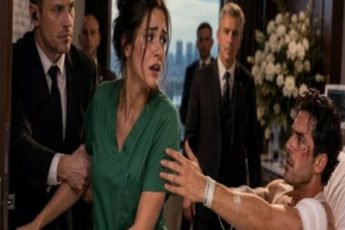
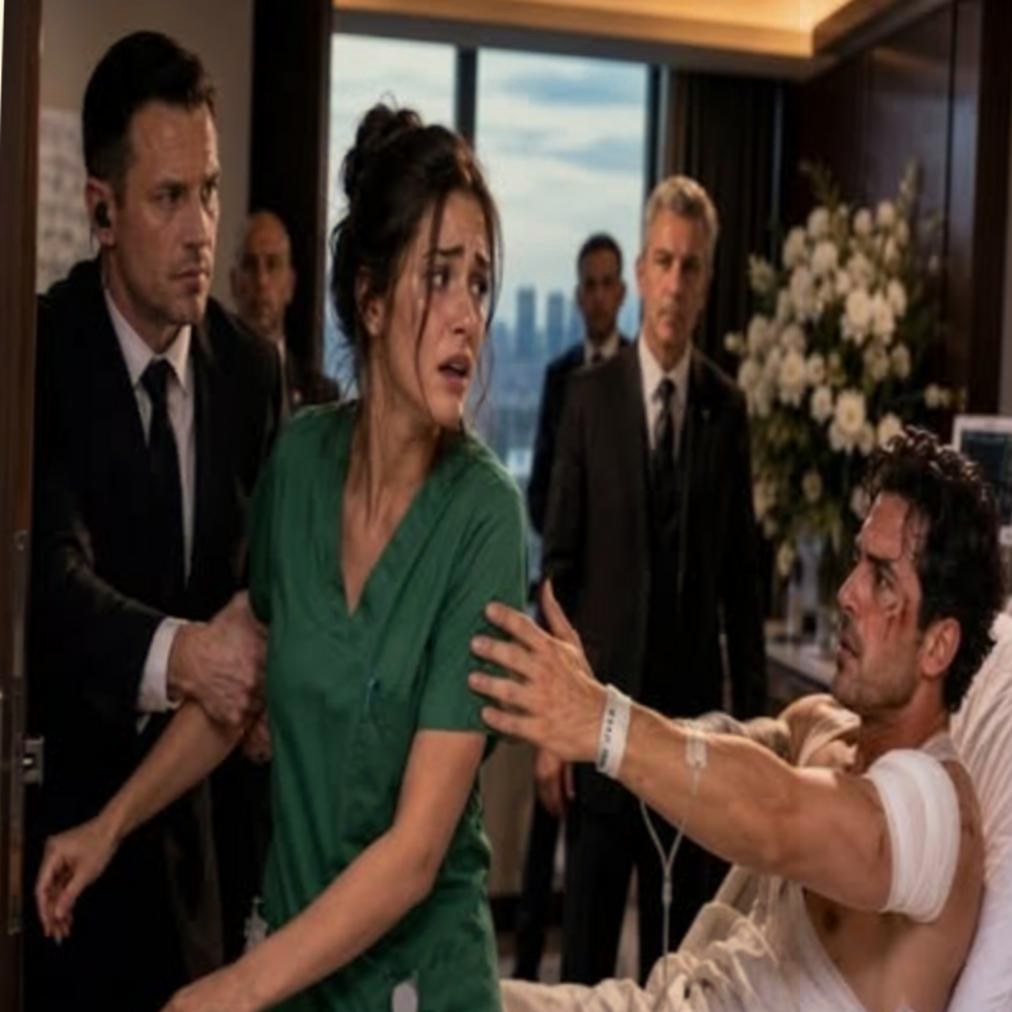
Hector reached toward the gun.

But this time the door opened by itself. The hospital’s chief doctor entered, and behind him stood two real investigators and a deputy prosecutor.
“Guns on the floor,” one of the investigators said.
Hector smiled.
“You have no idea whom you are touching.”
“We do,” the woman replied. “That is why we came prepared for so long.”
I handed the card to her.
“The recording is here. We also have the camera.”
The deputy prosecutor took the small device and looked at the screen.
Renata turned toward me.
“Where did you get this?”
“From your flowers.”
Her hand was trembling for the first time.
Mateo closed his eyes. He did not want to see how the woman beside whom he had stood for years was falling apart. But the truth left him no choice.
The investigator played the recording aloud.
Renata’s voice sounded in the room again:
“If the boy survives, Mateo will never obey me.”

Then Hector’s voice:
“Alma is a problem. She must be taken out of the hospital.”
The recording ended.
Renata leaned against the wall.
“It was only a conversation.”
“A conversation followed by an explosion,” I said.
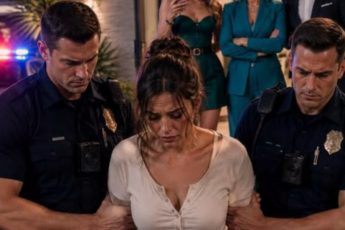
The deputy prosecutor placed handcuffs in front of her.
“Renata Alcaraz, you are under arrest on charges of attempted murder, planning a kidnapping, and destruction of evidence.”
Hector lost his voice for the first time.
Julian raised his hands himself.
“I will testify,” he said. “Everything.”
Mateo looked toward me.
“Emiliano is still with them.”
The investigator showed the phone. The number of the unknown call had already been identified. The signal was coming from the hospital’s old storage room.

We ran there.
Lidia was sitting on the floor, her hands tied, but she was alive. Emiliano stood beside her and pressed the obsidian cross to his chest.
When he saw me, he ran toward me.
“I knew you would come.”
I dropped to my knees and hugged him.
“I would always come.”
These words brought tears to Mateo’s eyes.
That same evening Renata, Hector, and Santiago were arrested. But the heaviest news was still ahead. Mateo’s head of security told the investigators that the route of the exploded car had not been changed by accident. The decision had been issued from Mateo’s own office, with his electronic signature.
Mateo looked at the recording.
“This is impossible.”
The prosecutor raised his head.
“If your signature was not stolen, someone much closer to you is still free.”

Mateo slowly looked at me.
Then a new message lit up on the hospital screen. It had been sent directly to his personal device:
“The first plan failed. Now we will leave the child without a mother.”
I took Emiliano’s hand.
For the first time, Mateo looked not at an enemy, but at his own past.
“Alma, you also need my protection.”
“No,” I answered. “I need the truth.”
That night the police sealed all the hospital exits, while Mateo ordered all the accounts of his company frozen. His partners called one another, because for the first time no one could make decisions in his place.
Santiago told everything during questioning. His brother had changed the car’s route; he had been stealing money from Mateo’s company for months. Renata found out and forced him through blackmail. His name had been neither in the recording nor at the attack site, but the transfers revealed the entire chain.
Mateo’s lawyer withdrew from the case the next morning.
“I can no longer defend a lie,” he told him.

Mateo sat for a long time in the hospital’s empty office. On the desk stood only the transparent glass vase left from my wet bouquet of roses. One crushed petal floated in the water.
“I thought power meant that I would protect everyone,” he said.
“Sometimes power only allows you not to notice for a long time who is betraying you.”
Several days later he listened to his own recording. It was a video taken from a security camera, in which, a few minutes before the explosion, he himself said:
“No one must find out about the child. Not yet.”
When he listened to his voice from outside, he buried his head in his hands.
“I hid him myself.”
“You hid him because you were afraid,” I said.
“No. Because I thought my world would protect the child.”
The room prepared for Emiliano in his old house was empty. Only a small wooden horse lay on the bed. On the wall hung a photograph of Mateo, Renata, and another woman—Sarah, Emiliano’s mother, who had died of illness two years earlier.

Emiliano looked at the photograph.
“Dad, did Mom know that we were afraid of you?”
Mateo answered after a long time.
“She knew.”
“Then why didn’t you come?”
Mateo lowered his eyes.
“I thought that when the danger disappeared, everything would be fixed.”
The child took his hand.
“When the danger disappeared, I was still sad.”
These words defeated Mateo more than all the investigations.
Three months later I no longer worked at the hospital. Not because Renata had managed to destroy me. On the contrary, the investigators’ testimony confirmed my dismissal, but I could no longer return to those corridors.
I began working at a small children’s clinic on the other side of the city. At six in the morning I opened the windows, checked the medicines, and taught new nurses how to protect patient information even when the most powerful person was breaking down the door.
Emiliano started school. During the first week he held my hand every morning. Then, little by little, he let go.

One day he brought me a drawing. Three people stood in the rain on it, and above them a small black camera was drawn.
“Who is this?” I asked.
“The one who sees everything,” he answered.
“And these three?”
“Us. We are not hiding anymore.”
Mateo was giving testimony in the case. He temporarily transferred management of his company to an independent board and began financing safe housing for children. I did not accept money from him.
Once I told him:
“You can help Emiliano, but do not buy my life.”
“I could never buy your life,” he replied. “I only want to earn a place in it.”
Six months later, Renata sent me a letter. It was short.
“Mateo betrayed you when he hid everything from you. You will betray him too. You can still make a deal with me.”
I put the letter in the trash.

That same evening Mateo called me.
“Alma, I want to take Emiliano. If you allow me, he will stay with me on Sundays.”
Through the window I saw the first snowflakes. Snow was rare in Guadalajara, but that night the sky was falling white.
“You can,” I told him. “But not with threats, not with protection, and not at the price of my debt. As a father.”
He was silent for a long time.
“I understand.”
This time I truly understood that for him this word was not an order, but responsibility.
In the morning I arrived at the clinic. Emiliano’s drawing was waiting for me on the desk. Beside it lay the small obsidian cross that he had not let go of on the night of the explosion.
I placed a glass vase by the window. I put a white rose inside, but this time there was no camera hidden in the water, no guards stood at the door, and no woman was waiting for me to take my life away.
Morning light fell on the rose petal.
I had nothing left to hide.
Missed the beginning?
Related posts:
 At a Family Dinner They Put an Empty Plate in Front of Me, but as Soon as I Took My Bag, My Husband’s Face Turned Strangely Pale
 They Were About to Throw Me Out of the Hospital for a Friend When the Wounded Billionaire Said My Name and His Fiancée Lost Her Color
 On the third day after my C-section, three children were left at my door, but after the call my husband’s face turned pale
 Two days before my brother’s wedding, my mother forbade me from coming, and when she read my reply, April’s smile disappeared
 My fiancée failed to turn off her phone while humiliating the maid, and the next morning my father’s face turned strangely pale
 Fourteen years later, my son invited his biological father to the final, but Daniel lost color upon hearing his first words