

Part 4
“Valera has also taken out a loan in your name, and they are demanding payment by tomorrow…”
At that exact moment, Valera raised his head.
— “Marina, this matter should stay within the family.”
— “It did stay within the family,” she replied. “Which is precisely why it is now a legal matter.”
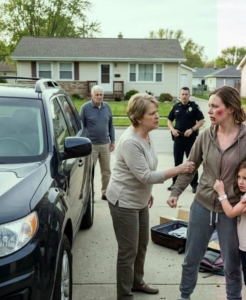
The police officers pulled up at the gate. One of them demanded Valera’s identification, while the second stepped aside with me to take down my official statement.
Valera was dialing frantically on his phone.
First, he called Sergi.
— “Serga, tell them it was just a joke. Tell them Galia misunderstood everything.”
Sergi’s response was loud enough that we could hear several words:
— “I wasn’t with you at all that day. Don’t call me again.”
Valera slowly lowered his phone.
Then he called his brother.
— “Misha, I need your car. I have to get out of here.”
After listening to the reply, the color drained from his face.
— “Are you just going to abandon me like this?”
He was silent for a few seconds.
— “Fine. Fine, I get it.”
Marina spoke with the bank representative. It turned out that my signature was written on Valera’s loan application, but it wasn’t mine. That was immediately obvious. I always signed “Galia” with letters slanting to the left, whereas on the document, the lettering was upright and harsh.
— “I didn’t sign this,” I said.
— “We know,” Marina replied. “We have already submitted your handwriting samples to the bank.”
Valera shouted:
— “You gave me permission yourself!”
— “When?”
— “When you married me.”
His words hung heavy in the air.
Nino turned on her phone once more. This time, everyone went silent and listened to what Valera had said in his own room just a few days ago:
“If the bank asks whether Galia knew, I’ll say she asked me to do it. Who will they believe—her or me?”
The recording ended.
Valera leaned against the fence. That was the moment he heard his own voice from the outside, as if listening to a stranger. He saw the terrified face of the buyer, the stern gaze of the police officer, and Nino’s clenched jaw. For the first time, he realized that all his life he had forced his words onto others, but now he could no longer escape them himself.
— “I didn’t say it like that,” he whispered.
— “You said it,” I replied.
— “Galia, let me into the house.”
— “This is my house too.”
That evening, Valera was taken to the police station for questioning. He wasn’t arrested immediately, but before getting into the car, he looked back at me as if it were my duty to save him.
I didn’t follow him.
When I entered the house, I saw his room without him for the very first time. A single pillow rested on the bed, the wardrobe door stood open, and only two empty hangers remained on the rack. A small plastic cap from a fishing rod lay on the floor. I picked it up, turned it over in my hand, and set it down.
What hurt most of all was the yellow folder. It lay on the kitchen table with its corner folded over—the object that had changed my life.
Nino decided to stay with me that night.
— “Mom, are you afraid?”
I looked out the window at the darkened yard.
— “No.”
— “Really?”
— “For the first time, no.”
Three weeks later, the bank canceled the loan under my name after forensic analysis confirmed the forged signature. The house purchase agreement was declared void since my consent for the property conversion did not exist. A criminal case was opened against Valera, and one day his lawyer called me himself.
— “Mrs. Galina, perhaps we could try to reach a settlement?”
— “On what terms?”
— “You withdraw your claims, and Mr. Valeri will only take his necessary belongings from the house.”
— “He already took his necessary belongings.”
— “He has nowhere to live.”
— “That is unfortunate.”
— “You lived together for thirty years.”
— “That is precisely why I know what I am saying.”
The lawyer was silent for a few seconds.
— “Are you truly not going to help him?”
— “No. Now, for the first time, he will have to carry the weight of his own life.”
The following week, we installed a new gate in front of the house. Not tall, not heavy. It was a simple wooden door with a small glass window. Only Nino and I held the keys.
I started working part-time at the town library. In the morning, I took the bus with a small thermos in my bag, no longer worrying on the way about what Valera would find to criticize when I returned home.
The sewing machine still stood on the veranda. Now, when I worked at it, the television wasn’t shouting, heavy footsteps weren’t echoing, and no one asked why I was wasting time on “useless rags.”
Nino asked me once:
— “What are you sewing?”
— “Curtains.”
— “For a new house?”
— “No. For the old house that is now mine.”
Four months later, the first snow fell. I walked out into the yard in the morning and saw that my footprints were alone on the white blanket.
That day, Valera sent me a message:
“Galo, let’s start everything over. I’ve changed. I can’t survive without you.”
I stared at the screen for a long time. In the past, I would have responded to such words immediately. I would have called him, apologized, and considered his loneliness my own fault.
Now, I typed back just one sentence:
“I wish you change, but I will no longer live your life.”
Then I laid the phone down.
In the evening, I sat at my mother’s sewing machine. Nino brought me a drawing from a little girl returning from school—a house, two windows, smoke rising from the chimney, and an open gate. In the corner of the drawing, she had asked me to write: “Mom’s Yard.”
I placed the paper on the wooden surface of the machine and set my foot on the pedal. The needle began its steady tapping once more, but this time I no longer needed that sound to hide behind.
It was the sound of freedom.
And outside, by the open gate, the snow silently covered the tracks left behind.
I was no longer waiting for anyone.
Missed the beginning?
Related posts:
 He locked me in at the dacha, and I spread my things out on the fence, but when he got out of the car, he suddenly fell silent.
 My husband asked me to donate an organ to his ex-mistress, but the doctor turned pale after my calm response.
 When my husband’s family broke my leg and my husband told me to submit, the smile vanished from his face three days later.
 My parents wanted to throw my belongings out into the yard and keep my child, but the smile vanished from my father’s face the moment I gave my answer.
 They didn’t invite me to their country house, but after my calm reply, the daughter’s smile suddenly vanished.
 I was barred from my daughter’s vineyard wedding, and when I quietly canceled everything, her fiancé stopped smiling