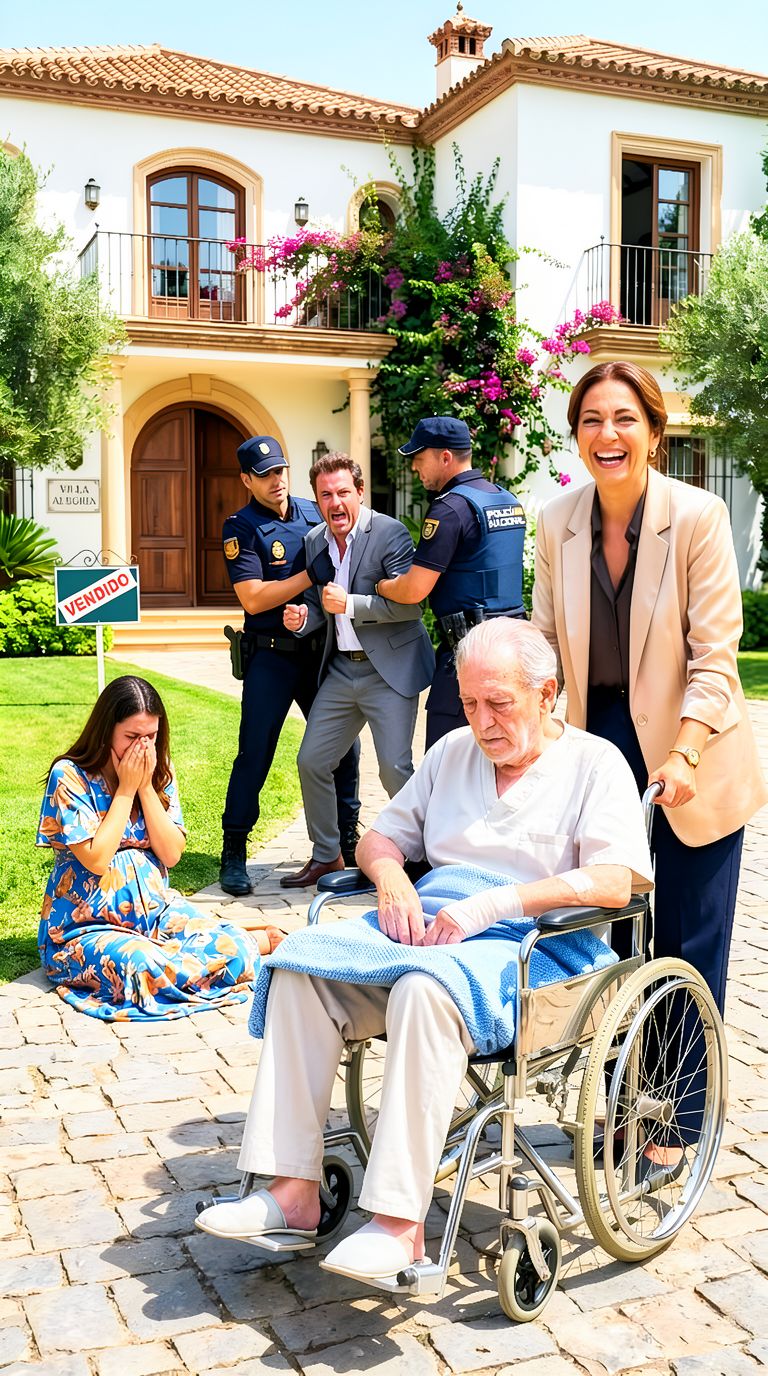
The day I wrote “daughter” on my former father-in-law’s hospital form, his own son had just declared him too old to save.
I was standing in the nursing home’s dim admissions office at 9:40 on a rainy Tuesday morning, still holding the audit folder that had slipped from my hands. Dust clung to its gray cover. Behind me, Richard lay beneath a thin blanket, his face turned toward the wall. The man who had once filled every room with his booming laugh now looked small enough to disappear.
“Claire,” he whispered, “you should never have found me here.”
I had known Richard for fifteen years. He had welcomed me when my marriage to Ethan collapsed, defended me when Ethan moved into a glass villa with Marion, and once told his son, “You are destroying this family.” Then Richard vanished. Ethan stopped answering my calls. Nobody told me his father had been placed in a nursing home with his pension mysteriously reduced.
The smell of disinfectant could not hide the damp in the walls. Richard’s slippers were split at the toes, and the green stone from his wedding ring was gone. I noticed that detail before I noticed the bruises around his wrist.
“What happened to your ring?” I asked.
Richard pulled the blanket higher. “Some things are easier to lose than to explain.”
Three weeks later, at 6:15 in the evening, he fell in the corridor. I heard the crash while arguing with the administrator beside a flickering vending machine. At the clinic, a surgeon told me Richard had a serious fracture and needed immediate surgery. The receptionist slid a payment form across the counter.
“We need a guarantee tonight,” she said. “Otherwise, we cannot schedule the operation.”
I called Ethan from a plastic chair beneath a buzzing fluorescent light.
“Your father needs surgery. They require a guarantee immediately.”
For several seconds, I heard only traffic through his car window.
“He is old, Claire,” Ethan finally said. “Sometimes you have to accept when things are ending.”
My fingers tightened around the phone. “He is your father.”
“And you are his former daughter-in-law. Do not make this my problem.”
I emptied my savings that night. I signed every page. On the line asking for my relationship to the patient, I wrote one word: daughter.
Richard survived. In early November, I brought him to my old carpentry workshop, a narrow building behind my house. At 7:30 the next morning, sunlight touched the freshly painted walls, the iron stove, and the workbench I had scrubbed until my hands hurt. I placed his old toolbox beside the armchair.
He ran one trembling finger over the scarred wood.
“I made Ethan’s cradle here,” he said. “He slept in it before he knew how to say my name.”
White headlights suddenly swept across the windows. A vehicle stopped outside. Richard’s face drained of color.
“Claire,” he murmured, clutching a small brass key, “whatever he says, do not give him the black box.”
The door handle began to turn. I reached toward the sealed gray folder as a familiar voice called from the porch, “Father? I know you are in there…”
PART 2
The door flew open at 7:32, and Ethan stepped inside wearing an expensive coat that smelled of new leather. Marion followed him, her polished boots leaving wet marks on the wooden floor. She glanced around the workshop as if she were inspecting a property already sold.
“You hid him here?” Ethan demanded.
Richard pushed himself upright in the armchair. The brass key trembled against his knuckles.
“I am not hidden,” he said. “I am somewhere people wanted me.”
Ethan gave a short laugh. “This building belongs to the family. Everything in it belongs to me.”
I moved between him and the table. “Leave.”
His eyes settled on me. “You are not his daughter, Claire.”
“Maybe not on your family tree. But I paid for his operation while you refused to answer the phone.”
Marion folded her arms. “You always loved making scenes.”
“No,” I said. “I love keeping receipts.”
For one second, Ethan’s expression cracked. Then he noticed the gray folder. At 7:35, the stove popped, sending a bright spark through the grate, and he took a step toward the table.
“Give me that.”
“Why?”
“Because you do not understand what you are holding.”
“Then explain it.”
He said nothing. Marion’s gaze drifted toward a stack of firewood beside the stove. A corner of a black metal box showed behind it. She crossed the room and bent down.
“Do not touch that!” Richard struck the floor with his cane. The sound echoed against the rafters.
Ethan spun around. “Father, you can barely remember your own medication.”
Richard’s mouth tightened. “I remember the night you brought those papers.”
The room went still. Rain tapped the window like impatient fingers.
Richard told me everything he had hidden since the divorce. Ethan had asked him to sign powers of attorney, claiming they would simplify medical bills and banking. Soon afterward, Richard’s house was sold. His savings disappeared. Even his prescriptions became expenses the nursing home said it could no longer cover.
“I believed he would help me,” Richard said, staring at the worn toolbox. “He was my son.”
I opened the folder at 7:42. Inside were bank statements, property contracts, and copies of signatures that looked like Richard’s. But the dates were wrong. On two of them, Richard had been hospitalized. On another, he had been unconscious after a stroke.
Ethan’s hand closed over the back of a chair. “You stole those documents.”
“I copied them,” I answered. “There is a difference.”
“You will regret this.”
“The clock is recording you,” I said.
His eyes snapped toward the old wooden clock on the wall. For three days, a tiny recorder had captured every conversation with Richard’s permission. Ethan stared at it as if it had grown teeth.
Richard reached behind the firewood and lifted the black box. “Your father did not only steal my money,” he told Ethan. “He stole something far more important.”
Ethan went pale. Richard placed the brass key in my palm. Beneath a child’s shirt and a loose button tied with blue thread lay a sealed notarial envelope bearing my name. I lifted it, while Ethan whispered, “Claire, if you read that letter, you will learn why I really abandoned you…”
PART 3
I stood beneath the ticking clock with the envelope between my fingers. The paper had yellowed at the edges, and red wax sealed it with the name of Richard’s notary. Ethan stepped closer, his leather sleeve brushing the chair.
“Do not open it,” he said. “You have no idea what you will destroy.”
I looked at Richard. His eyes were frightened, but he nodded once.
“No,” I told Ethan. “You already destroyed enough.”
At 7:46, I broke the seal.
The letter did not contain an inheritance or a secret marriage. It explained that Richard had discovered years earlier that Ethan was siphoning money from the family carpentry business. He had wanted to protect his son, so he gave Ethan one chance to repay what he had taken. Ethan answered by creating false powers of attorney, selling Richard’s home, and transferring the money into an account he shared with Marion.
Richard had kept everything. The original bank statements. Copies of the property deeds. The business ledger with every missing payment written in his narrow handwriting. Even a recorded confession Ethan had made after forcing him to sign documents in the nursing home.
I touched the loose button tied with blue thread.
“Where did that come from?” Ethan asked.
“Your father found it on the night you tried to force his signature,” I said. “It came from your old coat.”
Marion’s face hardened. “This is absurd. You cannot prove any of it.”
I pulled a second device from my pocket. “The bank already verified the transfers. The notary confirmed the signatures were forged. And the recording has been copied.”
Ethan stared at me. “You planned this?”
“I planned to save Richard. The truth planned the rest.”
That was when the front door opened again. My attorney, Helen, entered with two police officers and a court order folded inside a blue envelope. The officers’ boots left muddy prints beside Marion’s polished ones.
Ethan recoiled. “Claire, you cannot do this to me.”
“I am not doing this to you,” I said. “I am stopping you from doing it to anyone else.”
The officers read the charges: abuse of a vulnerable adult, forgery, and financial theft. Marion tried to run through the side door, but one officer caught her beside the woodpile. Ethan stood motionless until the handcuffs closed around his wrists.
Richard watched without triumph. Only exhaustion moved across his face.
Months later, his house and much of his money were restored. He refused to live there alone, so he stayed in my workshop beside the stove and the scarred workbench where he had built Ethan’s cradle.
One quiet evening, he handed me another envelope. Inside was a legal adoption document, prepared with Helen and the notary.
“You never needed paper to be my daughter,” Richard said, his thumb resting over the green stone ring he had finally recovered. “But I needed a way to say it officially.”
I pressed my forehead to his shoulder. The old button with the blue thread rested in the stove, glowing once before it disappeared, and Richard held my hand like a father who had finally found his child.
Related posts:
 My husband pushed me from a frozen cliff, then complained at my funeral that I had taken too long to die—and someone went pale
 I was ordered to feed the city’s most feared man, but when he tasted my burnt garlic, his expression suddenly changed
 My Mother Swore Under Oath That I Had Never Served in the Army, While My Brother Tried to Steal Our Father’s Defense Company—Then a Federal Marshal Walked Into Court With a Sealed Gray Case
 My Ex Called Me a Liar, Gave My Best Friend’s Baby His Name, and Raised Him as His Son—Until One Terrifying Hospital Night Revealed Whose Child He Had Really Abandoned
 My Three-Year-Old Daughter Asked New York’s Most Feared Man to Hold Her Hand, and the Sealed Medical File He Had Hidden for Years Exposed the Truth About Why He Stayed Away
 I Died Giving Birth to Triplets While My Husband Signed Emergency Divorce Papers Outside the Intensive Care Unit—Then My Father’s Sealed Letter Exposed the Trap He Had Built for Him