Here is the complete English translation of Part 4, concluding the narrative:
Part 4
Theodore’s phone was ringing again.
Adrian picked it up.
— “Tell me you found the file.”
A sharp voice sounded through the receiver.
— “Mr. Vale, it’s not just the folder that has vanished from the foundation archives. The security logs have been wiped as well.”
Adrian closed his eyes tightly.
— “Who had access?”
— “Only three people: you, Ms. Winthrop, and the foundation’s chief legal counsel.”
Celeste flared up instantly.
— “This is absurd! I wasn’t even near the place before the party started.”
Theodore answered calmly:
— “Ms. Winthrop, access was granted remotely.”
Celeste looked over at Adrian.
— “Do you truly believe I would do such a thing?”
— “I don’t know what I believe anymore,” he said softly.
His attorney, who had been standing silently in the corner of the hall all evening, stepped forward.
— “Mr. Vale, I strongly advise you to end this conversation right now. Any emotional statements made here will be used against you in the future.”
Adrian slowly unbuckled his watch and laid it flat on the table.
— “Are you my attorney, or are you the manager of my silence?”
— “I am attempting to protect your interests.”
— “Then for once in your life, protect the truth.”
The attorney shook his head.
— “If you acknowledge this woman publicly, the foundation board will turn against you. The prenuptial agreement may be voided. Stock values will plummet.”
— “And if I don’t acknowledge her?”
The attorney glanced toward me.
— “Then everything can remain under control.”
Listening to those words, I realized the kind of life Adrian had lived: he had been convinced his entire life that human pain was merely another inconvenience that could be resolved with money.
— “You may leave,” Adrian told him.
— “Mr. Vale…”
— “Leave.”
The attorney gathered his briefcase and walked out of the hall.
Then Theodore switched on the small audio recorder.
First came static, followed by the voice of a young man.
Adrian’s voice.
“If Father finds out about this, he’ll strip Rose of everything. I will take her away as soon as I finalize the agreement with the foundation.”
Then Rose’s voice filled the air—young, exhausted, yet filled with warmth.
“Adrian, I don’t want money from you. Just tell me once that you haven’t abandoned me.”
A long silence lingered on the recording.
Then Adrian spoke:
“Wait for me. I swear, I will return to you.”
He heard those words for the first time as we all did—from the outside.
His hand gripped the edge of the table.
— “I said that,” he whispered faintly.
— “Yes,” Theodore replied.
The recording continued.
A third voice emerged—stern, commanding, belonging to an older man.
“If I see my son near that girl again, he will no longer be my heir. Pay off the girl’s mother and make her vanish from this city.”
It was the voice of Adrian’s father.
Then came the heavy thud of a door slamming shut, followed by Rose’s quiet sobbing.
Adrian collapsed into a chair.
Celeste stood backed against the wall. The anger had completely vanished from her face, leaving only raw fear behind.
— “I knew about the letter,” she admitted quietly.
Adrian raised his head sharply.
— “What did you say?”
— “I knew Rose had sent you a letter. Your father told me that woman had left and was destroying your life. I didn’t know she had a child.”
— “But you were the one who took the file.”
Celeste pressed her lips together.
— “I only wanted to ensure our wedding wasn’t canceled.”
— “Our wedding was already canceled,” Adrian said. “We just hadn’t made it to the altar yet.”
I didn’t let go of Lucia’s hand for the rest of that night.
Three days later, we visited Rose’s old studio.
The building stood on a historic street in Boston. The paint was peeling off the stair railings, and raindrops trickled down the windowpanes. Inside, the small wooden piano still rested in the corner, with the white ceramic bird my mother always kept on top still sitting in its place.
We found a dusty cabinet in the corner of the room. Tucked into its bottom drawer among sheets of old sheet music lay a thin paper folder.
Inside rested a letter written in my mother’s hand.
Not addressed to Adrian.
Addressed to me.
“Marina, if you are reading this, you likely already know that we never forgot your father. I stopped waiting for his return not because I ceased to love him, but because I needed far more for you than endless waiting. You deserved to grow up in a home where love doesn’t stand outside the door waiting for permission.”
I pressed the paper against my chest.
Lucia stood beside me.
— “Did Grandma write this for you?”
— “Yes, sweetie.”
— “Then is she here?”
I looked around the room. An old mirror hung by the window, carrying a thin trace of dust that looked almost like my mother’s fingerprint.
— “Sometimes,” I told her, “people remain wherever we learned something from them.”
Adrian stood at the doorway, holding the small silver star that had come unstitched from Lucia’s shoe.
— “Did you find that on the floor?” I asked.
— “Yes. May I keep it?”
Lucia looked up at me. I nodded gently.
Adrian placed the star inside a small wooden box.
— “I cannot give you back those lost years,” he said to me.
— “No, you can’t.”
— “But I want to do what is right with what remains.”
— “Then don’t attempt to save me. Simply stop hiding the truth from me.”
He lowered his head in silence.
Over the following weeks, everything shifted rapidly.
Theodore turned the documents over to the authorities. The foundation board severed its agreement with Celeste. Her legal counsel withdrew from the case after records proved the order to delete the archive file originated from her personal account. Celeste faced legal proceedings, though I took no satisfaction in attending any hearings. Her downfall was not my victory.
My victory was that, for the very first time, Lucia knew the origin of our music.
Two months later, we reopened my mother’s studio.
We cleaned the mirrors, painted the walls a warm yellow, restored the old piano, and hung a small sign by the entrance: “Rose’s Room.”
In the mornings, I taught children how to dance; in the afternoons, I met Lucia after school; and in the evenings, I brewed tea in the small pot with the wooden bead my mother had carved attached to its handle.
The season’s first snow arrived in December.
Lucia stood by the window and showed me a new drawing. Four figures were drawn on the paper: herself, me, Rose, and Adrian. All held hands, with a bright yellow sun drawn above them.
— “Why isn’t your father standing right next to us?” I asked gently.
Lucia shrugged her shoulders.
— “Because he still has to learn how to come to us.”
It was the wisest thing I heard all day.
Adrian visited the studio often, but he always knocked before entering. He never walked in uninvited. He brought books and colored pencils for Lucia, while offering me no promises he couldn’t keep.
One evening, he told me:
— “My therapist told me that guilt is not the same as responsibility.”
— “That’s true.”
— “Responsibility means choosing to act differently every single day.”
— “That takes time.”
— “I know.”
For the first time while speaking with him, I no longer felt as though I was fixing my mother’s lost life. I was simply standing grounded in my own.
Six months later, I received a brief letter from Celeste:
“Marina, I now understand how much that family hid from both of us. Your resentment is entirely justified. If you ever wish to speak, I will be ready.”
I stared at the paper for a long moment.
Then I folded it and tucked it away—not discarding it, but keeping it as proof that the past no longer held power over me.
That same evening, Adrian called.
— “Celeste left,” he said.
— “I know.”
— “I am not asking you to come back to me.”
— “Good.”
— “I just want you to know that if you ever need me, I will be here.”
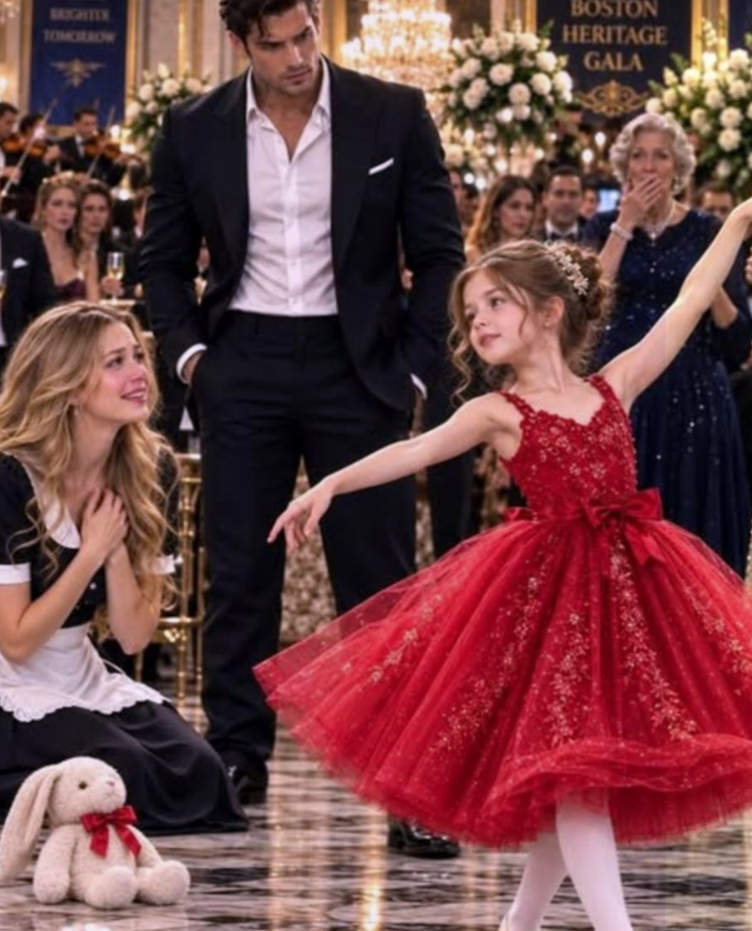
I stood by the window as snow fell softly outside. In the studio hall, Lucia danced barefoot while “Moonlight Staircase” played softly from the piano.
— “Adrian,” I said, “I no longer need you to be here. I want you to choose to be here yourself.”
A long silence settled over the line.
— “Then I will come tomorrow,” he said softly. “And I will knock.”
— “The door will be open.”
I disconnected the call.
Lucia finished her final movement and ran toward me, a new silver star freshly stitched onto her shoe.
I knelt in front of her and touched the star.
That evening, I realized for the very first time that my mother’s song was no longer merely about lost people.
It was about returning home.
Lucia extended her hand to me.
I stood up.
And together, we began to dance.
Missed the beginning?
Related posts:
 I tried to protect my six-year-old daughter when the billionaire’s fiancée led her onto the stage, and the laughter in the hall suddenly stopped.
 At the engagement, the groom referred to his first love as “wife” just as they were asked to smile, while his mother’s smile suddenly vanished.
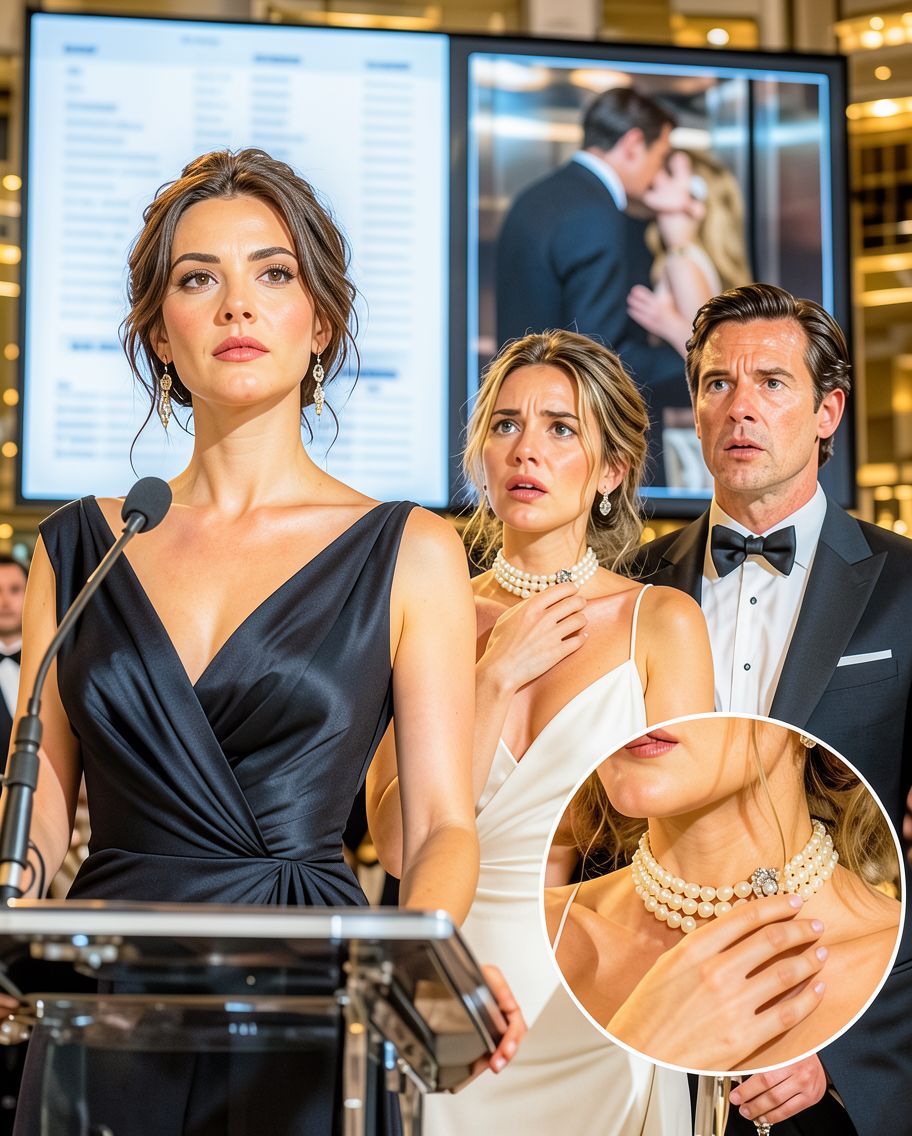 My husband let his mistress steal my speech and wear my mother’s pearls, but the hospital screen made him stop smiling
 My father kicked me out of the house at the Thanksgiving dinner, but when I placed the car keys on the table, the smile vanished from his face.
 A fourteen-year-old waiter read a single sentence from a rich man’s diary, and the foreigner sitting in the room instantly turned pale.
 My parents wanted to throw my belongings out into the yard and keep my child, but the smile vanished from my father’s face the moment I gave my answer.