Part 4
— “…What is hidden there is no longer my property,” Ruth concluded softly. “However, the truth is still inside that house.”
The police entered the bank six minutes later.
At first, Daniel attempted to maintain a calm, collected front. He insisted to one of the officers that it was merely an internal family misunderstanding and accused me of manipulating my grandmother’s fragile state for personal gain.
I gave no response.
Attorney Ilya Kavtaradze stepped into the room holding an official temporary protective order issued by the court. The document dictated that all transactions, sales, and transfers regarding Ruth’s assets and bank accounts were frozen with immediate effect.
My mother dialed my number from the hallway.
— “Nino, please, don’t break our family apart.”
— “You broke it the day you dumped Grandmother in that lobby.”
— “We were simply trying to help her.”
— “Then why did you need to forge her signature?”
Silence stretched across the line.
— “Your father is out of his mind,” she whispered eventually. “You know the pressure he was under.”
— “His actions were his own choice.”
For the first time in my life, I hung up without feeling a shred of guilt.
Daniel was not placed in handcuffs that evening, as investigators required his official statement and the seizure of bank records first. However, he was barred from leaving the premises.
He paced nervously back and forth inside the small room.
— “Nino, that recording was obtained unlawfully.”
— “Grandmother recorded a conversation inside her own home.”
— “I am your father.”
— “Which is precisely why it breaks my heart that you were the one who did this.”
He was left without a reply.
The following morning, Ruth, Ilya, and I drove back to my grandmother’s house. Police tape was already wrapped around the front gate. Standing by the driveway was the potential buyer, a middle-aged man clutching construction blueprints under his arm.
— “I was told the contract was ready for signing,” he stammered.
— “You were deceived,” Ilya informed him firmly. “The transaction is void.”
Inside, the house remained frozen in childhood memories, though a strange, unfamiliar scent hung in the air. The photo frames along the hallway walls had all been taken down. Only a single frame remained in the corner of the living room: my grandfather standing beside a young Ruth, holding a small wooden music box in his hands.
In my father’s study, the desk drawers were left open. Inside, we uncovered records of Grandmother’s pension withdrawals, several blank checks, and a folder bearing my name.
Inside that folder were letters.
Daniel had written to my mother, stating that I was asking too many questions, poking around where I shouldn’t, and that my access to Ruth needed to be restricted.
One line read: “If Nino stays close to Ruth, everything will fall apart. We transfer her to the nursing home first, then settle the rest.”
Ruth read the line and lowered her eyes.
— “I always believed he was simply weak,” she said quietly. “I had no idea he was planning it so meticulously.”
I wrapped my arm around her shoulders.
— “You were never weak, Grandmother.”
That same evening at the police station, investigators played Daniel’s own words back to him inside an interrogation room. I sat watching through the one-way glass.
On the recording, his voice echoed clearly:
“If you don’t sign, I’ll dump you in a place where nobody will listen to you.”
Daniel snapped his head up.
— “I didn’t say that.”
The investigator rewound the tape.
His own voice repeated the sentence word for word:
“If you don’t sign, I’ll dump you in a place where nobody will listen to you.”
This time, Daniel lowered his eyes.
A person listens to themselves last of all.
The investigation confirmed that Daniel had been illegally siphoning funds from Grandmother’s account over several months. My mother was fully aware of the scheme and had signed as a witness on two forged documents. Criminal proceedings were officially initiated against both of them.
Grandmother’s house was placed under temporary protective custody. The buyer’s deposit was returned, and my parents were legally barred from stepping foot on the property.
A week later, I stepped into Ruth’s room.
The closet was almost bare. Resting on the bed was her old wooden music box. Its internal winding mechanism had snapped years ago, rendering it silent.
Grandmother rested her finger on the carved lid.
— “Your grandfather owned this. When he passed, I left it to your father. He later told me he couldn’t stand old things.”
— “Now it’s back with you.”
— “No,” Ruth told me. “Now it belongs with you.”
I picked up the box. A thin layer of dust remained on my fingers. In that moment, I realized an object isn’t valuable because of its price tag—it is precious because someone tried to strip it away from you.
Three weeks later, Ruth moved into my home in a quiet coastal town. We drank tea together every morning. She read the newspaper while I worked remotely, auditing financial fraud cases.
We established a new rhythm.
Fresh lavender sat on the windowsill.
Warm bread always waited in the kitchen.
Ruth’s medications were organized inside clear glass jars, each labeled carefully with its proper time.
During the first week, she woke up startled several times in the middle of the night.
— “Are they coming back?” she would ask.
— “No, Grandmother. No one comes in here unless we invite them.”
— “Truly?”
— “Truly.”
Two months later, our neighbor’s young grandson, Luka, brought Grandmother a drawing. It depicted three figures standing in front of a house: me, Ruth, and Luka himself. A bright yellow sun rose above the roof, even though it was raining outside that day.
Ruth pinned the drawing onto the refrigerator door.
— “Now that is what a home looks like,” she smiled.
— “The roof is a bit crooked,” I teased.
— “What matters is that we lock the door from the inside.”
In the fourth month, a letter arrived from Daniel, forwarded by his defense attorney. In it, he wrote that he missed me, that my mother’s health was deteriorating, and that we could start everything over as a family.
At the bottom of the page, a single line was written: “I need your help.”
I held the letter in my hands for a long time.
I could have replied the way I used to—calming him down, making excuses, solving his problems for him.
Instead, I handed the letter back to the attorney.
I gave him only one message:
— “Tell him my door is no longer his lifeboat.”
The first winter snow fell that evening.
Ruth stood by the window watching the yard. I placed the small brass key onto the table—the one I had kept ever since we retrieved it from the bank box.
— “What does it open?” Ruth asked me.
— “I don’t know yet.”
— “Then keep it.”
— “Why?”
She smiled, her face entirely peaceful this time.
— “You shouldn’t go looking for every door until you are ready to never walk back through it.”
I opened the wooden music box and repaired the small broken spring inside. For the first time in years, a soft, melancholy melody began to play.
Outside, snow landed gently on the window ledge. The scent of lavender filled the warm room. Ruth closed her eyes, swaying lightly to the rhythm of the music.
I laid the brass key beside the music box.
This time, the door belonged to us.
Missed the beginning?
Related posts:
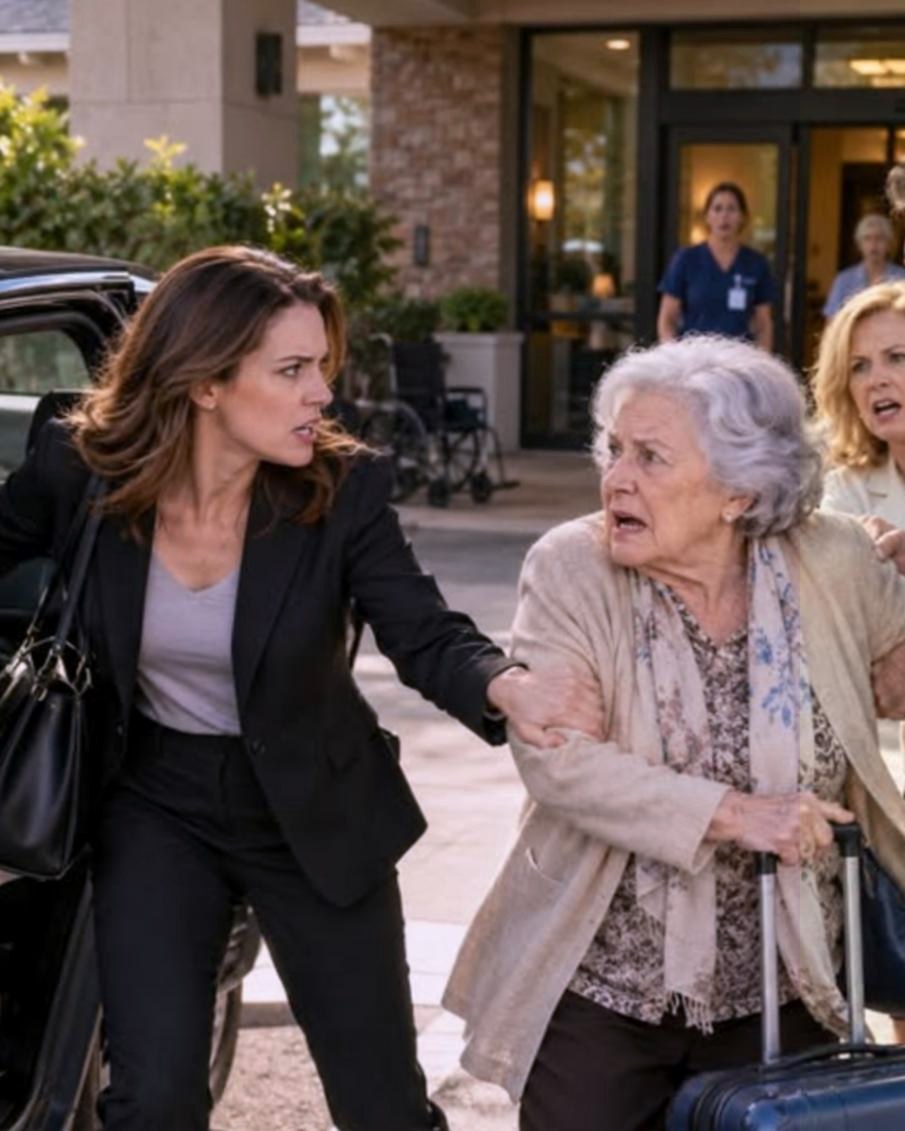
 They were taking Grandma to a restaurant, but three hours later, they left her at a nursing home—when I asked about it, my father stopped smiling for the first time.
 When the dangerous mobster’s son reached out towards me, his father looked at the photo and went pale.
 My parents wanted to throw my belongings out into the yard and keep my child, but the smile vanished from my father’s face the moment I gave my answer.
 The day before our fifth anniversary, I overheard my husband’s secret conversation, and when I entered the room, his smile vanished.
 No one could stop the mafia boss’s son until I approached him—and the color instantly drained from Rico’s face.
 I was humiliated for feeding an unwanted old man, but when a black car stopped outside, Beatriz suddenly stopped smiling