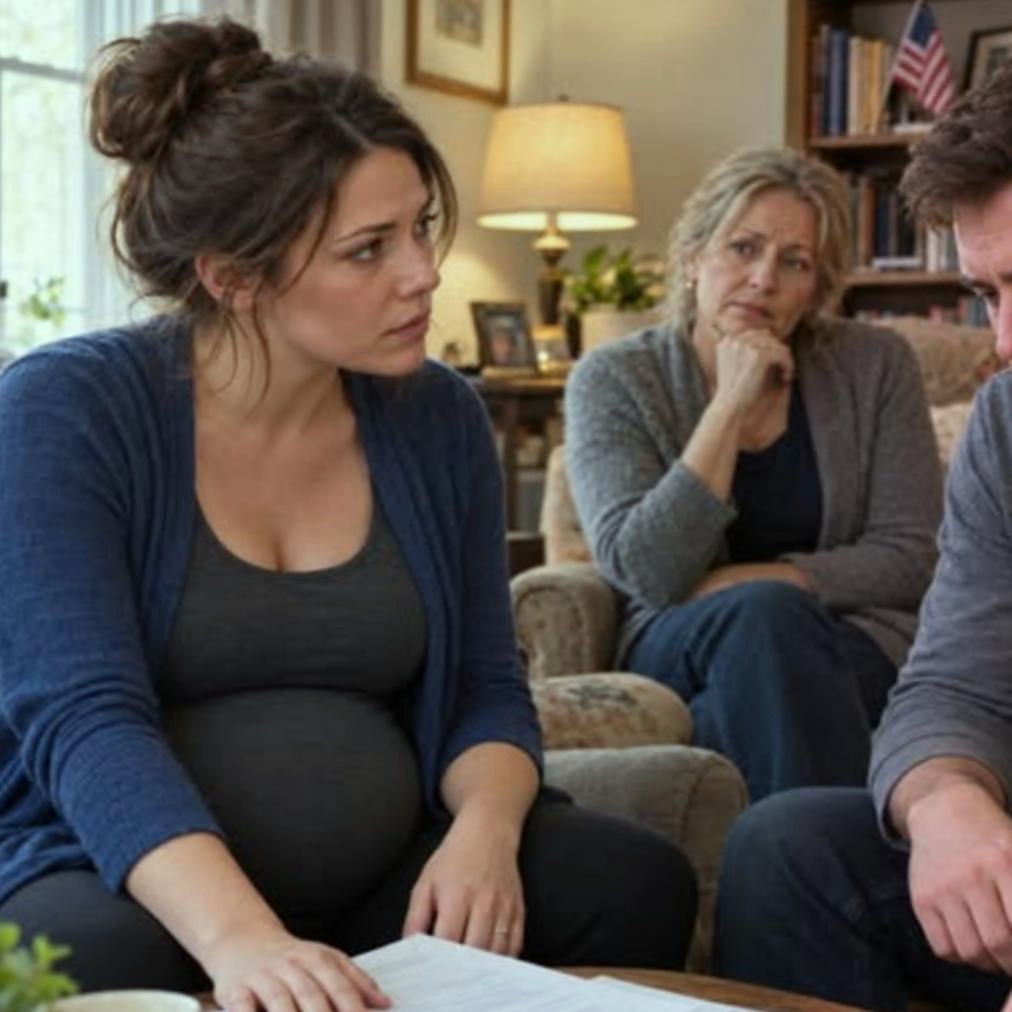

When my husband’s mother entered our apartment and told me that her son was not my servant, I was still wearing my hospital work uniform, and my legs hurt so much that I could barely stand. I was sixteen weeks pregnant. I had spent the entire shift on my feet, my back was burning, my shoes were tight, but when I returned home, instead of rest I found dishes piled up in the sink.
Lasha was sitting on the sofa, holding a game controller. Socks were scattered in front of him, and a bowl full of dried porridge stood by his feet.
“Please wash these dishes,” I told him and put my bag over my shoulder.
“I’ll wash them later.”
“You have been home for two hours. I have worked all day.”
He put down the controller, picked up his phone, and called his mother.
“Mom, she is shouting at me again,” he said in such a gentle voice as he had never used with me.
I could not forget one word. Again.
As if I were the constant problem, while he was the person who needed to be rescued. In the end, I washed the dishes myself. Not because he was right, but because the smell of the food bothered me and I did not want to wake up in the same dirt in the morning.
The next morning his mother came. Eka stood at the door in a cream-colored jacket, holding a heavy bag with a wooden handle. Her face had the expression of someone whose verdict had already been delivered.
“Lasha is not your servant,” she told me.
“Neither am I his servant.”
“Pregnancy does not give you the right to treat my son disrespectfully in his own home.”
“We both have to pay the rent. We both work. Why is my request disrespect?”

Lasha was standing by the refrigerator and looking at the floor. I expected him to say at least once, “Nino is right.” But he remained silent.
After Eka left, the door closed forcefully. I stood behind it and felt the baby’s calm movement inside me.
“Our quarrel does not mean inviting your mother,” I told him.
“She loves me and cares about me.”
“I am your wife.”
Lasha did not answer me.
In the following weeks Eka came often. She brought Lasha’s favorite food, reminded me that he needed rest, and never once asked how I was. At work, my colleague Salome realized that I had stopped joking. During the break she offered me her yogurt and quietly said:
“You are not exaggerating, Nino.”
That simple kindness nearly made me cry.
For the eighteen-week appointment I sent Lasha the address and time several times. He promised he would come. I was getting out of the car in the clinic parking lot when I received a message: his mother’s kitchen tap was leaking. He had to go there first.
He did not appear at the appointment.
In the evening he returned together with Eka.
“A water leak is a serious matter,” Eka told me.
“My doctor’s appointment was also a serious matter.”
“Lasha was helping his family.”
“I am also his family.”
This time Lasha only rattled the keys in his hand.
That night I lay alone in bed. I put my hand on my stomach and for the first time felt a small, light flutter. I wanted to wake Lasha, but I could not make a sound. It was as if I had to face even this happiness alone.

A week later, when I returned home, I found my cups on the top shelf, while the baby’s clothes smelled strongly of someone else’s detergent. Eka had a key to enter the house.
“Did you give your mother a key?”
“For emergencies.”
“Moving the cups—is that an emergency?”
“She is helping you. You should thank her.”
That evening I found two cash withdrawals from our joint account. Altogether, three hundred and fifty lari was missing.
“What did you take this money for?”
“I lent it to a friend from work.”
“Which friend?”
“Do not turn this into an interrogation.”
This time I folded the bank statement and put it in my work bag. A few days later I called a lawyer. First I bought a new lock. Salome came during the break to help install it. We struggled at the threshold until the screws went in correctly.
I left Lasha the new key. Eka did not get one.
The old lock was lying on the table when Lasha saw it. His face changed, and he immediately reached for his phone.
“If you call your mother now, you will prove what I am saying,” I told him.
That night he packed a bag and left the house.
In the morning, while looking for the lease agreement requested by the lawyer, I found a crumpled folder behind old tax papers. There was a finance company’s stamp on its cover. Inside were monthly payments of four hundred and eighty lari. The dates began before our wedding. The remaining amount was more than eight thousand lari.
I photographed every page.
Then I came across Lasha’s open correspondence on the phone. It contained detailed instructions for the arguments. But at one message I froze: “If she asks about the money, tell her you lent it to a friend.”
His mother’s answer was written below: “Do not worry, I will handle it.”

My mother came that same evening. She sat on the sofa, while I arranged the folder, statements, and printed messages on the table.
Lasha entered the house, saw my mother, and stopped on the threshold.
“Sit down,” I told him.
He took his phone into his hand.
“All of this is taken out of context.”
I placed the payment sheet in front of him.
“Then explain the context to me.”
His hand reached toward the phone. I reached for the last sheet in the folder, where, in his own handwriting, it said: “I am afraid Nino will find out.” Under it was Eka’s answer: “Do not be afraid, I will take care of this.”
Lasha’s hand stopped in the air. I pushed the sheet toward him and asked:
“What did you take care of, Eka?…”
Lasha looked first at my mother, then at the door, as if he should find a way out of the room there.
“It is an old debt,” he said.
“Whose debt?”
“Mine.”
“Then why was our joint account paying it?”
Eka tried to make a call. My mother calmly told her:
“No one is calling anyone now. First let us hear the truth.”
Lasha sank into the armchair. His fingers were trembling so much that the keys fell onto the floor.
“Mother needed money. They were going to lose the house.”
“And why did you tell me you had lent it to a friend?”
“I knew you would get angry.”
“Anger is not a reason for lying.”

Eka raised her head.
“My son was helping his family. You only see money.”
“I see money that we should be saving for the baby.”
At that moment the lawyer called me. I turned on the speaker.
“Nino, I received the contract,” he said. “But one thing in the document you sent is much more serious. Your name is listed as a co-borrower on this loan.”
The air disappeared from the room.
“I did not sign anything.”
“That is exactly why I ask you to come to me tomorrow morning. I found one more document, and after you see it, everything will change…”
I went to the lawyer’s office the next morning. Raindrops ran down the windows, and a red folder lay on the table. Salome came with me, my mother followed Lasha, and Eka entered at the last minute and leaned her umbrella in the corner.
The lawyer, Mr. Irakli, locked the door.
“I arranged this meeting for only one reason,” he said. “You must find out what happened in your name.”
He placed the first sheet on the table. It said that four years earlier, one month before our wedding, Lasha had taken twelve thousand lari from a finance company. His name was listed as the borrower, and mine as the co-borrower.
“I had not even seen the application then,” I said.
“I know,” the lawyer answered. “That is why I checked the signature.”
He took two sheets from the folder. One had my real signature, while the other seemed to be a rough copy of it.
“This is not my signature.”
Lasha lowered his head.
“Mother signed instead of you,” he said.
Eka immediately jumped up.
“Do not talk nonsense!”
“You told me Nino would become my wife anyway and there would be no problem,” Lasha looked at his mother for the first time. “You told me I would take care of the payments.”
I watched his face. At that moment I understood for the first time that his silence had not only been weakness. It had been a choice.
“Where did the money go?” I asked.
The lawyer turned over the third sheet. It was a list of transfers. Part of the twelve thousand had gone to pay Eka’s mortgage, and part to online gambling. My hands went cold.
“That is impossible,” my mother whispered.
“It is possible,” Irakli said. “The bank confirmed the dates and recipients of the transfers.”
Eka slammed her bag onto the table.
“You destroyed my son because of a debt!”
“The two of you took a debt in my name,” I said. “And I was paying your house rent, food, and this loan at the same time.”
Lasha began to cry.
“I wanted to fix everything.”
“For four years you could not tell me one truth.”
The lawyer took out the last sheet.
“This is not everything yet. The bank called me this morning. They received a request to encumber the apartment. Someone submitted a document as if you agreed for this apartment to become security for the loan.”
Lasha’s face went pale in one second.
“I did not do this.”
Eka stood silently.
The lawyer looked toward her.
“Then, Mrs. Eka, you know who did it. The bank-camera recording came to us today, and that person applied to them in your name. The face is clearly visible in the recording…”
Her phone buzzed. Irakli looked at the screen and turned his gaze toward Lasha.
“The police are calling me,” he said. “They asked me to ask you whether you know the woman who left your office this morning, because she is already involved in another case as well…”
Eka stepped back. Her umbrella fell to the floor.
I still did not know how far all of this had gone. But Lasha had already realized that every lie he had told to protect his mother would now return against him…
როცა ლაშამ საკუთარი სიტყვები მეორედ მოისმინა…
მეგონა, ყველაზე მძიმე სიმართლე უკვე ვიცოდი. მაგრამ შემდეგ აღმოჩნდა, რომ დამალული ფული მხოლოდ დასაწყისი იყო.
„დედამ მითხრა, რომ ყველაფერი მოგვარდებოდა.“
ოთახში პირველად აღარავინ დაიცვა იგი.
😱 გაიგე, რას მალავდნენ ისინი →
👇 ისტორიის ფინალი უკვე გახსნილია
Related posts:
 Part 4 — I only asked him to wash the dishes during my pregnancy, but my mother-in-law stormed into the house and my husband’s face suddenly changed
 They told me I was outdated and reduced my working hours — but the director’s face changed when he saw the messages from ten o’clock
 For three years he told me that he would never walk again, but when his laughter returned home, it froze my husband in place
 I took my mother from the house, but when my brother opened her room with a duplicate key, the color drained from his face
 A Flat Tire Stopped Me at a Desert Diner, but When the Waitress Heard My Name, the Color Drained from Her Face
 When They Considered Taking My Mother to the Doctor Humiliating, the Color Drained from My Husband’s Face and a Heavy Silence Fell over the Room