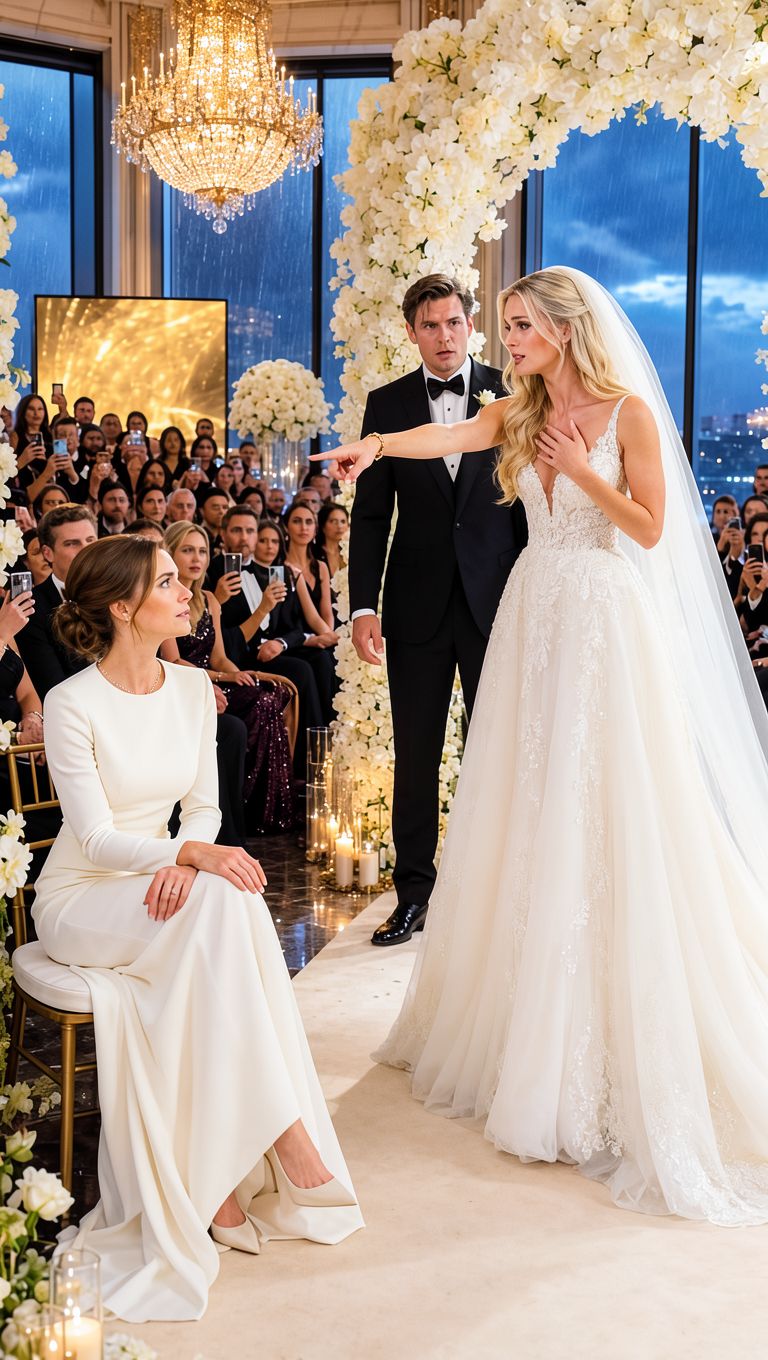
At 6:12 on Monday morning, I was making my husband’s espresso when his mistress announced online that she was about to become Mrs. Whitmore.
The machine hissed beside my hand. Upstairs, Preston was still asleep in our bed, one arm thrown across the pillow where I had slept alone for nearly a year.
Marissa Vale had posted a photograph of ivory roses, champagne glasses, and a blurred man’s hand resting on a velvet ring box. His face was hidden, but not the scar beside his thumb. Preston had gotten that scar on our honeymoon in Santorini while opening a bottle against a stone railing.
The caption read: “When love is finally brave enough to give you the right name. #BecomingMrsWhitmore.”
I stared at it until the espresso overflowed and ran across the marble counter.
“Mom?” my daughter’s old voice seemed to echo from memory, though Clara had been away at college for three months. “You always say the first thing people reveal is what they think they can get away with.”
I reached for a linen napkin embroidered with tiny gold keys, a ridiculous wedding gift from Preston’s grandmother. I had kept it because the keys reminded me of Whitmore House, the Manhattan hotel everyone believed belonged to the Whitmore family.
It did not belong to Preston.
Not entirely.
I took screenshots instead of waking him. I saved the images to three different places. Then I poured his espresso into the porcelain cup with the hairline crack near the handle and carried it upstairs.
Preston opened one eye.
“What time is it?”
“Six seventeen.”
“Why are you awake?”
“Why is Marissa Vale planning our wedding venue?”
His hand stopped halfway toward the cup.
For a second, the only sound in the room was the faint ticking of the brass clock on his dresser.
Then he laughed.
“Marissa? Eleanor, that’s ridiculous. She’s a social media obsessive. She invents things.”
“She used your scar in a photograph.”
“People have scars.”
“She used my last name.”
His shoulders loosened when he saw my face remain calm.
“Please don’t start this before breakfast,” he said. “It’s fantasy.”
I repeated the word softly.
“Fantasy.”
“Yes. Nothing is happening.”
He kissed my forehead, grabbed his espresso, and walked into the bathroom as if he had just settled the matter.
I stood beside the bed, watching coffee tremble inside the cracked porcelain cup.
That afternoon, Marissa posted a video from the ballroom at Whitmore House. She spun beneath the chandeliers in white feathers while a caption announced that her fiancé had already booked her dream venue before asking her to marry him.
A follower asked, “Isn’t he still married?”
Marissa replied, “Some marriages are paperwork. Real love is obvious.”
I saved that too.
That evening, Preston came home carrying orchids.
“I know you’re upset,” he said.
“I’m not upset.”
“You’re being strangely quiet.”
“Am I?”
He put the flowers in a crystal vase, then reached for my hand. His wedding ring felt cold against my fingers.
“Nothing online is real,” he whispered. “You know me.”
I looked at the orchids, the polished stems, the expensive lie.
“I know you better than you think.”
Two nights later, we attended the Whitmore House Foundation Gala. Marissa crossed the ballroom in a silver gown, wearing the Cartier bracelet Preston had told me he lost in Paris two years earlier.
I touched the bracelet lightly.
“Beautiful,” I said. “I owned one just like it before Preston lost mine.”
Preston’s face went white.
Marissa lifted her chin. “Cartier makes thousands.”
“Keep it,” I replied. “It clearly means more to you than it ever did to me.”
By midnight, she had posted a close-up of the bracelet with the words, “The future sparkles brighter than the past.”
Her wedding hashtag exploded.
So did my plan.
On Monday at 10:17, a courier delivered an invitation sealed with white wax. It named Marissa Claire Vale and “P.W.” and invited me to a private celebration of love, truth, and new beginnings on June 14.
The location was Whitmore House.
Rosa, my housekeeper, found me holding it in the foyer.
“Should I call security?” she asked.
“No.”
I carried the invitation into my office, locked the door, and called Miriam Bell—my attorney, my godmother, and the only person who knew what Preston had never bothered to learn about Whitmore House.
When Miriam saw the invitation, she went silent for eight full seconds.
Then she asked, “Does he really not know whose building he just booked?”
I opened the desk drawer and reached for the folder marked with a small brass key…
PART 2
The brass key was warm from my hand when I turned it in the lock.
Inside the drawer sat a leather folder, a flash drive, and a narrow receipt from a private jeweler in Paris. The receipt was dated two years earlier—the week Preston had told me my bracelet vanished from our hotel room.
Miriam’s voice remained low through the speaker.
“Eleanor, listen carefully. Do not confront him yet.”
“I’m not planning to.”
“Good. And do not go to Whitmore House alone.”
“Why?”
“Because Marissa’s invitation may be the least dangerous thing they’ve done.”
I looked through the office window at the rain sliding down the glass. Across the street, the hotel’s upper floors rose above the city like a dark ship.
“What did you find?” I asked.
“I didn’t find it. You did. You just haven’t opened the folder.”
The next morning, at 8:40, Miriam arrived with two coffees and a stack of certified documents. She wore her red wool coat, the one she had owned since representing my grandmother in the Whitmore trust hearings.
She placed the documents on my desk.
“Your grandmother transferred the controlling ownership of Whitmore House into a private trust before she died,” Miriam said. “You are the sole beneficiary.”
“I know.”
“Preston knows you own a minority interest. He does not know the trust became irrevocable when you turned thirty-five.”
I felt my pulse in my fingertips.
“Why wouldn’t he know?”
“Because your grandmother instructed me to keep the amendment private unless he tried to sell, pledge, or misuse the property.”
Miriam slid another paper toward me.
It was a hotel authorization bearing Preston’s signature.
He had booked June 14 under a false corporate account, promised private access to the ballroom, and charged the deposit to a foundation account used for children’s scholarships.
“He moved money,” I said.
“Almost six hundred thousand dollars in nine months. Catering deposits, jewelry, travel, decorators, private apartments.”
I stared at his signature. It looked exactly as it had on our marriage certificate.
“He told me the foundation was struggling.”
“It was. Because he was draining it.”
At noon, I went to Whitmore House with Miriam. The lobby smelled of lemon polish and fresh lilies. Behind the reception desk, the brass bell had been replaced twice, but the concierge still knew me.
“Mrs. Whitmore,” he said carefully.
“Please call me Eleanor.”
Preston appeared from the executive corridor before we reached the elevators.
“What are you doing here?”
“Reviewing a private event booked in my building.”
His jaw tightened.
“Your building?”
Miriam stepped beside me. “That is precisely the issue.”
Marissa emerged behind him, wearing the Cartier bracelet and holding a folder covered in pearl-colored paper.
“Preston said you were helping with the gala,” she said.
“I’m helping with something.”
Her smile sharpened. “June fourteenth will be beautiful. I hope you’ll attend. It would mean a lot to Preston if you could finally let go gracefully.”
The lobby seemed to contract around us.
Preston whispered, “Eleanor, not here.”
“Then cancel the celebration.”
Marissa laughed. “You can’t cancel our wedding.”
“No,” I said. “But I can cancel what you rented.”
The color left her lips.
Preston caught my elbow. His fingers dug into my skin.
“Enough,” he said. “You’re embarrassing yourself.”
Miriam looked at his hand.
“Remove it.”
He did.
That evening, Rosa showed me another package delivered to the house. It contained a framed photograph of Marissa standing beneath the Whitmore House chandelier, smiling beside a printed sign that read: “Future Mrs. Whitmore.”
On the back, someone had written, “You were always temporary.”
I turned the photograph facedown.
At 11:26, Preston entered my office without knocking.
“Are you trying to destroy me?” he demanded.
“No.”
“Then why is Miriam freezing every event account?”
“Because she can.”
He leaned over the desk, and I smelled whiskey on his breath.
“You think you’re protected because your grandmother left you paperwork?”
“I think paperwork matters when people sign their names to it.”
His eyes flicked toward the leather folder.
“What’s in there?”
“Something you should have learned about years ago.”
For the first time, fear crossed his face.
At 7:03 the next morning, Miriam called again.
“Eleanor, I found the original recording.”
“What recording?”
“The one from the night Preston met Marissa in the hotel office. The night they discussed the transfer.”
My throat tightened.
“Transfer of what?”
Miriam inhaled.
“Your marriage, your name, and Whitmore House are not the only things they planned to take.”
Before I could answer, the office door handle began to turn from the outside…
PART 3
The handle turned once, then stopped.
Preston’s voice came through the door.
“Eleanor, open this.”
Miriam was still on the phone. “Do not let him in.”
I pressed the folder against my chest. “He knows?”
“He suspects. That’s different.”
The lock clicked.
“Eleanor,” Preston said, louder now. “We need to talk about the hotel.”
I stepped away from the door. “You can talk from the hallway.”
His laugh sounded thin. “You’re acting insane.”
Miriam said, “I’m sending the recording to your phone. Play it now.”
A file appeared. The time stamp read March 3, 11:48 p.m.
I pressed play.
At first there was only the hum of an air conditioner. Then Preston’s voice emerged, unmistakable and relaxed.
“The trust amendment is the only obstacle,” he said.
Marissa answered, “She won’t fight if you make her believe everyone knows she’s being replaced.”
I closed my eyes.
The recording continued.
“She cares about the Whitmore name,” Preston said. “If I make her look unstable, she’ll sign whatever I put in front of her.”
“What about the building?” Marissa asked.
“When she signs the separation agreement, I’ll use the marital property claim. The board will panic. By the time she understands, the hotel will be leveraged.”
“And me?”
“You’ll have the wedding, the apartment, and the name.”
Marissa laughed softly. “I already have the bracelet.”
The sound stopped.
For several seconds, I heard nothing but my own breathing.
Behind the office door, Preston said, “Open it.”
I looked at Miriam on the screen.
“Play it for him,” she said.
I connected the phone to the office speakers and pressed the file again.
The voices filled the room.
Preston stopped speaking in the hallway.
When the recording ended, the silence became enormous.
Marissa appeared behind him. Her face had gone pale.
“You recorded us?” Preston asked.
“No,” Miriam replied through the speaker. “The hotel’s security system did. You held the conversation in a room under continuous legal surveillance.”
“That’s inadmissible.”
“It is not.”
I opened the door.
Preston stood inches away, his hand still raised. Marissa was behind him, clutching the pearl-covered folder so tightly that her knuckles had turned white.
“You said I was temporary,” I told her.
“I didn’t mean—”
“You said I would sign anything.”
Preston stepped forward. “Eleanor, listen to me.”
“No. You listen.”
I placed the trust amendment on the desk between us.
“Whitmore House is not marital property. It never was. The trust became irrevocable six months before our wedding. I am the sole beneficiary and the only person authorized to approve a transfer, lease, or encumbrance.”
Preston stared at the page.
His mouth opened, but no sound came out.
Miriam continued, “The foundation accounts are frozen. The financial review begins this afternoon. The recording, the booking documents, and the bracelet receipt are being delivered to investigators.”
Marissa looked at Preston.
“You told me she owned nothing.”
“I thought she didn’t know,” he muttered.
“You told me the hotel was yours.”
“It was supposed to be.”
Her face changed then—not into shame, but calculation.
She dropped the folder onto my desk.
Inside were draft invitations, a wedding contract, and a proposed transfer agreement giving Preston’s new company control of the hotel’s event division.
At the bottom was my forged signature.
Miriam picked it up with a tissue.
“This is not a misunderstanding,” she said.
Preston lunged for the papers.
The door behind him opened, and two investigators entered with a court order.
But before anyone could speak, my phone rang.
The caller identification showed Whitmore House security.
I answered.
The chief of security said, “Mrs. Whitmore, we found someone in your grandmother’s private archive. He was looking for the original trust ledger.”
I looked at Preston.
His face changed again.
“Who?” I asked.
The guard hesitated.
“Your husband’s father.”
And then he added, “He says he has proof that your grandmother never meant for you to inherit anything…”
He heard his own voice, and finally stopped denying it…
I thought the truth would destroy the life I knew. Instead, it revealed the life waiting underneath it.
The last conversation changed everything.
“You thought the truth only mattered when someone heard it.”
For the first time, he had no answer.
👇 The ending is already open
Related posts:
 PART 4 — My husband’s fiancée used my surname on her wedding invitation, but when I mentioned one stolen bracelet, his face went white
I chose the restaurant my son had visited for ten years, and when the waitress approached me, Chloe stopped breathing
PART 4 — My husband’s fiancée used my surname on her wedding invitation, but when I mentioned one stolen bracelet, his face went white
I chose the restaurant my son had visited for ten years, and when the waitress approached me, Chloe stopped breathing
 I was ordered to feed the city’s most feared man, but when he tasted my burnt garlic, his expression suddenly changed
 I Came Home Early and Found My Pregnant Wife Eating Scraps—Then My Sister’s Smile Vanished
PART 4 — I chose the restaurant my son had visited for ten years, and when the waitress approached me, Chloe stopped breathing
I Came Home Early and Found My Pregnant Wife Eating Scraps—Then My Sister’s Smile Vanished
PART 4 — I chose the restaurant my son had visited for ten years, and when the waitress approached me, Chloe stopped breathing
 I signed my former father-in-law into emergency surgery while his own son called him too old to save—and then my ex stopped smiling