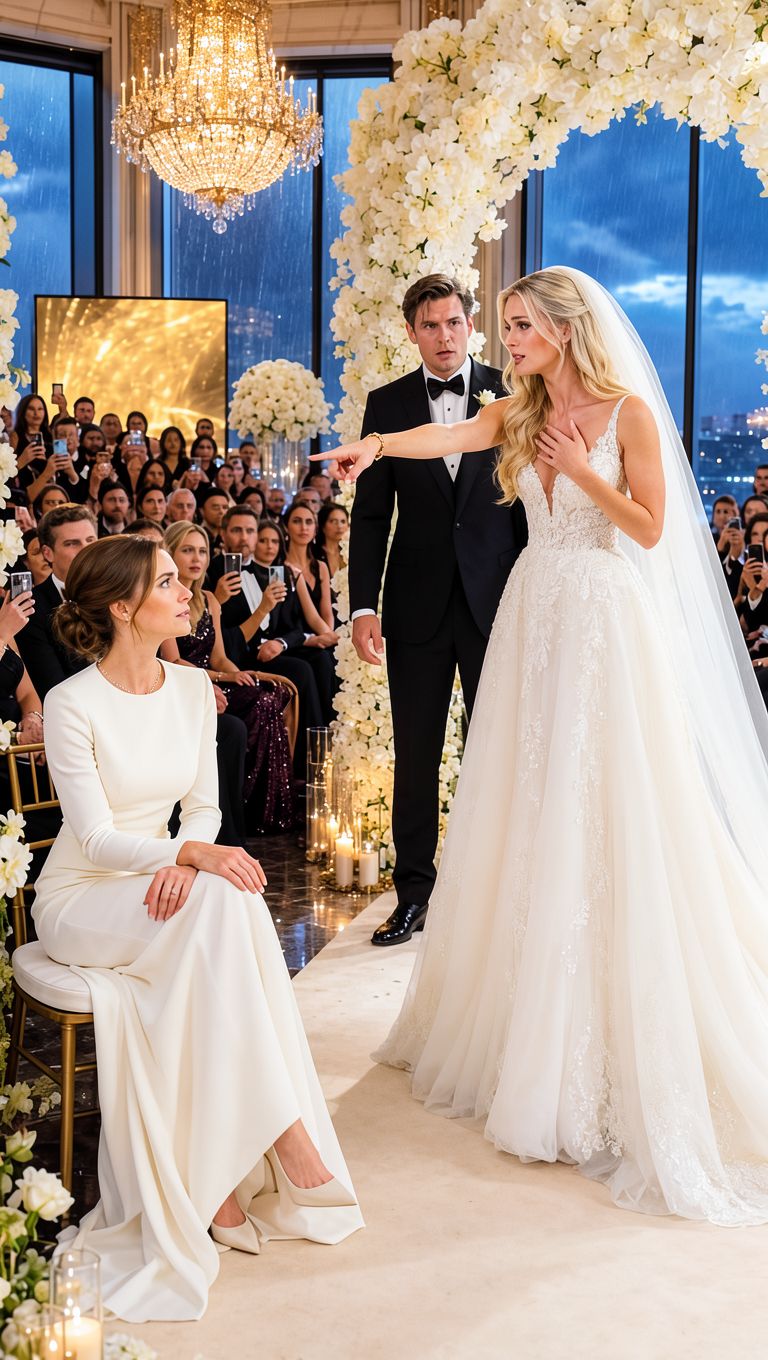
PART 4
For one breath, nobody moved.
Then Preston reached for my phone.
I stepped back.
“Don’t touch her,” one of the investigators said.
Preston’s hand dropped.
His father, Charles Whitmore, was seventy-two years old and had spent his entire life behaving as if every room belonged to him. Even from the security camera still Miriam pulled up, I recognized the posture: shoulders straight, silver hair combed back, one hand resting on the archive door as though he had merely wandered into the wrong library.
“Where is he?” I asked.
“In the private archive. We have him secured.”
Charles’s voice came through the phone a moment later.
“Eleanor, this is a family matter.”
“No,” I said. “It became a criminal matter when you entered a locked room.”
“You are making a serious mistake.”
“I’ve made enough of those.”
Preston turned toward me. “You can still stop this.”
Miriam looked at him with exhausted contempt.
“No, Preston. She can’t stop what you already started.”
His attorney arrived forty minutes later, carrying a briefcase and the expression of a man who had just learned his client had been lying to him for months.
He listened to the recording once.
Then he closed the laptop.
“What?” Preston demanded.
“I’m withdrawing from representing you in any matter involving the foundation or the hotel.”
“You can’t do that.”
“I just did.”
Marissa began crying in the hallway.
Not because she loved Preston.
Because the wedding contract had a cancellation penalty large enough to swallow everything she owned.
She turned to me.
“Please. You have to understand. He told me you were already leaving.”
“I understand that he lied to you.”
“You could have warned me.”
I looked at the bracelet on her wrist.
“You were wearing my warning.”
She covered it with her hand.
At 3:15 that afternoon, security escorted Charles from the archive. He carried a black walking cane with a silver handle, and his face was rigid with fury.
“You have no idea what your grandmother promised me,” he said.
“Then you should have brought the promise instead of breaking into her records.”
He stopped.
Miriam stood beside me.
“The original ledger confirms the amendment,” she said. “So does the trustee’s seal. Eleanor inherited the property lawfully.”
Charles looked at Preston.
“You said she didn’t know.”
Preston’s eyes lowered.
That was the first time I saw him understand that there would be no version of the story in which he remained the victim.
That evening, investigators played the recording in the hotel’s boardroom.
There were twelve people around the table: trustees, accountants, foundation directors, and the hotel’s general counsel.
I sat at the end, my hands folded over the linen napkin with the tiny gold keys.
Preston sat across from me.
The recording began.
His own voice filled the room.
“She cares about the Whitmore name. Make her look unstable.”
He stared at the table.
Marissa’s voice followed.
“I already have the bracelet.”
A trustee shifted uncomfortably.
The accountant removed his glasses.
Preston heard himself promise apartments, money, and control of the hotel.
He heard himself describe our marriage as paperwork.
When the recording ended, he whispered, “I was angry.”
The general counsel answered, “You were planning fraud.”
“No one was supposed to hear that.”
I looked at him.
“That was the problem. You thought the truth only mattered when someone heard it.”
The board removed him from every foundation and hotel position that night. The investigators filed charges connected to embezzlement, forgery, and unlawful access to the archive. Marissa agreed to return the bracelet and testify about the financial transfers. Charles faced his own charges and lost the family office he had controlled for decades.
None of it felt like victory.
It felt like a house after a fire: standing, but full of rooms that could never be entered the same way again.
Three days later, Preston called from an unfamiliar number.
“Eleanor, please answer.”
I listened without speaking.
“I can explain the money.”
“You already did.”
“I never stopped loving you.”
I looked across the kitchen at the cracked porcelain cup. The one with the brown stain near the handle. The cup I had carried upstairs while he was still pretending to sleep.
“You stopped respecting me long before you stopped loving me.”
“I was confused.”
“No. You were confident.”
He began to cry.
For years, I had believed his tears were proof that something inside him could still be saved.
That night, they sounded different.
They sounded like consequences.
I filed for divorce the following week.
The separation agreement gave me nothing I had not already earned. The hotel remained protected by the trust. The foundation funds were restored through recovered assets. Clara’s tuition account was untouched.
Preston kept his apartment for exactly six weeks.
Then the bank took it.
I did not celebrate.
I did not visit.
I simply stopped answering messages that began with “Remember when.”
The physical proof of my old life was the empty room at the end of the upstairs hall.
Preston had removed his watches, suits, framed awards, and travel bags. The closet was a pale rectangle where his clothes had blocked the light for fourteen years.
On the shelf, he had left one photograph from our honeymoon.
We were standing beside the sea, younger and sunburned, his injured thumb wrapped in gauze. I was laughing at something outside the frame.
I turned the photograph facedown.
Then I took the cracked espresso cup downstairs and put it in a box marked for donation.
I could not throw it away yet.
Some objects need time before they become only objects.
Six weeks later, I moved into a smaller apartment overlooking the East River. In the mornings, I walked to the hotel instead of taking the private car. I learned the names of the night staff. I began reviewing foundation grants personally and reopened a scholarship program Preston had quietly cut.
Clara came home on a Thursday in October.
She found me at the kitchen table, sorting applications beneath a yellow lamp.
“Are you happier?” she asked.
The question landed harder than any accusation.
“I’m quieter,” I said.
“That isn’t what I asked.”
I smiled faintly.
“I think happiness is starting to feel possible.”
She studied me.
“Did Dad ever tell you why?”
“Why what?”
“Why he thought you would just sign everything.”
I looked at the river, where the lights trembled in the dark water.
“Because I spent years making his life easier.”
Clara reached across the table and took my hand.
“You made it beautiful.”
“No,” I said. “I made it survivable.”
She leaned her head against my shoulder.
The next morning, she left a drawing on my desk. It showed Whitmore House with every window lit, and a small woman standing outside holding a ring of gold keys.
At the bottom, Clara had written, “Home is where nobody has to disappear.”
I kept that drawing beside the trust documents.
Winter arrived early.
On the first morning of snow, I stood in the hotel lobby while Rosa placed evergreen branches along the reception desk. The new general manager brought me a cup of coffee in a clean white mug.
I laughed when I saw it.
“What?” he asked.
“Nothing. It’s just safer this way.”
That afternoon, another message arrived from Preston.
He was asking to meet before the divorce became final.
The message was longer than the others. He mentioned our first apartment, the blue bicycle we bought Clara, and the restaurant where he proposed. At the end, he wrote, “I know I ruined everything, but you are still my family.”
I read it twice.
Then I replied with one sentence.
“Family does not ask you to vanish so it can inherit your life.”
I blocked the number.
Months later, when the divorce was final, I returned to the private archive with Miriam. The ledger rested inside its velvet-lined case, its pages protected by a brass clasp.
I ran my fingers over the cover.
Miriam watched me.
“Your grandmother would be proud.”
“I don’t know if I did what she wanted.”
“She wanted you to understand the difference between preserving a name and surrendering yourself to it.”
Outside, snow tapped against the tall windows.
I thought of the morning everything began—the espresso machine hissing, the cracked cup trembling in my hand, Marissa smiling beneath a photograph that was never hers to post.
I had believed the cup was a reminder of betrayal.
Now it sat on my office shelf, filled with small brass keys from the hotel’s old rooms.
Not because I needed to remember Preston.
Because I needed to remember the woman who finally stopped carrying his coffee upstairs.
The keys caught the winter light.
And for the first time in years, every door opened toward me.
Missed the beginning?
Related posts:
 My husband’s fiancée used my surname on her wedding invitation, but when I mentioned one stolen bracelet, his face went white
I chose the restaurant my son had visited for ten years, and when the waitress approached me, Chloe stopped breathing
My husband’s fiancée used my surname on her wedding invitation, but when I mentioned one stolen bracelet, his face went white
I chose the restaurant my son had visited for ten years, and when the waitress approached me, Chloe stopped breathing
 I was ordered to feed the city’s most feared man, but when he tasted my burnt garlic, his expression suddenly changed
 I Came Home Early and Found My Pregnant Wife Eating Scraps—Then My Sister’s Smile Vanished
 Dreizehn Jahre nach unserer Scheidung stellte mein Ex mich vor allen bloß, doch als sein Sohn mich erkannte, verstummte der ganze Saal
 My Three-Year-Old Daughter Asked New York’s Most Feared Man to Hold Her Hand, and the Sealed Medical File He Had Hidden for Years Exposed the Truth About Why He Stayed Away





