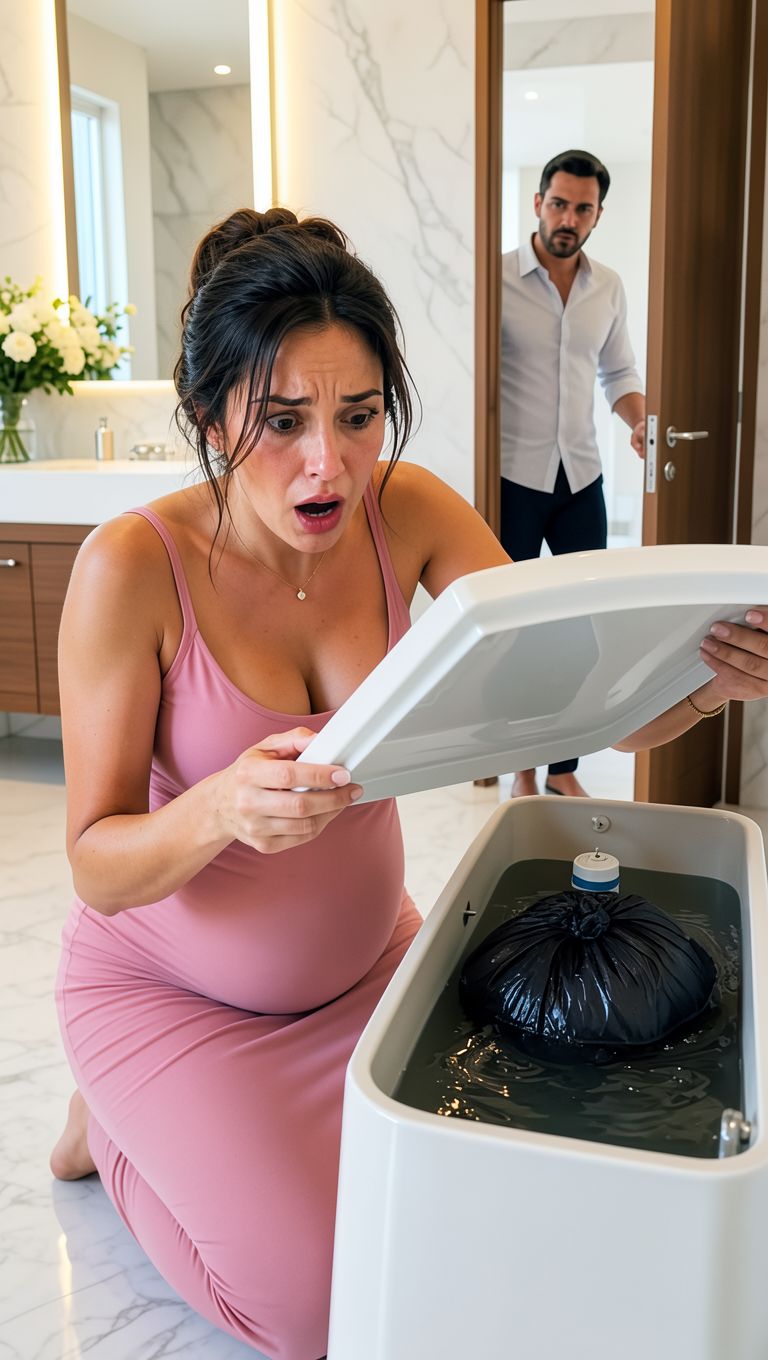
PART 4
“That admission is not authorized,” Máximo said into the phone.
He did not raise his voice.
He did not need to.
The room seemed to shrink around those words. The fluorescent light hummed above us, and the brass whistle beside my hand reflected a thin, trembling line of gold.
Román reached for his phone.
Máximo stepped between us.
“Put it down.”
“You have no right to stop me.”
“The clerk has already notified the authorities. The phone, the documents, and the financial records are being secured.”
Román turned to Alicia.
“Call the doctor.”
Alicia stared at him.
“Which doctor?”
“The one who wrote the report.”
“She won’t answer me.”
“Call her again.”
“I’m not calling anyone.”
His face twisted. “You were part of this.”
“I was part of an affair,” Alicia said, wiping her cheeks. “I was not part of imprisoning a pregnant woman.”
The sentence landed harder than a slap.
Román looked at me, expecting me to collapse, to cry, to ask him why. Instead, I held the table and stayed standing.
The authorities arrived before midnight.
They searched the house while Román paced in the living room, calling one person after another. His bank refused the next transfer. The private facility denied the admission once Máximo sent them the preservation order. The doctor who had signed the false report stopped answering every call.
Finally, Román’s attorney arrived at 1:15 in the morning.
He carried a briefcase and wore one shoe untied.
“Román, we need to speak privately,” he said.
“I need you to fix this.”
“I can’t fix fabricated medical records, unauthorized withdrawals, or a planned involuntary admission.”
“You’re my lawyer.”
“I was your lawyer when you told me your wife was unstable and that the documents were legitimate.”
Román glanced toward me.
The lawyer’s expression hardened.
“You lied to me too.”
At dawn, they played the recording in a small interview room at the municipal station. I sat beside Máximo. Román sat across from us, his hands flat on the table.
His own voice filled the room.
“She already looks exhausted. The doctor will sign whatever we need.”
The recording continued.
“And the baby?” Alicia asked.
“Mine. Ana won’t be in a position to fight.”
When the audio ended, nobody moved.
Román stared at the table as if the words had been spoken by someone sitting behind him.
“Turn it off,” he muttered.
“You said it,” the investigator replied.
“I was angry.”
“You discussed dates, payments, and custody.”
“I didn’t mean it.”
I finally spoke.
“You meant it enough to hide the phone in the tank.”
His eyes lifted to mine.
For a moment, I saw the man who had brought me tea during morning sickness. Then I saw the signature copied onto the psychiatric report.
The tenderness had been a costume.
The investigation lasted months. The court froze the remaining inheritance funds, restored the house to my sole control, and ordered Román to stay away from me and the baby. The withdrawals were traced through Alicia’s company. She cooperated, returned part of the money, and accepted responsibility for what she had done.
Román did not apologize.
He sent explanations.
He sent accusations.
He sent a photograph of the yellow baby socks and wrote, “You are keeping my daughter from me.”
My lawyer answered once: “All communication must go through the court.”
Then Román stopped calling.
The empty nursery was the first thing I noticed after he left.
He had painted one wall pale green without asking me. A single paper moon hung from the ceiling, turning slowly whenever the window was open. In the closet, one yellow sock remained on the shelf.
The other had been lost beneath the table on the night everything broke.
I found it three weeks later behind the radiator.
I held it in my palm and cried—not for Román, but for the woman I had been when I believed love meant explaining away every warning.
My daughter was born on a rainy Tuesday in October.
I named her Valeria, after my father, because he had taught me that a home was not merely walls. It was the place where nobody had to beg to be believed.
When the nurse placed her against my chest, Valeria opened one tiny hand and caught the edge of my hospital gown.
“She knows you,” the nurse whispered.
I laughed through my tears.
“No,” I said. “I’m the one who finally knows her.”
Six weeks later, I moved into a smaller apartment near the university in Mexico City. I took a position coordinating youth athletics, using the program my father had started. Every morning, I packed Valeria’s bottle, checked the bus schedule, and opened the windows before making coffee.
There were ordinary sounds again.
A neighbor’s broom against the pavement.
The elevator groaning between floors.
Valeria laughing whenever sunlight touched the curtains.
I kept my father’s whistle on a hook beside the door. I did not carry it because I was afraid anymore. I carried it because it reminded me that warnings could be inherited as carefully as houses.
One cold morning, months after the hearing, Valeria pointed at the whistle.
“What is that?” she asked, though her words were still soft and uneven.
“It belonged to your grandfather.”
“Was he loud?”
“Only when people stopped listening.”
She considered that, then placed a crayon drawing beneath it. The picture showed three crooked figures standing beneath a yellow sun. One was tall, one was small, and one had an enormous round belly.
“Is that us?” I asked.
Valeria nodded.
“Home.”
The word struck me in the chest.
That evening, Román made one final attempt. He appeared outside the apartment building with flowers and a folder. The security guard called me from downstairs.
“He says he wants five minutes.”
I looked at Valeria asleep beside her stuffed rabbit. Snow had begun to fall beyond the window, the first of the season, melting against the glass.
“Tell him no,” I said.
“He says he has changed.”
I closed my eyes.
For years, I had believed refusing someone was cruel. I had confused silence with peace and forgiveness with surrender.
“Tell him,” I said, “that my answer is still no.”
The guard returned a minute later.
“He left the flowers.”
“Throw them away.”
I did not go downstairs.
I did not watch him leave.
I went to the hook by the door and touched my father’s brass whistle. Its surface was warm from the afternoon sun, worn smooth where his thumb had rested for thirty years.
Behind me, Valeria stirred.
“Mom?”
“I’m here.”
“Stay?”
I turned toward her.
“Always.”
Outside, the snow covered the pavement where Román had stood. By morning, there would be no footprints left.
The whistle stayed in my hand.
And for the first time, home sounded like silence.
Missed the beginning?
Related posts:
 At seven months pregnant, I found something hidden in the bathroom tank—and when my husband came home, his smile vanished
A férjem egy másik nő nevét mondta a házassági évfordulónkon, majd amikor a mikrofonhoz léptem, hirtelen elsápadt
I brought my daughter to the Cole mansion for one dinner, but when Julian saw her sleeve, his polite smile vanished
At seven months pregnant, I found something hidden in the bathroom tank—and when my husband came home, his smile vanished
A férjem egy másik nő nevét mondta a házassági évfordulónkon, majd amikor a mikrofonhoz léptem, hirtelen elsápadt
I brought my daughter to the Cole mansion for one dinner, but when Julian saw her sleeve, his polite smile vanished
 I was ordered to feed the city’s most feared man, but when he tasted my burnt garlic, his expression suddenly changed
My billionaire ex-husband stormed into my home on Christmas Eve demanding answers, but one glance at my living room made him go pale
I was ordered to feed the city’s most feared man, but when he tasted my burnt garlic, his expression suddenly changed
My billionaire ex-husband stormed into my home on Christmas Eve demanding answers, but one glance at my living room made him go pale
 My ex-husband sat beside me to mock my ruined life, but at the airport three children ran toward me and his smile vanished