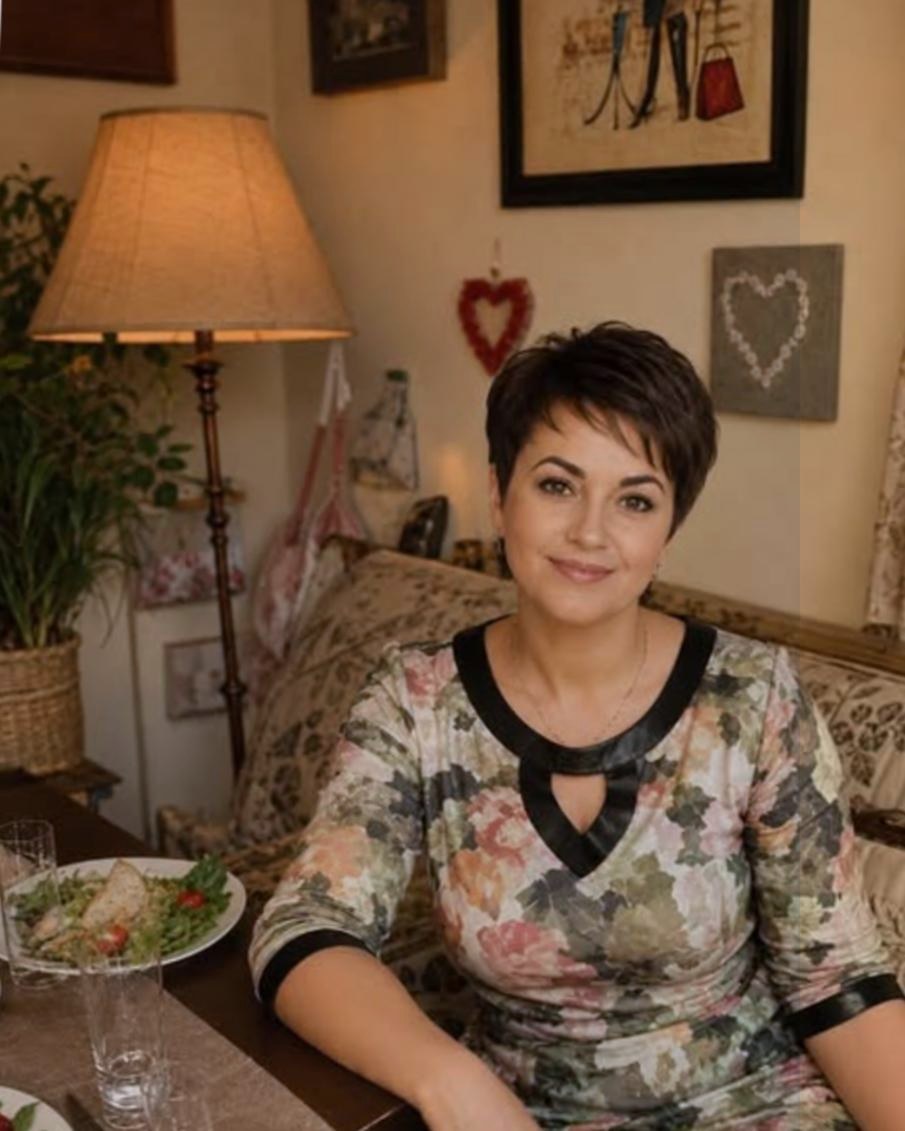
Julian Cole stopped breathing with a fork halfway to his mouth when my daughter reached for a napkin at the family dinner table.
Sofia had not even been supposed to sit there. The babysitter canceled forty minutes before dinner, and I could not leave my three-year-old alone in the tiny apartment above the garage while I served a room full of people who owned more silverware than I owned winter clothes.
So I placed Sofia on a dining chair, folded two cushions behind her back, and whispered, “Use your quiet voice, sweetheart.”
She lasted six minutes.
Then she began explaining the history of her chicken nuggets to anyone willing to listen.
I kept my eyes on the plates and tried to disappear. That was what I had learned to do around wealthy families. Move quietly. Speak only when spoken to. Never let them see how badly you needed the job.
But Julian looked at Sofia.
Her left sleeve had slipped above her elbow, exposing the small crescent-shaped birthmark on her forearm. It was the color of weak coffee, tilted slightly to one side.
His fork struck the porcelain.
The sound was tiny, but I felt it in my spine.
“Mr. Cole?” I asked. “Are you all right?”
He did not answer. His face had gone pale as he stared at the mark.
Sofia, unaware of the silence spreading around her, lifted her glass of apple juice. “Mommy, Richard has three potatoes.”
Richard Cole, Julian’s cousin, laughed without looking up from his phone. “A serious accusation.”
Julian finally blinked. “Where did she get that mark?”
The question was too sharp. Too personal.
I pulled Sofia’s sleeve down. “It’s a birthmark.”
“I can see that.”
“Then why ask?”
For the first time in six weeks, Julian looked directly at me. His eyes were gray, exhausted, and suddenly frightened.
“Because my mother had the same one.”
The room went strangely quiet.
I had never met his mother. Everyone in town knew Eleanor Cole had died three years earlier, leaving behind a grieving son, a powerful company, and a mansion where the curtains were always drawn. I had also heard that Julian became almost impossible to reach after her death.
I had not known about the mark.
I had known about the other thing.
Three years earlier, before Sofia was born, I had spent one night with a stranger at a roadside inn during a storm. He had called himself Julian. He had been gentle, lonely, and wearing a brass compass clipped to his coat pocket. In the morning, he kissed my forehead and promised to find me.
He never did.
Two weeks later, a woman claiming to be his assistant told me Julian wanted nothing to do with me. When I asked about the baby, she said, “He has already made his decision.”
I believed her because I had no reason not to.
Now Julian was staring at my child as if the past had just walked into his dining room wearing pink socks.
“Marisa,” he said quietly, “where did you live three years ago?”
Richard’s chair scraped against the floor.
“Julian,” he warned.
I felt the old fear return, cold and familiar. “Why does that matter?”
Julian stood so quickly that his wineglass trembled. “I need to speak with you. Privately.”
Richard reached across the table and caught his wrist.
“Not here,” Richard said. “Not tonight.”
Julian looked down at his cousin’s hand. “Take it off me.”
Richard released him, but his expression had changed. The easy family smile was gone.
That was when I understood something terrifying.
Richard knew exactly why the birthmark mattered.
At ten thirty that night, after I put Sofia to bed, someone slid an envelope under my apartment door. It had no name on it, only a brass compass drawn in black ink. My hands shook as I opened the flap, and before I could see what was inside, footsteps stopped outside my door…
PART 2
The footsteps remained outside my door for three full seconds.
Then they moved away.
I stood barefoot on the cold kitchen tile, holding the envelope against my chest while the little brass compass on my key ring pressed into my palm. I had kept that compass for three years, even after convincing myself that the man who gave it to me had forgotten my name.
Sofia stirred in the bedroom.
“Mommy?”
I shoved the envelope beneath a stack of unpaid bills. “Go back to sleep, sweetheart.”
In the hallway, the floorboard creaked again.
I did not open the envelope until morning.
At 6:15, the kitchen smelled of burnt toast and cinnamon cereal. Sofia sat at the table in dinosaur pajamas, swinging her legs while I watched the envelope like it might bite me.
“What’s that?” she asked.
“Something for work.”
“Does work send letters?”
“Sometimes.”
“Does it send cookies?”
“Not usually.”
She considered this. “Then work is disappointing.”
I almost laughed. Instead, I slid a butter knife beneath the flap.
Inside was a single photograph.
It showed a younger Eleanor Cole standing beside a hospital window, her left sleeve rolled up. The same crescent marked her forearm. On the back, someone had written a date from three years earlier and four words: Ask who signed the discharge.
My stomach twisted.
At eight, I went to the mansion and found Julian waiting in the library. Rain tapped against the tall windows. A fire burned low beneath the marble mantel, and the brass compass from my memory sat on his desk.
He stared at it.
“You gave me that,” I said.
His face tightened. “I have never seen it before.”
“You clipped it to your coat the night we met.”
“I was not at a roadside inn three years ago.”
“You were.”
He rose slowly. “Where?”
I told him the name of the town. His hand closed around the edge of the desk.
Richard entered before he could answer.
“Julian, the board is waiting.”
I turned toward him. “Who signed Eleanor Cole’s hospital discharge?”
Richard’s expression did not change, but the firelight caught a pulse beating hard in his neck.
“What an odd question,” he said.
“It was written on the back of a photograph delivered to my apartment.”
“Then perhaps you should ask whoever delivered it.”
Julian stepped between us. “Richard, leave.”
“You have a board meeting.”
“I said leave.”
Richard smiled at me. “You should be careful, Marisa. People can mistake desperation for evidence.”
The words landed exactly where he intended.
I felt my cheeks burn, but I did not lower my eyes. “People can also mistake money for power.”
For one second, Julian looked almost proud.
That afternoon, a woman named June Bell met me behind the old courthouse. She had been Eleanor’s private nurse and now walked with a silver cane whose rubber tip squeaked against the pavement.
“I thought I was done with this family,” June said.
“Why contact me?”
“Because I saw your daughter at dinner.”
She handed me a small leather notebook. Its clasp was broken, and the pages smelled faintly of lavender.
“Eleanor knew Julian had a child,” June whispered. “She discovered it before she died.”
My knees weakened. “She knew?”
“She tried to tell him. Richard stopped her.”
“Why?”
June looked toward the courthouse doors. “Because Eleanor changed her will. She was going to remove Richard from the company and name the child as beneficiary.”
The wind lifted the corner of the notebook.
Inside, beneath a list of medications, Eleanor had written one sentence in shaky handwriting: The child must be protected from the man who thinks inheritance is ownership.
That night, Julian came to my apartment. He looked soaked, furious, and terrified.
“I remember you,” he said.
I gripped the doorframe. “You told me you didn’t.”
“I remember the storm. The compass. Your red scarf hanging over the chair.”
“Then why did you never come?”
His voice broke. “Because Richard told me you had taken the baby and wanted money.”
I could not speak.
Julian looked past me toward Sofia’s bedroom. “I want a DNA test.”
Before I could answer, his phone rang.
He listened for five seconds, then went completely still.
“What happened?” I asked.
He lowered the phone. “The laboratory has already received a sample from Sofia.”
My blood turned cold.
“Who sent it?”
Julian looked toward the dark hallway behind me.
“The report is ready,” he said. “And Richard is on his way to collect it…”
PART 3
Richard arrived at 7:42 the next morning with two attorneys and a folder tucked beneath his arm.
I watched them cross the mansion’s marble foyer through the security monitor in the kitchen. The camera showed every detail: Richard’s polished shoes, the silver clasp on one attorney’s briefcase, and the faint smile Richard wore when he believed he had already won.
Julian stood beside me.
“Do not let him take Sofia,” I whispered.
“He will not.”
“You said that before.”
His jaw tightened. “I was wrong before.”
The front doors opened.
Richard entered carrying the laboratory report.
“I brought clarity,” he announced.
Julian held out his hand. “Give it to me.”
Richard ignored him and looked at me. “You have caused enough disruption. Take your daughter and leave the property today.”
“On what authority?” I asked.
“Mine.”
One of the attorneys cleared his throat. “Mr. Cole, perhaps we should handle this privately.”
“No,” Julian said. “We will handle it here.”
Richard placed the folder on the foyer table. A brass bowl beside it held Eleanor’s old house keys, their teeth clicking softly as the air-conditioning moved them.
“The test confirms what we suspected,” Richard said. “Sofia is not Julian’s daughter.”
The room tilted.
Julian snatched the report and opened it. His eyes moved across the page.
Then he looked at Richard. “You forged this.”
Richard laughed. “That is an emotional response.”
“You used a private laboratory that closed eight months ago.”
The attorney nearest me reached for the folder. “May I see the document?”
Julian handed it to him. “The sample number belongs to a patient who died last year.”
Richard’s smile vanished.
I could barely breathe. “Then where is the real test?”
A woman in a navy coat stepped from the hallway. It was Dr. Lena Morris, the geneticist Julian had hired after Richard threatened to remove the first report.
She carried a sealed evidence pouch.
“The real test was completed at my laboratory,” she said. “Both samples were collected in front of witnesses, sealed, and tracked.”
Richard turned toward the door.
Julian blocked him. “Stay.”
Dr. Morris placed the pouch on the table and broke the seal. “The probability that Julian Cole is Sofia Alvarez’s biological father is 99.9998 percent.”
No one moved.
My hand found the edge of the table. The wood felt rough beneath my fingers.
Julian covered his mouth. His eyes filled, and for a moment the powerful man everyone feared looked like someone who had just been handed three lost years.
“My daughter,” he whispered.
Sofia appeared at the bottom of the stairs, holding her stuffed rabbit by one ear.
“Mommy?”
Julian turned toward her. “Sofia.”
She studied him. “Are you sad?”
He knelt. “I think I am happy and sad at the same time.”
“Then you need a hug.”
She ran into his arms.
Richard stood frozen beside the table.
June Bell entered behind Dr. Morris and opened Eleanor’s lavender notebook. “The paternity test is not the only evidence.”
She read aloud the note Eleanor had written, then produced an old digital recorder from her handbag.
Richard’s face drained of color.
The recording began with his voice, younger but unmistakable.
“You will never tell Julian about the woman or the child,” he said. “If you do, I will make sure the company dies with you.”
My knees nearly gave way.
The room filled with the sound of Eleanor breathing shakily.
Richard lunged for the recorder.
Julian caught his arm. “You lied to me for three years.”
“I was protecting the company.”
“You stole my daughter from me.”
“I protected you from a stranger who wanted your money.”
I stepped forward. “You told me Julian rejected us.”
Richard’s eyes met mine. “You were never supposed to survive long enough to ask questions.”
The attorney lowered his folder.
“What does that mean?” Julian demanded.
Richard said nothing.
Then June pulled one final paper from the notebook. It was a copy of Eleanor’s amended will, signed two days before her death. The beneficiary was not Julian.
It was Sofia.
And beneath the signature was a handwritten warning: If Richard learns the child is alive, he will come for her…
Richard heard the recording—and suddenly stopped fighting…
I thought the truth would bring relief. Instead, it forced everyone to face what came next.
“Those are my words.”
Nobody in the room looked away.
👇 The ending is already open.
Related posts:
 PART 4 — I brought my daughter to the Cole mansion for one dinner, but when Julian saw her sleeve, his polite smile vanished
My husband’s fiancée used my surname on her wedding invitation, but when I mentioned one stolen bracelet, his face went white
PART 4 — I brought my daughter to the Cole mansion for one dinner, but when Julian saw her sleeve, his polite smile vanished
My husband’s fiancée used my surname on her wedding invitation, but when I mentioned one stolen bracelet, his face went white
 I signed my former father-in-law into emergency surgery while his own son called him too old to save—and then my ex stopped smiling
Mein Mann versteckte mich bei seiner Gala hinter der Küche – doch als der Milliardär meine Kette sah, verschwand sein Lächeln
I signed my former father-in-law into emergency surgery while his own son called him too old to save—and then my ex stopped smiling
Mein Mann versteckte mich bei seiner Gala hinter der Küche – doch als der Milliardär meine Kette sah, verschwand sein Lächeln
 My ex-husband sat beside me to mock my ruined life, but at the airport three children ran toward me and his smile vanished
 My husband pushed me from a frozen cliff, then complained at my funeral that I had taken too long to die—and someone went pale