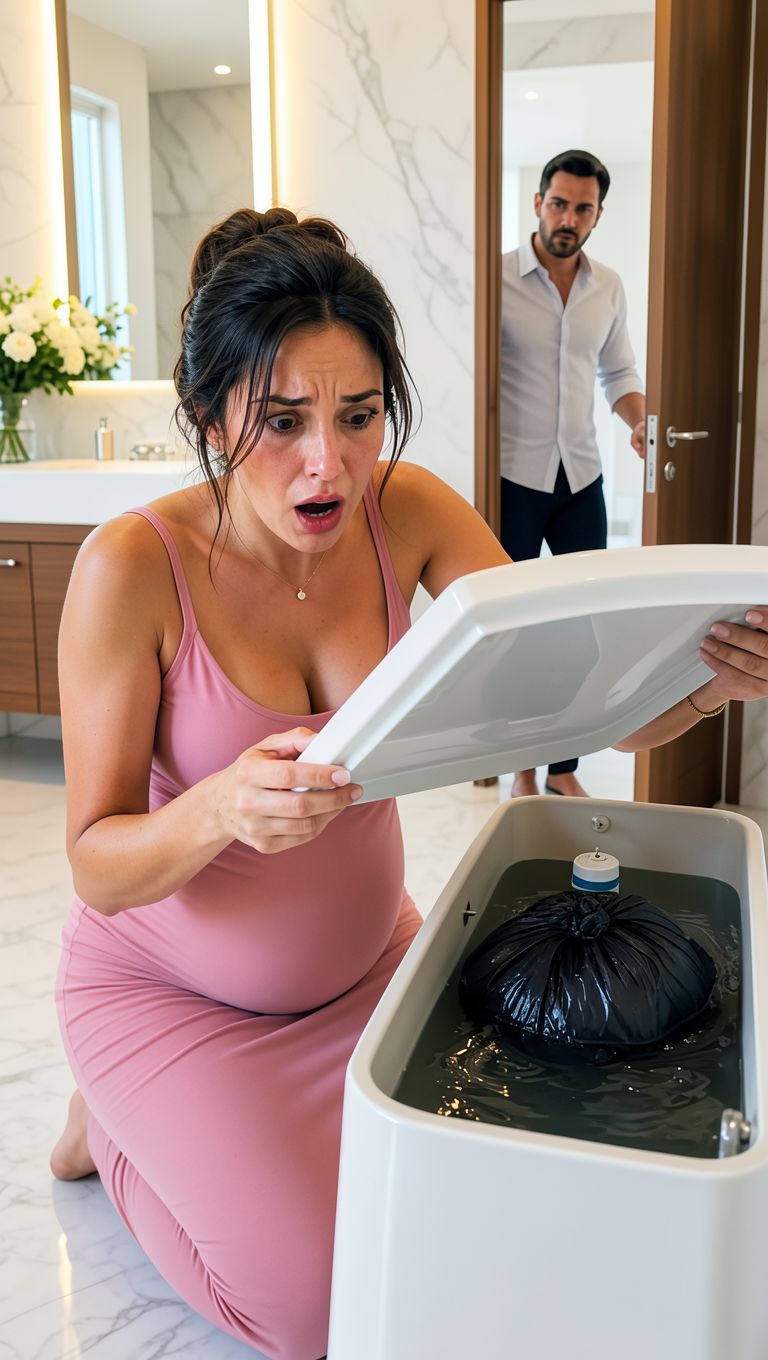
At seven months pregnant, I stood in the bathroom with both hands submerged in icy water while my husband’s plan for my life floated beneath the porcelain lid.
I had seen Román hide the black plastic bag at 5:30 that morning. He thought I was asleep, but the baby had pressed hard against my ribs, and I had followed the faint scrape of porcelain across the floor. He lowered the bag into the tank, washed his hands, and kissed my forehead as if he had only taken out the trash.
“Try to sleep a little longer,” he whispered.
Now his truck was gone, and I was kneeling on the cold tile with my heart pounding so violently that I had to grip the toilet seat.
Inside the bag was a phone Román had claimed to lose four months earlier. Beside it were the original deed to my father’s house, a psychiatrist’s report carrying my name, and a draft petition asking a court to declare me incapable of managing my own property. The report described me as unstable, paranoid, and dependent on sedatives.
I had never taken sedatives in my life.
At the bottom lay a contract from a private residential facility outside Toluca. The line for the patient’s name was blank, but the admission date was the day after my scheduled delivery.
My fingers went numb.
The house belonged to my father, Valerio Hernández. He had built it after my mother died, one wall at a time, while training teenagers at the municipal track. The hallway still smelled of cedar polish and the orange soap he used every Sunday. Before he died in a highway accident, he had pressed a brass whistle into my palm.
“Never sell this place because someone gives you a beautiful speech,” he told me. “A house remembers who fought for it.”
Román had handled the funeral and every inheritance document. He had also offered to protect the two million four hundred thousand pesos my father left for a new transport van for his athletes. For months, two hundred forty thousand pesos vanished from the account.
I had called it paperwork.
Now I understood it was financing.
I photographed everything with my own phone, returned every item to the bag, and called the lawyer whose number my father had kept on a card inside his wallet.
“Máximo Tovar speaking.”
“Mr. Tovar, I found documents in my bathroom tank.”
There was a long silence.
“Send me the pictures,” he said. “And listen carefully. Do not confront your husband.”
“Why?”
“Because if he is building a case that you are mentally unfit, he may be trying to become your legal guardian. That would give him control over your home, your money, and possibly your child.”
The baby moved, a sharp kick beneath my hand.
That night, Román served me soup and stroked my hair.
“You look pale,” he said. “You need rest. I’ll take care of everything.”
I smiled and lifted the spoon.
But I did not eat.
Three days later, our cat Durazno dragged a folded page from beneath the sofa. It was a payment calendar for an apartment in northern Toluca. The buyers were listed as Román Téllez and Alicia Lozano, his coworker.
A handwritten note was clipped to the contract.
The nursery furniture arrives Thursday. After the hospital, Ana must not return to the house.
I was still staring at the words when headlights swept across the curtains. Román’s truck stopped outside. The front door opened. His keys struck the wooden table.
“Ana?” he called.
I hid the paper beneath my sweater and forced myself to breathe.
Then he walked into the room, looked at my face, and reached for the folder beside me…
PART 2
His hand stopped two inches from the folder.
For one second, neither of us moved. Durazno sat beneath the table, his tail curled around his paws, while the brass whistle from my father’s old key ring tapped softly against my hip.
“What are you reading?” Román asked.
“Nothing important.”
His eyes dropped to my stomach, then returned to my face.
“You’re shaking.”
“I’m seven months pregnant.”
“That isn’t an answer.”
He smiled, but the smile belonged to a stranger. I folded the payment calendar and slid it into my pocket.
“Work has been stressful,” I said.
Román took one step closer. His cologne smelled of cedar and bitter citrus, the same scent that had once made me feel safe.
“You’ve been forgetful lately,” he said. “You leave things everywhere. You ask the same question three times.”
“I asked you once where you were yesterday.”
“And you accused me of lying.”
“I asked.”
His jaw tightened.
That night, I waited until he fell asleep, then carried my phone into the laundry room and called Máximo. The washing machine clicked through its rinse cycle, filling the room with a dull metallic rhythm.
“He knows I found something,” I whispered.
“Then we move faster,” Máximo replied. “Can you leave the house?”
“Not without him noticing.”
“Do not leave yet. We need copies, not suspicion. Do you still have access to the bank account?”
“I have the password.”
“Change it from a device he cannot reach. Tomorrow, bring me the phone, the documents, and that contract.”
“What if he catches me?”
“Then tell him nothing. Your safety is evidence too.”
At eight the next morning, Román stood in the kitchen holding a pill bottle between two fingers.
“These will help you sleep,” he said.
The label carried my name.
I stared at the white tablets shining through the plastic.
“Who prescribed them?”
“Dr. Salgado.”
“I’ve never seen him.”
“You saw him last week.”
“I went to my obstetrician.”
Román sighed as if I had disappointed him. “This is exactly what I mean. You’re confused.”
I made myself look frightened.
“Maybe I am.”
His shoulders relaxed.
“That’s why you need to trust me.”
When he left for work, I placed the bottle inside a clean sock and photographed the label. Then I found the phone from the tank still sealed in its bag and carried both to Máximo’s office above a bakery in downtown Toluca.
He examined the plastic without touching it.
“Good,” he said. “You returned it exactly as you found it.”
“Can you open it?”
“Not here. A digital examiner can preserve the contents and prove the device was hidden, not stolen.”
He showed me bank statements on his computer. Every monthly transfer had gone to a company connected to Alicia Lozano.
My throat closed.
“She wasn’t just his coworker.”
“No,” Máximo said. “She was preparing the new home.”
At noon, he placed a small recorder in my palm.
“Keep this under your blouse. Ask him about the pills, the residence, and the apartment. Do not accuse him. Make him explain.”
That evening, Román came home carrying a cardboard box tied with kitchen string. Inside was a tiny pair of yellow socks.
“For our daughter,” he said.
I touched the soft fabric and felt something inside me break.
“Román, why is there an apartment contract with Alicia’s name on it?”
The box slipped from his hands. One sock fell onto the floor.
“What apartment?”
“The one you’re paying for.”
His face changed slowly, like a curtain being pulled across a window.
“You went through my things.”
“I found a note.”
“You’re imagining things again.”
The recorder pressed cold against my ribs.
“Am I imagining the pills with my name on them?”
He stepped toward me.
“Give me your phone.”
“Why?”
“Because you’re not well, Ana.”
At that exact moment, someone knocked three times on the front door. Román turned toward the sound. His hand reached for the lock, and I saw a woman’s shadow beneath the door…
❤️ Thank you for reading this part. The complete continuation is waiting in the first comment. 👇
If the comment does not appear immediately, tap “See all comments.”
If you want to know what happens next, leave a Like and write “Yes.”
PART 3
The door opened before Román could touch the lock.
Máximo stood outside with a court clerk and a digital examiner carrying a hard black case. Behind them was Alicia Lozano, pale and breathless, clutching a leather handbag against her chest.
Román stumbled backward.
“What is this?” he demanded.
Máximo held up his identification. “A preservation order for the device and financial records. Step away from your wife.”
Román looked at me as though I had become dangerous.
“You called him?”
“I called someone who listened.”
The examiner placed the recovered phone inside a clear evidence sleeve. At Máximo’s office, two hours later, we sat beneath a flickering fluorescent light while the device was examined. My father’s brass whistle rested on the table beside my hand.
The phone had not been lost.
It had been used every day.
Messages filled the screen between Román and Alicia. They discussed the transfers, the apartment, the psychiatric report, and the plan to have me admitted after delivery. Alicia had sent a photograph of a nursery with the caption: “Once she is declared unstable, the house is ours.”
Then the examiner opened the audio files.
Román’s voice came through the speaker, unmistakable.
“She already looks exhausted,” he said. “The doctor will sign whatever we need.”
Alicia answered, “And the baby?”
“Mine. Ana won’t be in a position to fight.”
My chair scraped backward. My hand went to my stomach.
Alicia covered her mouth.
“That isn’t what you told me,” she whispered.
Román spun toward her. “You knew everything.”
“I knew you wanted the house.”
“You signed the apartment contract.”
“I thought you were divorcing her, not locking her away!”
Máximo lifted the psychiatric report. “This document is fabricated. The doctor’s office has confirmed that no examination occurred. The signature was copied from an old insurance form.”
Román’s skin drained of color.
The examiner opened another file: a photograph of the hidden bag, timestamped by my phone, followed by the original bank transfers. The evidence was complete.
Román stared at the screen.
“You recorded me?”
“I asked questions,” I said. “You answered them.”
For the first time, he looked afraid.
The clerk secured the phone and documents. Máximo told me I could remain in the house under emergency protection while the authorities reviewed the evidence. Alicia began crying quietly in the corner, her handbag slipping from her fingers.
Then my own phone rang.
The number belonged to the maternity clinic.
“Mrs. Hernández?” a nurse said. “Your appointment was changed this morning. Someone called and canceled all your prenatal care.”
My blood turned cold.
“Who canceled it?”
There was a pause.
“The call came from your husband’s number. And there’s something else. A man matching his description came here earlier asking for your medical file and delivery plan.”
I looked at Román.
He was no longer watching Máximo.
He was staring at the doorway, calculating how to escape.
Then the nurse lowered her voice.
“Mrs. Hernández, we also received a message from a private clinic. They say you were scheduled to be admitted tonight under a psychiatric hold…”
The recording played, and Román finally heard himself…
I thought finding the evidence was the end of my fear.
I was wrong. The truth opened a door to consequences none of us expected.
“Turn it off.”
He finally understood he had said every word himself.
👇 The final part of the story is now open.
Related posts:
 PART 4 — At seven months pregnant, I found something hidden in the bathroom tank—and when my husband came home, his smile vanished
My husband’s fiancée used my surname on her wedding invitation, but when I mentioned one stolen bracelet, his face went white
PART 4 — At seven months pregnant, I found something hidden in the bathroom tank—and when my husband came home, his smile vanished
My husband’s fiancée used my surname on her wedding invitation, but when I mentioned one stolen bracelet, his face went white
 When my husband’s family broke my leg and my husband told me to submit, the smile vanished from his face three days later.
A férjem egy másik nő nevét mondta a házassági évfordulónkon, majd amikor a mikrofonhoz léptem, hirtelen elsápadt
I brought my daughter to the Cole mansion for one dinner, but when Julian saw her sleeve, his polite smile vanished
My billionaire ex-husband stormed into my home on Christmas Eve demanding answers, but one glance at my living room made him go pale
When my husband’s family broke my leg and my husband told me to submit, the smile vanished from his face three days later.
A férjem egy másik nő nevét mondta a házassági évfordulónkon, majd amikor a mikrofonhoz léptem, hirtelen elsápadt
I brought my daughter to the Cole mansion for one dinner, but when Julian saw her sleeve, his polite smile vanished
My billionaire ex-husband stormed into my home on Christmas Eve demanding answers, but one glance at my living room made him go pale