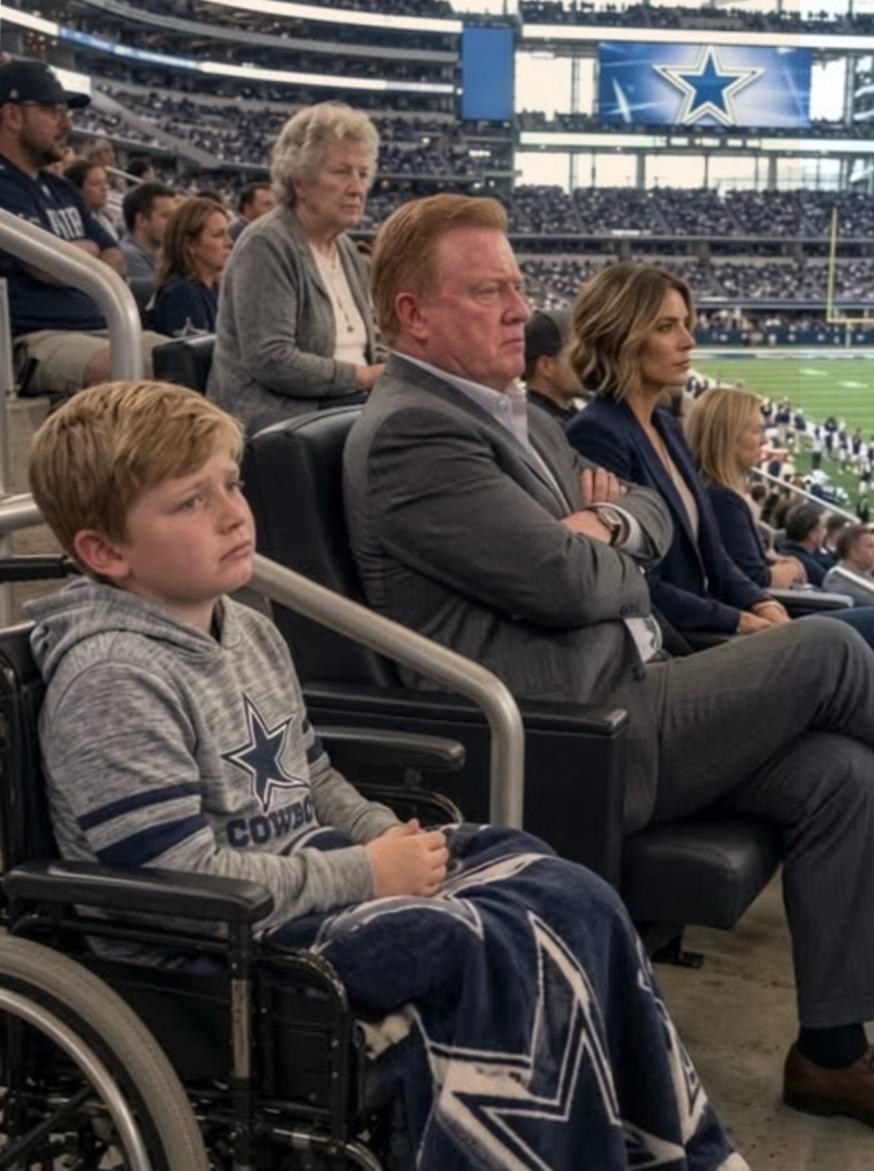

At the moment when my eleven-year-old son quietly told me, “I can watch from the corridor too,” I realized that someone had taken even his last dream away from him.
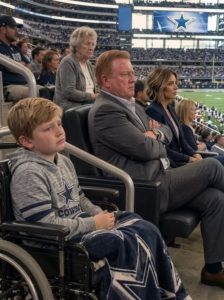
It was Saturday, six in the evening, and at the stadium entrance people were mingling as if the whole city were breathing at once. The air smelled of roasted corn and hot bread. Caleb sat in front of me in his wheelchair, gripping a little red-and-gold scarf so tightly that his fingers had gone white.
“Mom, will I really see the field?” he asked.
“From the very first rows, my boy. You will see everything.”
He had been talking about this match for four months. He was six when he first played football. Since then, he watched matches every week, knew the players’ names by heart, and invented a victory dance in the yard with his friends.
But six months earlier, one moment had been enough to change everything. After school Caleb saw a little boy run into the road to retrieve a ball. A pickup was coming straight toward him. Caleb ran, shoved the boy, and threw him onto the sidewalk.
There was no time left to save himself.
After the operation, the doctors told me that he might never stand on his feet again. Caleb lay in the hospital bed and thought about only one thing.
“Mom, if I hadn’t run, that boy would have been hit by the car…”
“I know, Caleb. I know.”
He never regretted that day.
I skipped lunches to pay for the match tickets, sold jewelry, and for several weeks walked instead of taking the bus. In the end I spent almost all my savings on two adapted seats. His name was not written on the tickets, but to me they were Caleb’s return to the world he loved so much.

We arrived at the appropriate section at six fifteen in the evening. The doors opened and Caleb’s face lit up.
“Mom, I can smell the grass!”
Then we saw our seats.
In the space intended for a wheelchair lay a woman’s expensive bag, and beside it sat a broad-shouldered man, looking at the field with a satisfied smile. A gold watch glittered on his wrist.
“Excuse me,” I said, holding out the tickets. “These are our seats.”
The man looked at the ticket, then at Caleb.
“Sit somewhere else.”
“He cannot sit somewhere else. This is a special seat.”
He shrugged.
“Not my problem. I need a good view.”
“My son has a wheelchair.”
“I can see that. That is exactly why I am saying he should watch from the corridor. Are you sure he even understands football?”
His wife quietly giggled.
I realized that my hands were trembling, but I did not back away.
“I will call security.”
“Call whoever you want. I spend more money here than people like you spend in an entire year.”
An employee standing behind us awkwardly stepped forward, but the man wagged a finger at him.
“Dato, do not interfere. He is my guest.”
Caleb tugged at my sleeve.
“It’s all right, Mom. Really. I can see from the corridor too.”
There was such exhaustion in his voice, as if he had returned again between the hospital walls. That hurt me more than the man’s words.
And then, behind us, a calm voice sounded.
“You. Stand up. Right now.”

Everyone turned around. A small, white-haired woman was standing there. She wore a simple brown jacket and held an old metal lunch box in her hand. Her fingers rested calmly on the box’s clasp.
The man chuckled.
“Ma’am, do not interfere in your own business.”
The old woman came one step closer and held the box toward him.
“Open this.”
“Is it a sandwich?”
“Open it.”
The man lifted the clasp with his finger. At first his face was still ironic, but as soon as he raised the lid, his smile disappeared. He looked inside, then at the woman, and suddenly fell to his knees beside Caleb’s wheelchair.
“No… please, no…” he whispered.
I looked into the box and my breath caught. The man raised his head; fear stood in his eyes.
“Give me another chance to try,” he said.
But the old woman slowly extended her hand toward the folder the security employee was holding…
The old woman’s hand moved toward the security employee’s folder, but before her fingers touched the cover, the man grabbed her wrist.
“No, Mother.”
Such desperation sounded in his voice that the whole section fell silent. The woman only looked at him. Then the man immediately let go, as if he had been burned by his own touch.
I could not understand what was happening.
“Do you know each other?” I asked.
The man did not answer me. He looked first at the metal box, then at Caleb’s red-and-gold scarf. His face no longer resembled the self-confident manager of a few minutes earlier. Sweat broke out on his forehead.
“Mother, not here. Not in front of people.”
“In front of people is exactly where you must speak, Victor,” the woman said.
Her voice was not loud, but it reached the last row.
Victor.
That was how I realized that the security employee knew him by name. He seemed about to say something, but Dato shrugged.
“Mr. Victor, I thought this place…”
“Be quiet,” the man snapped.

The old woman took a small black device from the box. It was an old voice recorder, with a scratched silver strip on its side. She pressed the button.
Victor’s voice sounded.
“If anyone asks, tell them the special seats have already been reserved. Ordinary families cannot do anything anyway.”
It was his voice. Exactly his.
The woman put the recorder back into the box.
“Where did you find this?” I barely asked.
“In my home,” she answered. “In the room where no one can enter my son’s anymore.”
Victor lowered his head.
“This recording is old.”
“It is from three days ago,” she said. “And you knew that.”
A cold heaviness settled in my heart. Caleb listened silently. The end of the scarf lying on his lap had fallen to the floor and touched the wheel.
“Mother, please,” Victor said. “I made a mistake only this once.”
“No. Today I saw for the first time how you behave when you think no one would dare stop you.”
At that moment the head of security, a tall woman named Salome, came over.
“Mr. Victor, these seats are definitely indicated on these tickets. Please move.”
“You believe her too?”
“I obey the rules.”
Victor looked at me.
“Ma’am, we can reach an agreement. We will take you to my private box.”
“I do not want an agreement. I want my son to sit in the place he bought.”
“I will give you your money back.”
“We have already paid the money. And I did not buy this place so that you could ask for charity.”

Caleb squeezed my hand.
“Mom, if they really move us, let’s go.”
Victor immediately smiled, as if his victory were still possible.
“You see? He is ready himself.”
“My son is ready for you to leave us alone,” I said.
The old woman closed the metal box. The sound of the clasp was very clear.
“Victor, now you have a choice,” she said. “Either you return the place to this child and confess everything, or I will open the documents in the folder.”
“What documents?”
“Your signature. Your orders. And the money that was intended for people.”
Victor turned pale.
For the first time I saw on his face not shame, but fear that someone had found his wall.
“You cannot do this,” he said.
“I already have.”
Salome opened the folder. She took out the top sheet, but had not unfolded it yet.
Victor looked at Caleb.
“Boy, do you want this evening not to be ruined for you?”
Caleb stared at him for a long time.
“You already ruined it for me.”
Victor’s jaw tightened.
At that moment the whole stadium was shouting, the players were coming onto the field, but for us time seemed to stop. The old woman signaled Salome to show the paper to everyone.
Salome raised the document high.
“Ma’am, you must know first that this is not only a matter of seats,” she told me. “This sheet changes more than anyone here today can imagine.”
She turned over the first page, and Victor closed his eyes. Then the telephone rang. His lawyer’s name appeared on the screen.
Victor answered the call.
“Mr. Victor,” a voice sounded loudly, “the police have already received…”
Victor dropped the phone from his hand.
The old woman turned toward me and quietly said:
“Nino, now you will understand why I have carried this box for twenty-nine years…”
But before she could say the reason, an unknown recording began playing on the stadium’s big screen…

First a black background appeared on the big screen, then a small back room. An old stadium sign hung on the wall, an empty coffee cup lay on the table, and the camera was filming Victor’s face directly.
In the recording he was exactly as calm as he had been a few minutes earlier, before everything collapsed.
“Adapted seats must be sold expensively,” he was saying. “If anyone complains, tell them the system is working incorrectly. The main thing is for revenue to increase.”
Someone in the section sighed.
Victor looked at the screen.
“Turn this off!”
Salome shook her head.
“I did not turn this video on.”
The old woman placed her hand on the metal box.
“I turned it on.”
Victor turned toward her.
“Mother, you have no idea what you are doing.”
“I know, Victor. I have been learning for twenty-nine years.”
She took a small photograph from the box. In the photograph a young boy sat in a wheelchair, and beside him fifteen-year-old Victor stood, wrapping a red-and-gold scarf around his arm.
“This was my son Niko,” the woman said. “Your brother. After the same accident he could no longer walk. Father built this stadium so that Niko and people like him would never have to watch matches from the corridor.”
Victor said quietly:
“Niko is gone.”
“But his promise remained. And you robbed the foundation created in his name for three years.”
Salome took several sheets from the folder.
“This is an audit of the foundation’s expenses. The money intended for ramps, the elevator, and special seats turned out to have been transferred to private companies. And the owner of those companies is…”
“Do not continue,” Victor whispered.
“Victor Beridze himself,” Salome finished.
The strength left my legs. I leaned on the handle of Caleb’s wheelchair.
“So you sold these places too?” I asked.
“Only temporarily,” Victor said.
“How many families were forced to watch from the corridor?”
He could not answer.
The old woman turned the voice recorder on again. This time another voice sounded, a child’s, weak and hoarse.
“Victor, if you ever become a big man, please do not forget what it was like when others closed doors because of you.”

Caleb raised his head.
“Is that Niko’s voice?” he asked.
“Yes,” the woman answered. “The last recording he left me.”
Victor fell to his knees, but this time not in front of Caleb. He covered his face with his hands.
“I was just trying to preserve everything.”
“The only thing you preserved was money,” his mother said. “Not Niko’s name.”
Salome signaled the security employees.
“Mr. Beridze, the police are waiting for you outside. You must come with us.”
Victor quickly raised his head.
“The police? Mother, you had your own son arrested?”
“Not me. Your signatures did.”
Caleb turned toward me.
“Mom, can we watch the game now?”
My eyes filled with tears.
“We can, my boy.”
Salome cleared our place. The woman’s bag lay on the floor, and the seats remained empty. I brought Caleb close to the field. The smell of grass could still be felt, but now the roar of victory was mixed into it.
The security employees took Victor away. As he left, he suddenly stopped and looked at the old woman.
“You are still my mother.”
The woman looked at him for a long time.
“That is why I gave you one last chance.”
Her telephone rang again. This time Salome answered, listened to several words, and her face changed.
“Nino, they are calling from the hospital.”
“Why?”
“The investigator in Caleb’s accident case said they found new material about the pickup driver. And this material is connected to Victor’s company.”
The old woman lowered her eyes.
“Then today’s story does not end here.”
I looked at Caleb. He waved to the players on the field and noticed nothing.
That night I still did not know that the answer hidden behind my son’s accident was much closer than I could imagine…
ვიქტორის ბოლო შეტყობინებამ ყველაფერი თავიდან გახსნა…
მეგონა, ყველაზე მძიმე სიმართლე უკვე ვიცოდი.
მაგრამ ბოლო ნაწილი იმაზე მეტს ცვლიდა, ვიდრე ერთი ოჯახის ბედი.
„პატიება შეიძლება მოვიდეს. დაბრუნება — არა.“
ამ სიტყვებზე მან პირველად თვალები დახარა.
👇 ისტორიის ფინალი უკვე გახსნილია
Related posts:
 In the supermarket, my son pointed at an unknown woman and said that she had been playing in our bedroom — the woman’s smile disappeared
 On the twelfth night after giving birth, my mother-in-law threw us out of the house, but after one answer from my husband his father froze on the spot
 Part 4 — My son’s wheelchair space was taken away, but the man’s face changed when the old woman opened the little box
 A woman who came to a blind date was slapped by her ex-husband in front of everyone, but one question from me immediately erased her smile
 My Father Was Fed by a Poor Woman at Night, but When I Followed Her Trail, a Stranger’s Face Suddenly Turned Pale
 An Unknown Man Humiliated Me in Front of Everyone, but the Restaurant Owner Looked at Me Only Once — and His Smile Immediately Disappeared