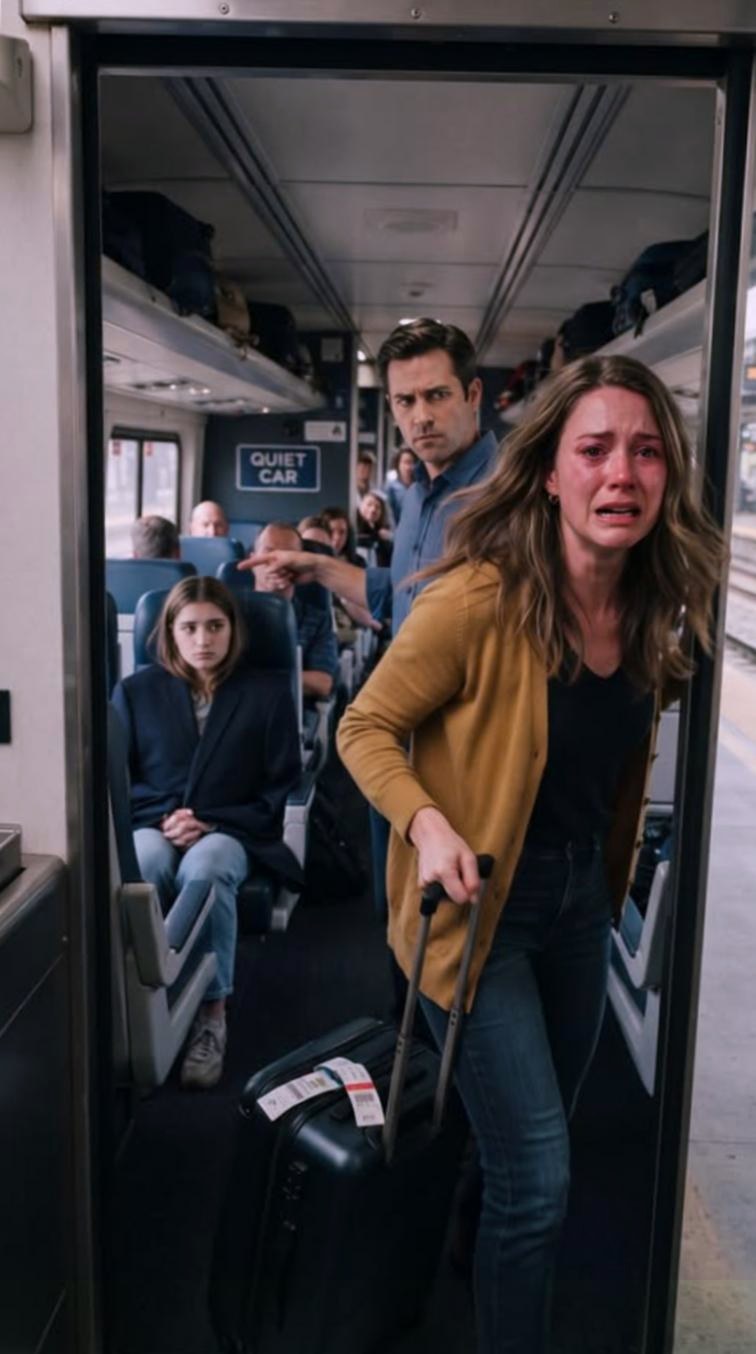



When I read the message, Daniel immediately realized that even his last bluff had failed.
Police officers appeared at the station door.
Nora closed the laptop and stood in front of me.
“You’re not going anywhere alone,” she told me.
“I wasn’t planning to.”
Daniel put the phone in his pocket.
“All of this may still be resolved.”
“No,” I said. “Now only an investigation remains.”
His lawyer arrived ten minutes later. He was holding a gray briefcase and entered the station café with such speed, as though he already knew that everything here was heading toward an end.
“My client will not comment,” he said.
Daniel smiled nervously.
“Lawrence, tell her that this is a family misunderstanding.”
The lawyer looked toward the laptop.
“Does a recording exist?”
“It does,” I answered.
“And the documents?”
“From the bank, from the lawyer, and from the signature examination.”
He looked at Daniel.
“You did all this?”
Daniel looked away.
“I was going to fix it.”
The lawyer closed his briefcase.
“Then find another lawyer. I will no longer be involved in this case.”
For the first time, Daniel was completely alone.



The police officer asked him for his phone. Daniel did not give it to him.
“It’s my personal property.”
“We have a court order,” the officer said.
His fingers gripped the phone so tightly that his knuckles turned white.
Melissa was crying, but this time not because of Daniel. She sat in the chair and stared at her own hands.
I sat down beside her.
“You are not against me,” I told her.
“But you helped him deceive me.”
“A choice made out of fear is not a crime if you tell the truth in the end.”
Daniel raised his head.
“Emily, don’t leave me like this.”
Those words had once immediately awakened guilt in me. Now they simply scattered through the room and fell onto the floor.
“I’m not leaving you alone, Daniel. Your silence simply can’t save you anymore.”
The police took him away for questioning. They did not put him directly in a cell, because the investigation was only beginning, but the investigator clearly told him that he was forbidden to leave the city and contact Melissa.
After he left, Nora played the recording again.
Daniel’s voice sounded through the café.
“After the wedding Emily will also take over my debts.”
Daniel stood right there, between two police officers, and for the first time heard his own words through someone else’s voice.
Something appeared on his face that I had never seen there before.
Fear.
He realized that the recording contained not his intention, but his real voice.
“Turn it off,” he said quietly.
“You said that,” I answered.
“I wasn’t thinking then.”
“That was when you were thinking most honestly.”



That same evening I no longer had to go to the old station. I forwarded the message to the investigator’s phone. They identified the number within several minutes. It had been sent by Daniel’s mother’s lawyer, who wanted to offer me a deal.
“If you withdraw the statement, we will return the money and finish everything quietly.”
I sent only one answer: “The truth has no price.”
Then the calls began.
Daniel’s mother called me.
Melissa’s former banker called me.
And one unknown man told me that, for my own interests, it would be better for me to forget everything.
I recorded every voice and forwarded them to the lawyer.
In three days the bank freed my accounts from the blocked loans. The examination confirmed that the signatures on the documents had been forged. Melissa handed all the conversations and transfers over to the investigators.
Daniel’s mother refused to testify, but that was no longer enough. The movement of money from her account matched the recordings.
The wedding hall was empty when I went to cancel the contract.
The initials of our names still hung on the wall, printed in gold on white paper.
The service manager asked me awkwardly:
“Would you like us to return part of the money?”
“Everything that can be returned,” I said. “I’ll resolve the rest legally.”
When I returned home, I first gathered his belongings.
His razor lay on the bathroom shelf.
His favorite cup remained in the kitchen, with a small crack on its handle.
In the bedroom, the wardrobe was almost empty.
My white dress still hung on the hanger. Beside it, on the floor, lay Daniel’s jacket—the one he had draped over Melissa on the train.
I picked up the jacket, checked the pockets, and took out a photograph of our engagement.
In the photograph Daniel was laughing. My head was resting on his shoulder.
I looked at it for several seconds.
Then I put the photograph in a drawer.
Not because I wanted to hide the past.
I simply no longer needed to see it every day.


Two months passed.
The trial was still continuing, but my life was no longer waiting for its decisions.
I moved with Nora into a small apartment on the other side of the city. In the mornings I walked to work. I was still doing financial auditing, but now I checked every document twice—not because of fear, but because I was learning once again to trust my own caution.
Melissa began therapy and found work in a small library. We met once a week.
One evening Nora’s seven-year-old daughter, Lily, sat beside me and drew with colored pencils.
“Who is this?” I asked when I saw a small house on the paper.
“You.”
“Why do I have such big windows?”
Lily shrugged.
“Because now you look outside.”
This simple sentence struck me more strongly than any court document.
When I returned home, I opened the window. The noise of the city came in, the screech of bus brakes, the long signal of a train in the distance, and the smell of rain.
For the first time in a long while, the road did not frighten me.
The final decision in Daniel’s case was announced four months later. He was found guilty of fraud, forgery of signatures, and taking out illegal loans. His mother was tried for participating in hiding the money. Melissa received a suspended sentence because of her cooperation, and part of her debts was canceled.



I had not waited for their punishment.
My freedom had already begun on the day I got off the train.
One morning, almost half a year later, I received a message from Daniel on my phone.
“Emily, now everything is over. I have changed. Come, let’s talk at least once. Our story should not have ended this way.”
I looked at the screen for a long time.
Then I wrote a reply:
“Our story ended the day you turned my fear into your plan. I am not going back to you. I wish you to live peacefully with your choices.”
I pressed the send button and put the phone aside.
I did not cry.
Nor did I tremble.
In the kitchen I picked up my bag and touched the small brass ticket punch hanging from it. My father had given it to me when I was a child and told me that every journey finds its station.
That day I boarded the train going toward Chicago.
The seat by the window was free.
I sat down, looked outside, and the train moved off calmly.
This time no one was waiting for me behind.
And for the first time I did not want anyone to return.
Missed the beginning?
Related posts:
 My Fiancé Gave His Sister Her Seat on the Train, and I Asked Him One Question—and His Face Immediately Changed
 My son demanded that I open the door of my house on Christmas morning, but he heard something on the phone and his voice suddenly fell silent
 When my daughter-in-law took over my house for Christmas, she made only one mistake — she thought I would still open the door for her, and Daniel turned pale
 I Locked My House for Christmas and Flew to Portugal — My Son Stopped Shouting for the First Time When He Reached the Door
 My husband gave me a choice in front of the family, but one message suddenly erased his smile
 They Built a Wall on My Pasture and Claimed the Land with a Map, but the Iron Marker They Found Changed Everyone’s Face