
The manager was silent for several seconds. I could hear his breathing from the other side of the phone.
“Mr. Nikoloz,” he continued, “when making the reservation, Natia said that you were her father-in-law and that you were financing the entire event. She used your name and the café address as a guarantee for the bill.”
Elene closed her eyes.
Andria looked at Natia.
“You gave them the address of my parents’ café?”
Natia immediately adopted a defensive tone.
“Otherwise they would not have reserved the hall for us.”
“But that was not your right,” I said.
“Don’t act as though we were strangers.”
“That is precisely why it hurts me: because we are not strangers.”
The manager told me that at ten o’clock in the evening Natia had told a restaurant employee that our signature would be on the bill in the morning. Then she had sent electronically a copy of my old identity card, which I had given to Andria years ago to handle a banking matter.
This was no longer simply a family embarrassment.
“Can you send all this to me in writing?” I asked.
“We have already sent it. And I advise you to contact a lawyer.”
The call ended.

Natia pulled the chair out so sharply that its wooden leg screeched bitterly across the floor.
“Nikoloz, if you do this, we will lose everything.”
“I have taken nothing from you.”
“The restaurant, the bill, the people… Will you call everyone?”
“I will tell everyone the truth.”
Andria stood in the middle of the room. He still held the phone from which he had heard his own voice.
“Natia, why did you do this?”
“Your family always thought that we were dependent on them.”
“We were dependent,” he said. “But that did not give you the right to spend Mother’s money.”
For the first time I heard not anger in his voice, but shame.
Kata stood by the window. The balloons left in the yard touched one another in the wind and quietly deflated.
“I want to leave,” she said.
Natia turned her head sharply.
“Where will you go?”
“I will stay with Grandma and Grandpa until my birthday is over.”
“I am your mother.”
“I know. That is why it hurts me more.”
That evening Elene and I sent all the documents to the restaurant manager. The lawyer also clearly said that without our signature no debt could be transferred to us.
“I cannot involve you in this matter,” he told Natia by phone. “You created the problem yourself, and now you will have to answer for it yourself.”

Natia immediately tried another way. She demanded that Andria ask money from him. Andria refused.
Then she called me.
“Dad, please, help us just once.”
“I have already helped you all my life.”
“I am your son.”
“That is precisely why I am telling you: I will no longer accept all the consequences in your place.”
I ended the call and sat motionless in the kitchen for a long time.
Elene stood in front of me. The bandage on her burned fingers had already been changed.
“Perhaps you are being too strict,” she said quietly.
“Maybe.”
“Andria is still our son.”
“He is our son. But he is an adult who must understand that a mother’s love is not a right.”
That night Andria and Kata stayed with us. Natia left alone. The sound of her heels could be heard in the corridor for a long time, and then the door closed.
In the morning Andria listened to the recording again on the phone. This time Elene and I were sitting beside him.
“Dad will stay silent anyway.”
When his own words ended, Andria buried his head in his hands.
“I really thought that,” he said. “I thought you would always solve everything.”
“I was teaching you this through my silence too,” I answered. “Every time I paid in your place, I showed you that responsibility could be handed over to someone else.”

Andria looked at his mother.
“Forgive me.”
Elene extended her hand, but she did not hug him immediately.
“Forgiveness is possible, Andria. But trust must be built again by you.”
After that, everything settled quickly, but peacefully.
The restaurant sent Natia and Andria a separate bill. They were forced to cover the remaining amount themselves. We did not call the guests, but Kata sent them a short message: the party would be held again in the grandparents’ yard, this time only for those who truly wanted to come.
Natia did not appear for several days.
I began repairing the café oven for Elene. A repairman came in the morning and took out the old, burned heating element.
“How long have you been putting off replacing this?” he asked.
Elene looked at me.
“For a very long time.”
“Now we will replace it,” I said.
While tidying the empty yard, I found one thing. Under one of the balloons, on the grass, lay the small paper label from the peach pie. Elene had written on it: “Andria’s favorite, a taste of childhood.”
I picked up the label and put it in my wallet.

It was the only thing I brought home from that day.
Three weeks later the café reopened. The new oven hummed softly. In the morning Elene kneaded dough, while I drank coffee by the window and organized the orders.
Kata often came. Returning from school, she went straight into the kitchen and put on an apron.
“Grandma, will you teach me to make peach pie today?”
“Not today. Today you will make it yourself, and I will only watch you.”
The first pie burned slightly, but Kata began to laugh. Elene laughed too. And I realized that our house was becoming noisy again, only this time that noise came not from obligation, but from love.
Andria came every week and returned the money to us. Not all at once, not in a heroic gesture. Little by little. From his salary. Once he sat alone with me.
“I left Natia,” he told me.
I asked him nothing.
“We have not finally ended everything, but I no longer intend to remain together only because I am a son and a husband. For the first time I am trying to understand what I want.”
“That is your matter now.”
“I know.”
For the first time, there was no demand in his voice.

Several months passed. At the end of spring we hung a small board on the café door: “Dish of the day—for people who say thank you.”
At first Elene thought it was too strict.
“Whoever reads it will understand,” I told her.
“Those who want to will understand anyway.”
One morning I received a message from Natia. It said that she regretted everything and wanted us to meet at least once “to bring the old family back.”
I showed the phone to Elene.
“What will you answer?” she asked.
I looked at the street from the window. People were entering the café there. Some alone, some with their children. Everyone had their own story.
“I will write that I no longer want to return to the old family,” I told her.
“Is that too strict?”
“No. It is simply the truth.”
I sent the message: “I forgive you, but I am not going back to the life where correcting your mistakes was my duty. If you ever want to build a new relationship, it must begin with the truth.”

No reply came.
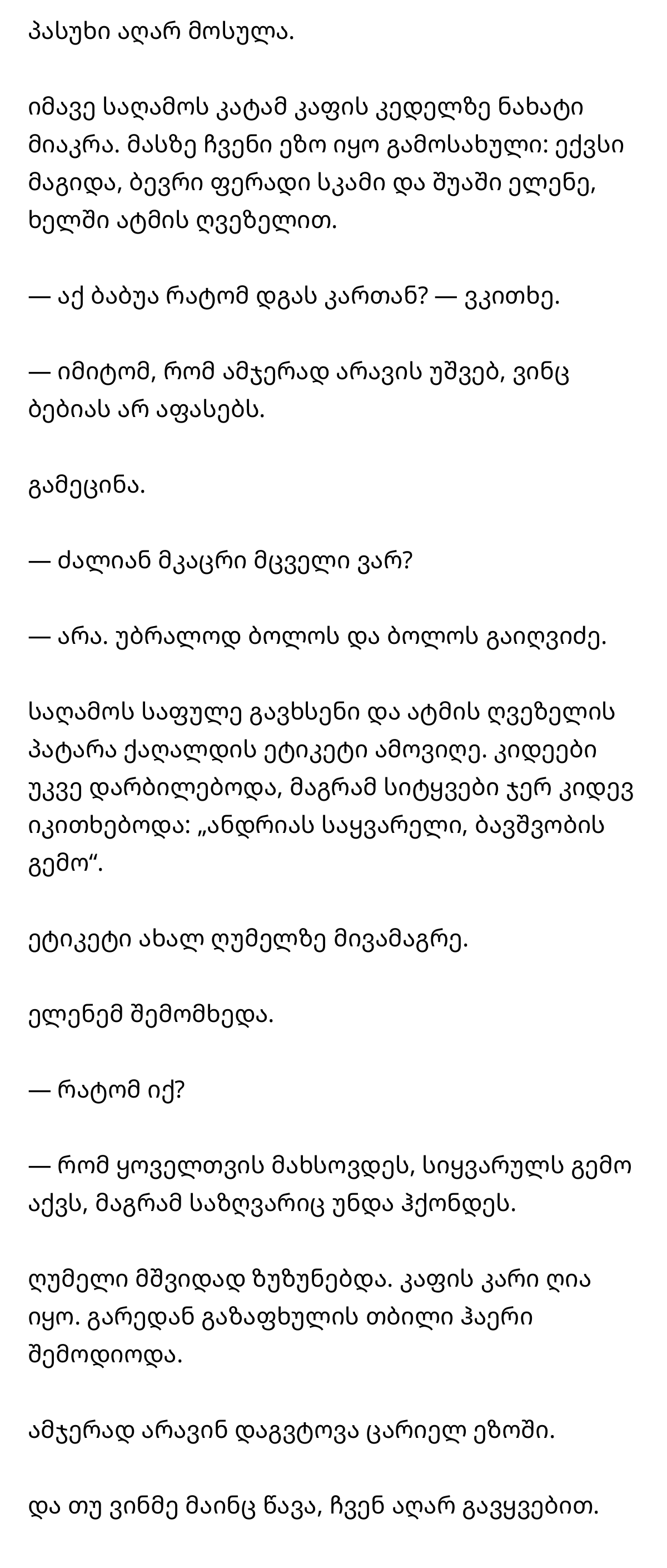
That same evening Kata attached a drawing to the café wall. It depicted our yard: six tables, many colorful chairs, and Elene in the middle, holding a peach pie.
“Why is Grandpa standing by the door here?” I asked.
“Because this time you let in no one who does not value Grandma.”
I laughed.
“Am I a very strict guard?”
“No. You simply finally woke up.”
In the evening I opened my wallet and took out the small paper label from the peach pie. Its edges had already softened, but the words could still be read: “Andria’s favorite, a taste of childhood.”
I attached the label to the new oven.
Elene looked at me.
“Why there?”
“So that I will always remember that love has a taste, but it must also have a boundary.”
The oven hummed quietly. The café door was open. Warm spring air entered from outside.
This time no one left us in an empty yard.
And if someone does leave anyway, we will no longer follow them.
Missed the beginning?
Related posts:
 My daughter-in-law emptied our yard in front of the guests, but her hands trembled when she heard one decision of mine
 Six days after giving birth, my husband took my child from me to court, but even the lawyer stopped breathing when he saw my uniform
 My husband left me and the children in poverty, but his mother stopped at the door, and her expression changed strangely.
 In the eighth month of pregnancy, I saw oil on the stairs, but when a scream came from below, my husband froze
 My husband gave flowers to his former lover, and I left the hall — behind the cameras, his smile disappeared
 I Overheard My Husband’s Secret Conversation at the Airport, but When He Mentioned Losing My House, His Companion Suddenly Turned Pale