
While my husband was taking my infant from my hands in the hospital corridor, I thought for the first time that this man had already planned in advance to take away his own child.
That night I slept for only an hour and a half. Then I woke again to Luka’s crying; my body hurt, my stitches burned, but Marina, David’s mother, called to me from the kitchen:
“Breakfast must be ready by morning. Take out the chicken.”
It was twenty minutes to four. Everyone in the house was asleep except the baby and the pain in my body. I went into the kitchen, put the chicken on the board, and wrapped Luka in the only clean blanket, which was hanging over the back of the chair. The blanket had a small yellow duck-shaped clip that had been left to us by my niece. Every time, Luka gripped its corner with his fingers.
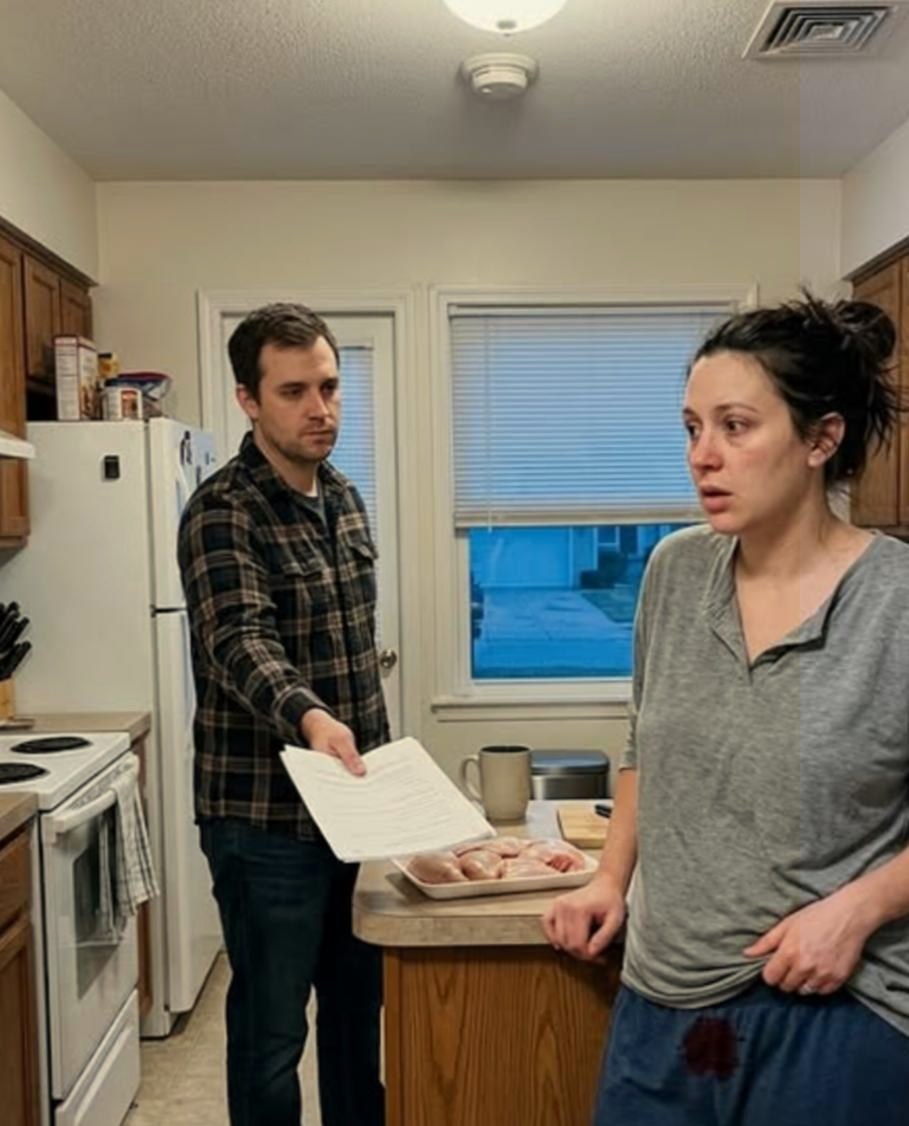
David returned when the sky beyond the window was still black. He quietly closed the door, took off his shoes, and did not even look at me. He was holding several papers.
“Sign it before everyone wakes up,” he told me.
He put the papers beside the raw chicken.
First I looked at the title, then at his face. I felt hot wetness in the area of my waist. My stitches had opened. Near the belt of my old pajamas, blood was slowly but clearly gathering color.

“David, I need to go to the hospital.”
“You are dramatizing again.”
“I am bleeding.”
“Then sign faster. Mother will wake up soon, and I do not want her to witness all this.”
There was that calm tone in his voice which he used with others when he wanted me to appear unstable. I took my phone. I photographed the kitchen, the chicken, the papers, and the darkening stain on my pajamas. Then I held Luka to my chest and left the house.
At the hospital where David worked, it was twelve minutes past six in the morning. At reception, the woman first looked at the baby, then at the bloodstain that had appeared on my waist.
“Whom should I call?” she asked.
“The family-safety protector. Elene K’avtaradze.”
She asked no additional questions. She waited for me near the elevators and led me straight into a small examination room. The nurse brought a basket for Luka, while I put my phone on the bed.
Exactly then the door opened.

David was already in medical clothing. His pass hung on his chest. He entered the room as if he had the right to everything there.
“She is exhausted,” he told the nurse. “She has not looked like herself since giving birth. Give me the baby and the phone.”
He reached toward the basket.
With one hand I pulled the basket toward me, and with the other I handed the phone to Elene.
“No. Save the photographs. Do not let him delete anything.”
David’s face changed for the first time.
“Nino, do not do this.”
“Do not touch the baby again.”
The nurse asked him to step back. David stepped back, but in such a way that his pass remained visible to everyone. As if working in this place automatically meant that he was the safest person.
Elene opened the first photograph. The chicken was still on the board. The papers were visible beside it. The bloodstain on the pajamas could also be clearly seen.

“This is only a draft,” David said. “She thinks I have already decided everything.”
“You told me to sign before everyone woke up,” I said.
“My mother needed food.”
“And taking the baby away?”
David looked away.
Elene asked me questions slowly. Had anyone locked the door? Had they taken away my keys? Had they told me that I could not take the baby?
“No one locked the door,” I answered. “They thought I was so exhausted that I would not even be able to walk.”
The nurse examined the wound and quietly said that I needed treatment. She recorded my condition, my clothing, and the time of arrival. It was a simple record, but that morning I needed precisely simple facts.
David reached toward the phone again. This time his fingers caught the edge of the protective case.
“Let go,” I said.

He looked at the nurse, then at the phone, and slowly raised his head.
Elene spread the papers apart. The first page said divorce petition. The following pages contained a temporary agreement according to which I was to leave the house, while the child would remain with David until I “recovered.”
“I have never seen this,” I said.
“It was temporary. Mother would help you.”
At that moment I realized that the word “mother” was not an answer, but the shadow of the entire plan. Elene opened a transparent folder and reached toward the last page…
Elene’s fingers touched the last page, but she had not turned it over yet. Only the even beeping of the machine and the soft rustling of Luka’s blanket could be heard in the room.
“Before you sign anything, we must document every page,” she told me.
“She was not going to sign,” David interrupted. “She is simply in an emotional state.”},{

“Her emotional state does not change the authenticity of this document,” Elene answered calmly.
She closed the folder, numbered the papers, and photographed each page. Then she wrote down the case number indicated on the petition.
“Now we will check in the public court record what has actually been filed,” she said.
I held the phone so tightly that my fingers turned white. Several times I tapped the wrong place on the screen. They brought me a glass of water, but I forgot to drink it.
Elene entered the case number.
“The petition was filed yesterday, in the second half of the day,” she said. “But this temporary agreement is not signed. Nor is there any temporary custody order for the child.”
David exhaled quickly.
“I said that I had filed it. That is true.”
“You spoke to me as if the decision already existed,” I said.
“Because it soon will.”

“Soon and already are not the same.”
His gaze hardened. For the first time he was no longer trying to look like an exhausted husband. Now a man stood before me who had encountered an unexpected obstacle in his plan.
At that very moment a message came to my phone.
“The child’s room is ready. There is no need to make everything more difficult.”
The sender was David.
I looked at him, then at the screen. He did not ask whether I had received the message. He simply knew.
“Do not answer,” Elene told me. “Save it.”
I took a screenshot of the screen.
“Is this a threat?”
“We cannot call it that yet,” Elene said. “But these are his words. And his words matter.”
The nurse pushed the basket toward the protected-patients’ corridor. I followed beside Luka. He clenched the blanket’s yellow duck-shaped clip in his fist, and then I realized that all the way I had been carrying the child as if this small plastic object were the only thing still connecting me to my old life.

David caught up with us at the door.
“Nino, where are you going?”
“To a room you cannot enter.”
“I am his father.”
“And I am his mother. That does not give you the right to take my phone or my child away from me.”
“You do not know what you are doing.”
“For the first time, I know exactly.”
As we entered the protected corridor, the door locked behind us. David’s face remained in the glass. He stood there for several seconds, then took out his phone and called someone.
Elene requested copies of my medical records, recorded the exact time of my arrival, and asked that David not be told my room number. Then she asked whether I could list the things left at home.
“I only want the child’s documents, clothes, and my work bag.”
“Anything else?”
I fell silent.

I thought about the photograph taken in the kitchen. Besides the papers, something else was visible there—a small camera monitor placed beside the refrigerator. It had been on all night because Luka’s crib was in the room adjoining the kitchen.
“There is a baby monitor at home,” I said. “A recording may be stored.”
Elene looked at me immediately.
“Who controls it?”
“David. But I set the password. I think I still remember it.”
I picked up the phone. The camera application opened, but the recordings section appeared empty. Elene watched the screen.
“It may not upload automatically. Could it be stored on another device?”
I did not have time to answer. A new message appeared on the screen—this time from an unknown number.
“If you do not return the child today, I will tell the police that you ran away from home and took him.”
Elene photographed the message.

Then she looked toward the small device hidden in Luka’s blanket and asked me quietly:
“Nino, are you sure there was only a camera at home?…”
Elene’s question remained hanging in the air. For several seconds I heard only Luka’s breathing. Then I remembered a small white device that David had placed in the child’s room and told me only detected the sound of crying.
“There was another sensor on the wall,” I said. “He told me it monitored the quality of the baby’s sleep.”
Elene immediately called a hospital technical employee. Half an hour later a young man came into the room, holding a tablet.
“If this device was on the network, a backup recording may exist,” he said.
“Were things recorded at home this morning?” I asked.
“Possibly. But access depends on the password.”
I entered the password. It was incorrect the first time. The second time as well. On the third attempt, a list of dates appeared on the screen.

Elene selected the recording—four eleven in the morning.
The image was of poor quality, but the sound was clear.
In the recording, I entered the kitchen. I was holding Luka. Several minutes later Marina’s voice was heard.
“If you do not sign, they will take the child away from you too and throw you out of the house.”
In the recording my voice was trembling.
“My stitches have opened. I need to go to the hospital.”
Then David’s voice was heard, calm and cold.
“Sign first. Then go.”
Everyone in the room fell silent.
David, who was standing at the door, gradually lost the color from his face. Elene played the recording again.
“This is fabricated,” he said.
“It is your voice,” I said.

“Someone may have edited it.”
The technician turned the tablet around.
“The recording was downloaded directly from the device’s server. The time intervals are continuous. There is no trace of editing.”
David grabbed the door handle.
“I was simply trying to calm her down.”
“In the recording you say that you will take the child away from me if I do not sign,” I said. “That is not calming someone down.”
Marina called me then. Elene turned on the speaker, but I did not say anything.
“Nino, where are you?” her voice sounded. “David told me that you are making scenes again.”
David lowered his eyes.
“Mother, do not call now.”
“I am only telling her that her condition is bad for the child. The lawyer said that if she leaves today, it will work against her.”
Elene ended the call.
“Now we have a document, messages, and an audio recording,” she said. “But there is one more thing we must find out. Why were they in such a hurry?”

I looked at David.
“Why?”
He could not say a word.
Elene placed an additional page taken from the case file on the table. It said that our house was to be put up for sale as soon as the divorce process began, and that the child’s residential address was temporarily to be registered at Marina’s house.
“They wanted to sell the house?” I asked.
“We have debts,” David said.
“You told me everything was fine.”
“Everything depended on me.”
“And therefore I had to disappear from the house?”
For the first time David could not cast me in the role of the guilty one. He could not tell me that I was overly sensitive. He simply stood and watched the recording in which his own voice could be heard.
Elene closed the file.
“Now we need a safety plan, a lawyer, and a request for temporary protection of the child. But first there is one issue.”
A call came to my phone.
David’s lawyer’s number appeared on the screen.
I answered.

“Mrs. Nino,” the man said, “your husband claims that you unlawfully took the child from the house and refuse to return him. If you do not appear at the police station within one hour, we will be forced to…”
Elene raised her hand so that I would not interrupt.
At that moment I realized that David had still not heard the recording to the end. He thought that simply bringing me to the hospital would change everything.
But Elene found one more file on the tablet, whose name carried the time of that same morning.
She opened it and her face changed.
“Nino, this is no longer only a conversation between you and David,” she told me. “Here we can hear how they planned to take you away from the hospital…”
მისმა საკუთარმა ხმამ ყველაფერი მის წინააღმდეგ შემოაბრუნა…
მეგონა, ყველაზე მძიმე უკვე გადავიტანე. მაგრამ ფინალმა მაჩვენა, რამდენად შორს წავიდა მათი გეგმა.
„მთავარია, ბავშვი ჩემთან აღმოჩნდეს.“
დავითმა პირველად ვერაფერი თქვა.
👇 ისტორიის ფინალი უკვე გახსნილია
Related posts:
 Before our fifth anniversary, I overheard my husband’s secret conversation and his laughter suddenly stopped
 My Former Billionaire Husband Left Me Because of the Children, but He Saw the Twins in a Restaurant and Lost the Color in His Face
 For three years he told me that he would never walk again, but when his laughter returned home, it froze my husband in place
 When my twelve-year-old daughter was ordered to clear out her own room, my husband’s calm smile suddenly made them go pale
 My daughter-in-law rented my mother’s lake house for a party, but after my calm response my husband stopped speaking
 I was bathing Dante’s mother at home when Luka’s unexpected question silenced the entire room