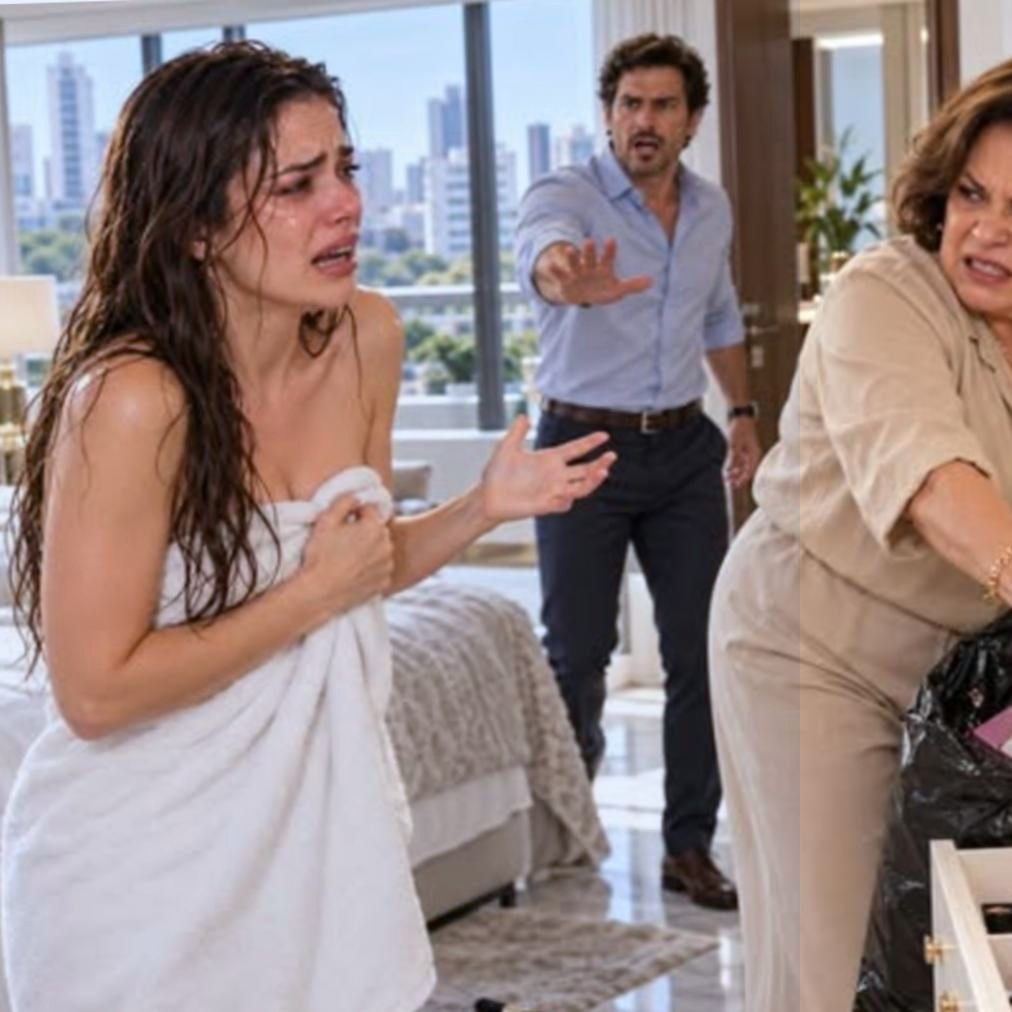

We received Celina’s statement that same evening. The lawyer, Rafael, spread the papers across the table and ran a hand over his forehead.
“This is not just an accusation,” he said. “She requested a temporary prohibition so that you cannot sell or re-register the apartment.”
Andre sat pale.
“Can she do that?”
“She can try. But we have camera footage, photographs, an audio recording, and bank statements.”
I photographed my wrist. Camila handed the memory card to the lawyer. Rafael listened to the recording to the end and then paused in silence for several seconds.
“Now she will have to retreat.”
Andre called his mother.
Celina answered immediately.
“You finally understood that your wife lied to you?”
“Mother, the lawyer heard everything.”
“What everything?”
“Your recording. Your plan. The lie about the apartment.”
Silence fell on the other side.
Then Celina chuckled.
“The recording means nothing. I was simply angry.”


“You said that you would deliberately smash the things.”
“And are you really going to testify against your mother?”
Andre closed his eyes.
“For the first time I am going to stop going against the truth.”
Celina ended the call.
Several minutes later Rafael called us.
“Her representative is withdrawing from the case.”
“Why?” Andre asked.
“He said that the client had hidden facts from him and had asked him to conceal evidence.”
Andre clenched his jaw. It was as if he was still waiting for his mother to save herself at the last moment. But that night he heard her words from the outside for the first time.
Rafael played the recording once more.
“First I will break the things. Then I will show the receipts.”
His own voice could not be heard, but such pain appeared on Andre’s face, as if he himself had said exactly those words.
“I allowed this for years,” he said quietly.
“You did not do what she did,” I answered.
“But every time I told you, ‘Mother needs patience,’ I left you alone.”

That same night Celina called once more. This time her voice was no longer confident.
“Andre, let us talk. I will withdraw the statement.”
“No, Mother.”
“I will return everything to you.”
“You cannot return my wife’s things to me. You cannot return her trust to me.”
“This woman is turning you against me!”
“No. Your decisions are putting you where you are now.”
He ended the call without answering.
The next morning we went to the police. I told the whole story there: the entry without permission, the destruction of the things, the mark left on my wrist, and the recording. Andre signed all the documents.
Celina was summoned that same week. First she denied everything, then said that she had been unwell, and finally she began to cry.
“I only wanted to protect my son.”
I stood beside her and for the first time was no longer trying to ease her shame.
“Protection is not breaking into someone else’s house,” I told her.

The case reached court. The judge listened to the audio recording, examined the bank statements, and watched the camera footage in which Celina entered through our door. Her request to seize the apartment was rejected. The cost of the damaged things and the lawyer’s expenses were imposed on her.
That day Andre handed over every key he had received from his mother.
“Sometimes the boundary is not a door,” he said, “it is a decision.”
Our bedroom looked empty for several weeks. I could afford to buy new things, but I did not do it immediately. I kept only the small golden cap that had survived from the smashed lipstick. The first letter of my name was still visible on it.
Andre took Celina’s things to his sister. Her room remained empty. On the bed lay only one old photograph in which Andre was a child and was holding his mother’s hand.
“Shall we take this photograph too?” I asked.
Andre looked at it for a long time.
“No. It is her past, but it is no longer my life.”
Three months later I was offered a promotion at work. I received a small office in the city center, where I made coffee myself in the morning and sunlight fell on the desk. In the evening I returned home, where the lock opened only with our permission.
Camila often came over. Once she brought her little daughter, Bea. Bea drew our apartment on a sheet of paper: two windows, a yellow sun, and three people by the door.

“Who is this?” I asked.
“You, Andre, and me,” the child answered. “No one comes in here unless you call them.”
Andre lowered his head. I attached Bea’s drawing to the refrigerator.
On the first morning of winter, when rare cold rain was falling in the city, I received a message from Celina.
“I miss you. May I come at least once?”
I handed the phone to Andre.
He read the message for a long time.
“What do you want to answer?”
“That no.”
“Are you sure?”
I went to the window. Outside, the wet street was shining.
“For the first time I am sure.”
Andre wrote a short answer: “We are well. Please do not come without an invitation anymore.”
Celina did not write to us again.

That evening I rearranged my things from the beginning. I bought new lipsticks, but not of the same brand. I chose a perfume with a light citrus scent. Not even a trace of the old disorder could be seen anymore.
I placed only the small golden cap beside the dressing-table mirror.
Every morning I looked at it and remembered not Celina, but the day when I said for the first time: “This is my house.”
One day Andre asked me:
“Are you peaceful now?”
I looked at myself in the mirror.
“I will be peaceful when my peace no longer needs protection.”
Andre took my hand.
Outside, the rain turned into snow.
The golden cap lit a small light on the mirror.
This house was mine again.
Missed the beginning?
Related posts:
 My mother-in-law smashed my things and showed my husband receipts for seven thousand reais — but the smile disappeared from Andre’s face
 Az esküvőm napján eltűntem, amikor meghallottam anyósom tervét, de amikor később megjelent nálunk, André keze megremegett
 Passei o dia inteiro servindo à família do meu marido, mas uma piada à mesa fez meu advogado empalidecer
 Meu marido embarcou no meu voo com outra mulher e um presente pago pela empresa, mas sua expressão mudou quando me viu sorrir
 I took my mother from the house, but when my brother opened her room with a duplicate key, the color drained from his face
 When They Considered Taking My Mother to the Doctor Humiliating, the Color Drained from My Husband’s Face and a Heavy Silence Fell over the Room