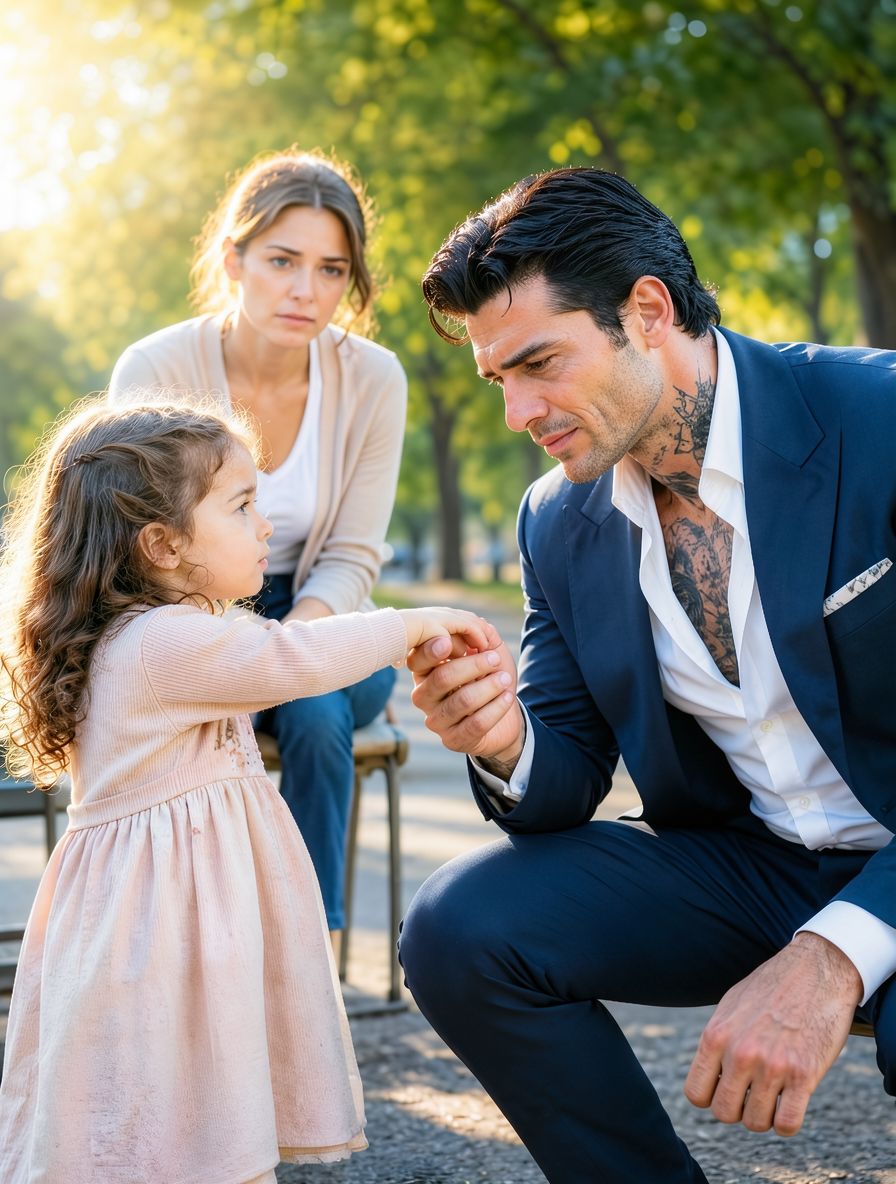
My three-year-old daughter reached for New York’s most feared man and asked him to hold her hand, while I stood frozen beneath the yellow leaves, realizing his eyes were the same blue-gray as hers.
“Daddy, can I hold your hand just once?” Lily asked.
The man in the black coat stopped breathing. Aleandro Moretti had been called many things in the newspapers—criminal kingpin, ruthless businessman, the man no one dared betray—but no one had ever made him look helpless. Until my daughter.
He stared at her red coat, her crooked ponytail, and the purple crayon mark on her cheek. Then his gaze lifted to mine.
“You brought her here,” he whispered.
“No,” I said. “You came to the park where we live.”
For three years, I had raised Lily alone. I worked nights, cleaned apartments during the day, and taught her not to ask for things we could not afford. Not new shoes. Not strawberries unless they were on sale. And never ask why every other child had a father when hers existed only in the pictures she drew.
In every family portrait, Lily drew a tall man with no face and one letter above his head: D.
I had met Aleandro at Rosie’s Diner when I was twenty-six and exhausted enough to mistake attention for safety. He drank black coffee after midnight and listened when I talked. He never told me his real name. I learned it from the news after I discovered I was pregnant.
I left his apartment before dawn with three words written on a napkin: I can’t. I’m sorry.
Then Vincent Russo called me at 11:23 on a rainy Tuesday night.
“Mr. Moretti has known about your daughter from the beginning,” he said.
The plate in my hand slipped and shattered.
“He knows where you live,” Vincent continued. “He knows her daycare. The men watching your building were there to protect you.”
“Then why did he let us struggle?” I asked. “Why did he let her believe she wasn’t worth finding?”
“Ask him yourself.”
Now Aleandro stood in front of us, thinner than I remembered, with a scar near his temple and a trembling hand extended toward Lily.
She placed her tiny fingers in his palm.
His face crumpled.
I should have walked away. Instead, I followed him to his private residence, carrying the wooden box beneath my bed and the sealed envelope I had never sent.
When I slapped him, he did not defend himself.
“You knew,” I said.
“Yes.”
“What else have you been hiding?”
His eyes dropped to the gray folder on the table. Slowly, he reached for the seal, and his fingers began to tear it open…
PART 2
His fingers began to tear it open, slowly, as if the paper between us contained something alive.
Inside was the letter I had written three years earlier, along with Lily’s hospital photograph and a copy of her birth certificate. Beneath them lay another folder, sealed with dark blue tape.
I pointed at it. “What is that?”
Aleandro’s expression changed so completely that the feared man from the newspapers disappeared. For one second, he looked like a terrified father.
“The reason I stayed away,” he said.
“Your reason has a name?”
“A medical file.”
He pushed it toward me, but I kept my hands in my lap.
“My family carries a hereditary heart disorder,” he continued. “My father died at forty-five. My grandfather died younger. After Lily was born, I had a specialist investigate whether I could have passed it to her.”
My throat tightened. “And?”
“The estimated risk was sixty percent.”
The room seemed to tilt.
“You knew she might be sick?”
“I knew she might carry the disease. I did not know whether she did.”
“And you decided I had no right to know?”
He looked directly at me. “Yes.”
His honesty hurt more than any excuse.
He told me he had paid Lily’s daycare through an anonymous account. He had received reports about her favorite books, her stuffed rabbit, and the way she refused to eat green beans. Guards had watched our building, but he had never let them approach us. He believed his enemies would use us against him if he claimed us publicly.
“You kept a file on your daughter,” I said, “but you never held her hand.”
His eyes filled with tears. “I was wrong.”
For two weeks, he did not pressure me. No lawyers arrived. No gifts appeared. He simply waited until I agreed to let Lily meet him in Central Park.
She reached for his hand before I could say a word.
For a little while, we almost believed the danger had passed. Aleandro learned how to cut strawberries into hearts. Lily painted him feeding ducks. I began to wonder whether fear had stolen three years from all of us.
Then Vincent called again.
Money had been moving from Aleandro’s accounts to the Delucci family, his oldest rival. The transfers were hidden through companies overseas. One photograph showed Marco Bellini, Aleandro’s most trusted adviser, shaking hands with Rocco Delucci.
“Marco knows about Lily,” Vincent said. “If he knows, the Deluccis know too.”
That afternoon, I collected Lily from daycare. A black vehicle rolled to the curb. Marco stepped out with a gentle smile.
“Aleandro sent me,” he said. “There has been an emergency.”
A gloved hand covered my mouth. Lily screamed once before someone pulled her into the van.
At the warehouse, Marco chained my wrist to a metal pipe and smiled.
“Aleandro will come alone at seven,” he said. “He wants his daughter. That is why he will finally be easy to destroy.”
At exactly seven, the steel doors groaned open. Aleandro stepped inside alone, and Marco raised his hand toward the waiting guns…
PART 3
Marco raised his hand toward the waiting guns, and every weapon in the warehouse pointed at Aleandro.
He had come without guards, without Vincent, and without the army of loyal men that had protected him for half his life.
“You were my brother,” Aleandro said.
“I was your shadow,” Marco replied. “I built your empire while everyone praised your name.”
Marco wanted power, but he wanted something else too. He wanted Aleandro to understand why he believed betrayal was deserved. That need to explain himself gave Vincent the time he needed.
Beneath the loading floor was an old drainage tunnel. Vincent and the loyal men had entered through it while Marco talked.
The metal grate exploded upward.
Gunfire shattered the warehouse.
Aleandro ran toward the back room, cut the chain around my wrist, and lifted Lily into his arms.
“Go with Vincent,” he ordered.
“No,” I said. “You are coming with us.”
His eyes met mine. “If we stay, none of us leaves.”
I grabbed Lily and ran toward the tunnel. Behind us, Marco broke free and raised his pistol toward the flash of Lily’s red coat.
Aleandro moved first.
He crossed the floor, wrapped his body around our daughter, and took the bullet in his back.
The sound tore through me.
He stayed standing long enough to whisper, “It’s all right. Papa is here.” Then he handed Lily to me, turned, and fired once into Marco’s leg.
Marco collapsed screaming. Vincent’s men restrained him until the police arrived, and the hidden accounts, messages, and warehouse records exposed the entire conspiracy. Marco was arrested for kidnapping, attempted murder, and the violence he had ordered against Aleandro’s family.
At the hospital, the surgeon told me the bullet had passed through Aleandro’s lung and stopped three centimeters from his heart. During the operation, the doctors also implanted the pacemaker he had refused for years.
“He survived,” the surgeon said. “With treatment, he has a future.”
When Aleandro woke, Lily sat beside his bed drawing with purple crayons. She held up the picture proudly: a mother, a little girl, and a tall man with a huge red heart on his chest.
“You took a bullet for her,” I whispered.
“Anytime,” he answered. “Anywhere.”
I forgave him slowly—not because fear excused his absence, but because he finally understood that protection without trust could become another kind of prison.
He sold the illegal parts of his organization, placed his legitimate businesses under strict audits, and created a foundation that paid for heart testing and treatment for children whose parents could barely afford groceries.
Six months later, he proposed on the same park bench where Lily had first reached for his hand.
“Just once?” he whispered when she walked toward him.
Lily shook her head and smiled.
“No, Papa. Every day forever.”
And the man who once believed love meant staying far away held her tiny hand as if it were the only thing keeping the whole world alive.
Related posts:
 I was ordered to feed the city’s most feared man, but when he tasted my burnt garlic, his expression suddenly changed
 My Ex Called Me a Liar, Gave My Best Friend’s Baby His Name, and Raised Him as His Son—Until One Terrifying Hospital Night Revealed Whose Child He Had Really Abandoned
 I signed my former father-in-law into emergency surgery while his own son called him too old to save—and then my ex stopped smiling
 My husband pushed me from a frozen cliff, then complained at my funeral that I had taken too long to die—and someone went pale
 I heard my daughter-in-law showering upstairs while my son said she had flown away, and the woman who entered my kitchen suddenly stopped smiling
 On the Morning of His Wedding, My Former Partner Saw My Three Three-Year-Old Children and Turned White—That Evening, His Bride Found a Second Sealed Envelope Addressed to Me