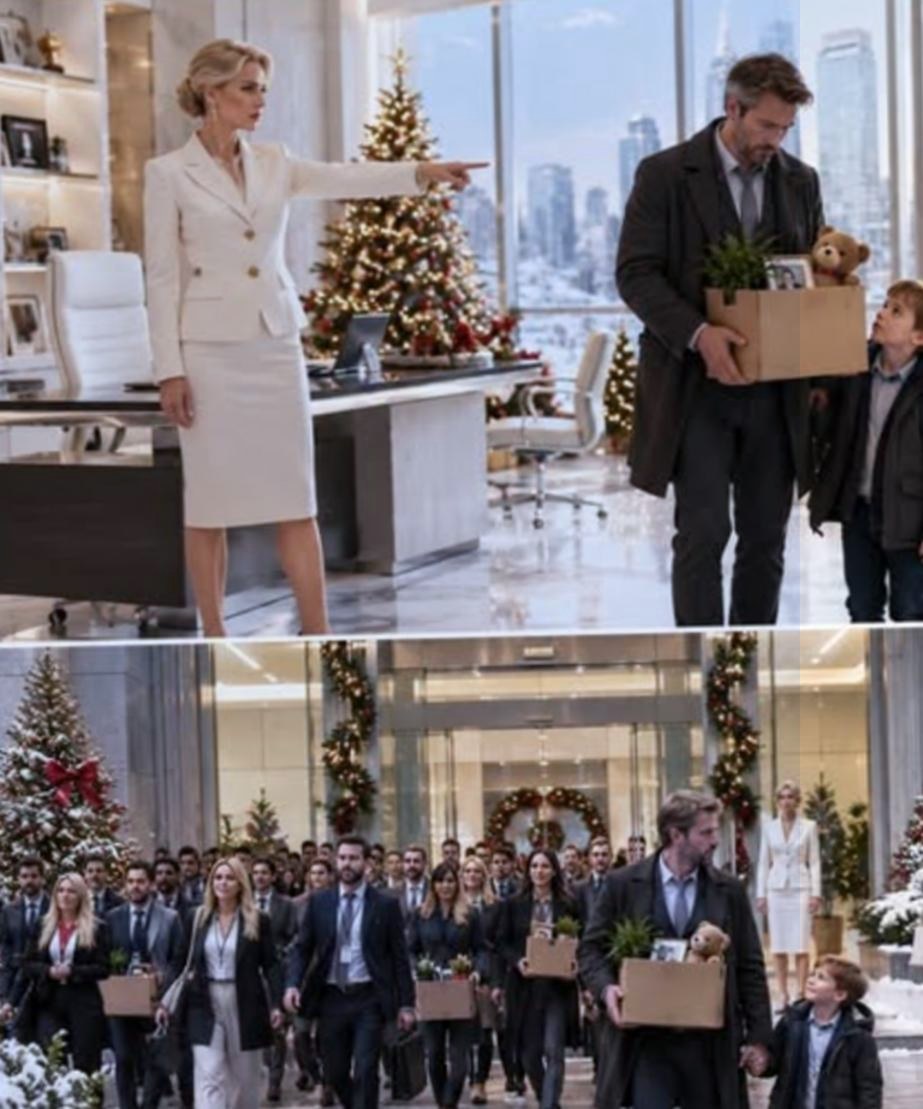

On the morning of December twenty-third, in front of one hundred and eighty people, the director told me that my fourteen years were worth one sentence: “You are a replacement expense.”
In the foyer of the Columbus warehouse, employees were holding red gift boxes. We were supposed to begin the Christmas meeting, but such silence fell over the room that everyone could even hear the click of the lid of my old metal thermos. In my pocket I had a small red train-shaped keychain—a gift from my son, Noah. Every time I touched it, I remembered that I had to be able to get home in the evening at any cost.
Victoria Langford closed the tablet and turned toward me.
“Mason, your position has been eliminated.”
“Today? Two days before Christmas?”
“A company cannot be run by emotions.”
“Nor can a warehouse be run by spreadsheets when a sensor breaks.”
The financial director, Adrian Cole, smiled awkwardly beside her.
“It is nothing personal.”
I looked at them and realized that this was exactly the most personal thing they could have said. I had spent fourteen years there. I had swapped shifts because of sick parents, opened frozen doors by hand, and rebuilt the lines after an accident. But to them I was only a salary.


“When will my final payment be deposited?” I asked.
Victoria was confused for a moment.
“The department will contact you.”
Rachel Dawson, who was in the foyer, put the box on the table.
“He took my shift on the day of my son’s operation,” she said.
“Rachel, this is not the time for discussion,” Victoria replied sternly.
“Maybe not for you.”
I asked Rachel with my eyes to be quiet. I did not want her to lose her job because of me at that moment.
I went to the exit outside. Security took my badge, cut the plastic card in half, and threw it into the trash can. That small sound hurt me more strongly than Victoria’s words.
“Dad, will you come early today?” Noah asked me in the morning when I took him to school.
I told him that perhaps we would go Christmas shopping. Now I did not know how I would look at him in the evening.
It was ten twenty-nine when Rachel took her own badge off her neck.
“If he is leaving, I am leaving too.”
“Go back,” I told her quietly.
“No, Mason. This time I am following you.”

Then Darren took off his badge. Then Luis. Two more followed. Victoria watched them as if this were an ordinary spectacle.
“I am warning everyone,” she shouted. “Only the dismissed employee must leave the building immediately.”
No one answered.
Four hundred and eighty people did not shout at the same time. They simply rose from their workstations, put on their coats, and walked toward the door. The conveyors stopped. The rows of orders on the screens grew. The warehouse showed me for the first time how much depended on invisible trust.
Victoria blocked my path.
“You are forcing them to do this.”
“I am only leaving.”
“If you walk through this door, you will never come back.”
I squeezed Noah’s little train in my pocket.
“Perhaps that is exactly why you wanted to fire me.”
At that moment Adrian quietly said something to the head of security. The head of security came toward me, holding a dark brown folder. He opened the lock, took out the first sheet, and handed it to Victoria. Victoria read it, her expression changed, and she reached toward the folder…

Victoria’s fingers touched the edge of the folder, but I grabbed it before her.
“What is that?” Rachel asked.
“Nothing that concerns you,” Adrian said.
“Then why have you gone pale?” I asked.
Inside the folder was a copy of the November audit. A few weeks earlier, at the request of the company’s owner, Henry Langford, I had begun comparing it with the warehouse’s actual data. The figures did not match. Dozens of payments were going to suppliers who existed only on paper.
“You knew this?” Victoria hissed through her teeth.
“I knew you were hiding something. I did not yet know the truth.”
Adrian stepped forward.
“Give me the folder.”
“No.”
Hundreds of employees were already waiting for me outside. No one was shouting. They were simply all watching.
Rachel took out her phone.
“Mason, there is another document here. With your father’s signature.”
“What document?”
She handed me the sheet. Only one sentence was visible on it, and below it was Henry Langford’s seal.
At that same moment my phone rang. It was Henry’s number, although three months earlier he had told me he could no longer call from the hospital.
I opened the message and read the first words: “If Mason is fired, immediately stop all signatures…”

The phone nearly fell from my hand. Henry Langford had been unconscious after a stroke three months earlier, so I could not believe a message received from him.
“It is fake,” Victoria said quickly. “Adrian, tell security to check everyone’s phones.”
“You can no longer order anyone around,” the head of security replied. “The people have already seen everything.”
I opened the folder. The very first page said that six months earlier Henry had given an independent auditor access to the company’s accounts. According to the audit, Adrian had been transferring money to phantom suppliers for two years, then returning part of the money to a consulting company created by Victoria.
The air in the foyer grew heavy.
“This is nonsense,” Adrian said. “I saved the company.”
Rachel snatched the sheet from me and read aloud:
“‘Falsified accounts, fictitious services, deliberate withholding of employees’ bonuses.’”
Victoria nodded.
“My father did not write this.”
“He did,” I answered. “And more.”
On the last page was a memorandum signed by Henry. It said that if the director dismissed the chief operations coordinator without the consent of the majority of employees, the control board would immediately suspend the director’s authority. The employees’ signed statement was already in the back pocket of the folder.

“Did you prepare this in advance?” Victoria asked me.
“No. Henry did.”
“Why you?”
The document itself answered that question. Fourteen years earlier, when the warehouse was on the verge of bankruptcy, Henry had assigned me to preserve the processes and had left me written authority to make critical decisions when management ignored the employees.
“My father trusted you?” Victoria’s voice broke for the first time.
“He believed that a company was people, not cells in a spreadsheet.”
Adrian reached for the phone.
“Victoria, we need to call our lawyer.”
“I already called,” she said, looking at the screen. “He is not answering.”
Then my phone came to life again. This time the call was from the hospital. The doctor told me that Henry had opened his eyes and spoken his first word.
“The folder.”
“What else did he say?” I asked.
The doctor was silent for several seconds.
“He told us not to trust Adrian. Then he added that the main evidence was no longer in the company.”
Everyone in the foyer turned toward me.
“Where is it?” Rachel asked.
I looked at the folder’s empty back pocket. Henry’s letter indicated one item that I had thrown into a trash can years ago and whose existence no one should have known about anymore.
At that moment a black car stopped outside. Two people got out; one of them was holding a box sealed with a court seal. Victoria saw them and lost the color from her face. And I realized that Henry’s last words had not been only a warning…
ჰენრის ბოლო სიტყვებმა ყველაფერი თავდაყირა დააყენა…
მეგონა, რომ მხოლოდ სამსახური დავკარგე. ფინალში გავიგე, რას იცავდა სინამდვილეში ჩემი დუმილი.
„სწორედ ამიტომ დაგიტოვე.“
მე პირველად ამეტირა.
👇 ისტორიის ფინალი უკვე გახსნილია
Related posts:
 My Six-Year-Old Daughter Quietly Warned Me Before I Flew Away, and the Smile Suddenly Disappeared from My Wife’s Face
 My Father Was Fed by a Poor Woman at Night, but When I Followed Her Trail, a Stranger’s Face Suddenly Turned Pale
 My Husband Returned Every Gift, but That Evening His Right Hand Suddenly Turned Pale
 My husband gave flowers to his former lover, and I left the hall — behind the cameras, his smile disappeared
 I Went to the Cemetery with Five Children, and My Ex-Husband’s Gaze Suddenly Froze
 Three Little Boys Met Me with Humiliation, but When I Told Their Father the Truth, the Glass in His Hand Stopped Motionless





