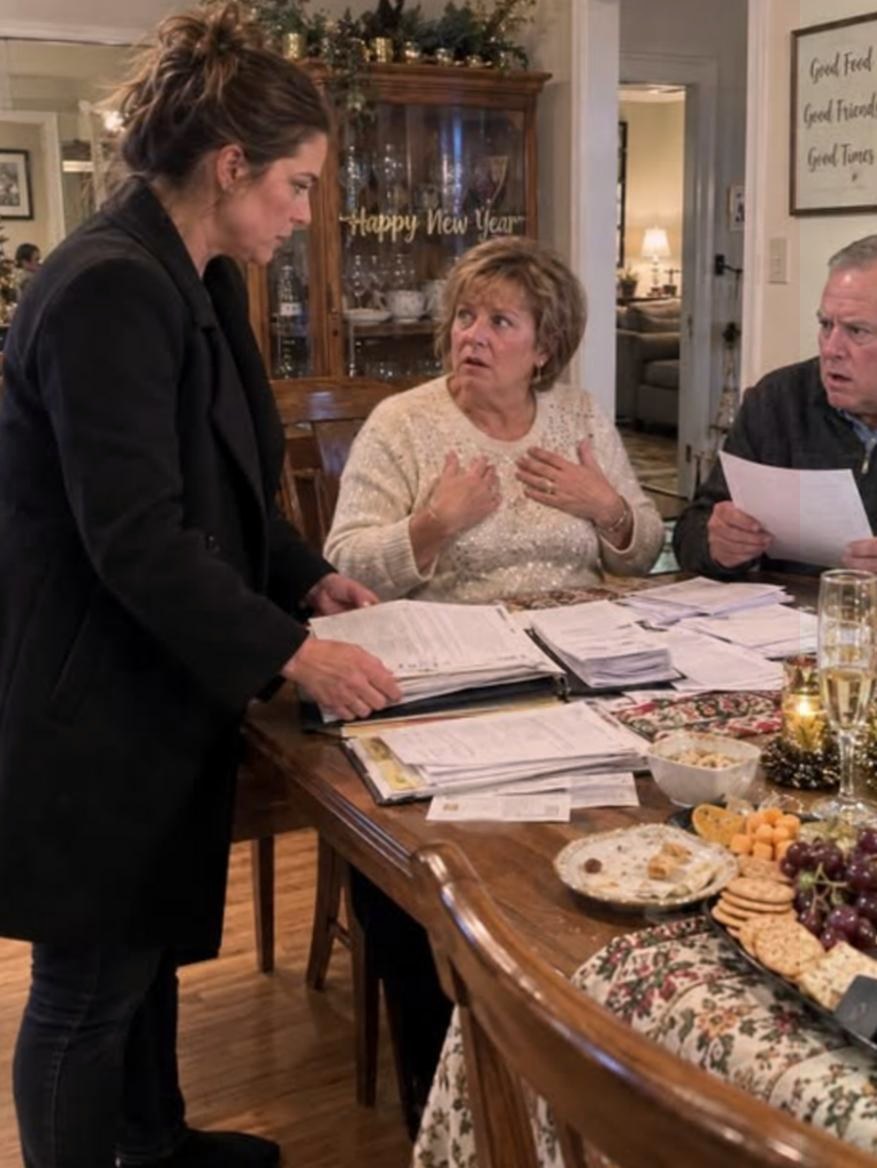

When I saw Arthur’s name, no one in the room could breathe freely anymore.
My mother put her hand on the table.
“Delete this message.”
“Why?”
“Because it means nothing.”
David took the phone from me and checked the number.
“This is a protected number of a law firm. The sender is the administrator of Arthur Bennett’s estate.”
My father went to the window.
“Arthur died ten years ago.”
“Not his estate,” Claire said. “Some cases are opened years later.”
My mother pushed the chair back.
“No one will open anything here.”
David answered calmly:
“They already have.”

That same night the bank temporarily froze all of my parents’ accounts. The reason was checking the origin of the money and investigating the false mortgage claims.
My mother could not let go of the phone.
“Call your adviser,” she told my father. “Tell him Emily made a mistake.”
My father dialed the number.
“Alan, they froze our money.”
Silence fell from the other side for several seconds.
My father stood pale.
“What do you mean, you no longer represent our interests?”
He slowly lowered the phone.
“He’s gone,” he said.
“Who’s gone?” my mother shouted.
“The lawyer. He said he has a conflict of interest and we will have to find a new representative.”
My mother turned toward me.
“You did this.”
“No. You did this.”
“You destroyed our family!”
“I only stopped the transfer.”
My mother covered her face with her hand. My father sat down in the armchair and closed his eyes.

The next day the bank’s investigative group sealed their house. I stood outside and watched as they attached a white paper to the door. The wind lifted the corner of the paper and stuck it back to the door.
My mother called to me before getting into the car.
“At least do one thing. Don’t tell your father that I lied to you.”
“He already knows.”
“His heart won’t withstand it.”
For the first time I heard fear in her voice, but I found no regret.
Several weeks later I gave testimony in the investigative room. A small wooden speaker stood on the table. The investigator turned on the recording.
My mother’s voice was heard:
“Tell Emily that if she does not send the money, we will lose the house.”
Then her second voice:
“There is no need for her to know that the loan has already been paid off.”

I already knew these words, but it was something else when I heard them together with other people.
My mother sat silently.
My father stood beside her and looked at his own hands.
“That is my voice,” my mother said.
“Yes,” the investigator answered.
“But I did not say it like that.”
David put a sheet of paper in front of her.
“You did say it. The recording, the bank statements, and the signed documents match one another.”
My father looked at my mother for the first time.
“Why did you do this?”
My mother did not raise her head.
“I was afraid that one day we would no longer have enough money.”
“You had four hundred eighty-two thousand dollars.”
“That money was for security.”
“For your security,” my father said.


The trial lasted several months. My mother confessed to the crime in order to avoid a harsher punishment. My father stated that he knew nothing about the accounts, but the court established that he had signed several documents.
The judge ordered my parents to return the hidden funds. The house was sold. Part of my transfers was returned to me, and the rest was to be transferred from the sold investments.
I could not call this result a victory.
Simply, for the first time I was no longer obliged to pay the price of their lie.
The hardest day came after the trial. My parents’ house was empty. In the living room there were only marks left by fingernails where pictures had once hung.
In the kitchen, the new cabinets I had paid for shone darkly.
In my father’s study I found a photograph from my childhood behind a cabinet. I was seven years old, holding a small wooden horse and smiling broadly in front of the camera.
On the back of the photograph my mother had written: “Our little savior.”
I left the photograph there.
I no longer wanted to take those words with me.

Three months later I rented a small apartment in Boston, where in the morning the sound of the tram could be heard through the window. I continued checking legal documents at work, but now I no longer opened the banking application with fear on the day my salary was transferred each month.
My account slowly grew.
For the first time I bought a new coat. I put the old black one away in the closet, because its torn lining no longer hurt me.
One evening Claire visited me. I put tea on the table, and she handed me a small box.
“They sent you the things remaining from the bank.”
In the box were my old bank card and all the letters I had received from my parents.
One of the letters was from my mother.
“You can come back. We no longer have a house, but the family still exists.”
Below it was written: “Your father asks about you every day.”
I looked at the letter for a long time.
Then I calmly folded it.

Claire asked me:
“Will you write back?”
“No.”
“Nothing at all?”
“I already answered. I no longer sent money.”
Several weeks later my father called me himself. His voice was quiet and tired.
“Emily, I know that not everything was my fault, but I did not protect you enough.”
I was standing by the window. The first snow was falling outside.
“That is the most important thing you have ever said.”
“Can you forgive me?”
The silence lasted a long time.
“Forgiveness is possible, Dad. But I can no longer return to my old life.”
“I understand.”
This time his voice was truly sincere.

My mother tried to return once more. She sent me a short message: “Come just once. I will explain everything.”
I sent my answer the next day.
“You should have confessed when I still believed you. Now I only want peace.”
After that she did not call again.
In the spring I began working as a volunteer at a free legal center, where I helped people read bank contracts. Often women sat before me who did everything for their families and were left with only leftovers in their own accounts.
I did not teach them anything about revenge.
I told them only one thing:
“Help is love, but erasing yourself is not an obligation.”

In the autumn my little niece, Lily, came to me. She was drawing with pencils on the floor. After a while she handed me the drawing.
On it was a small house, and in front of it a woman holding a large sun.
“This is you,” Lily told me. “Do you have your own house now too?”
I smiled.
“Yes. Now I have my own house.”
That evening I opened the closet and took out the old black coat. I put my fingers into the torn lining again, but this time the fabric did not prick me.
In its pocket I found the small wooden horse that I had held in the childhood photograph. It had probably fallen in there accidentally years ago and remained there.
I went to the window. Snow was falling again, calmly and silently.
I put the wooden horse on the table.
Then I hung the coat on the chair.
For the first time it no longer resembled a burden.
It was simply an old coat.
And I no longer let anyone control my life.
Missed the beginning?
Related posts:
 After My Husband’s and Daughter’s Funeral, My Mother Asked Me for the Insurance Money, but the Bag on My Table Suddenly Erased Her Smile
 My Father Was Fed by a Poor Woman at Night, but When I Followed Her Trail, a Stranger’s Face Suddenly Turned Pale
 I took my mother from the house, but when my brother opened her room with a duplicate key, the color drained from his face
 My daughter-in-law rented my mother’s lake house for a party, but after my calm response my husband stopped speaking
 When They Considered Taking My Mother to the Doctor Humiliating, the Color Drained from My Husband’s Face and a Heavy Silence Fell over the Room
 A Flat Tire Stopped Me at a Desert Diner, but When the Waitress Heard My Name, the Color Drained from Her Face