the screen for a long time before opening it, while Leo arranged sliced fruit on a small plate in the kitchen.
— “Mom, is it bad news again?”
— “Maybe.”
— “Then drink your tea first.”
He slid his cup right next to mine—a childhood habit of his whenever he noticed I was anxious.
I pressed play.
First came the clatter of silverware, followed by my father’s laughter.
“Isabella? She doesn’t even have a mind of her own. If I hadn’t stepped in, she would have accomplished nothing in her life.”
Then Penelope’s voice sounded over the speaker:
“She just got lucky. If she didn’t have the kid, she probably would have made something of herself.”
My father replied:
“She was always weak. I was the one who taught her how to work.”
My voice was nowhere on that recording. It didn’t need to be.
The words spoken in front of my own family echoed loudly enough.
My phone rang shortly after.
— “Ms. Moretti,” the lawyer said, “we have turned the material over to prosecutors and formally terminated every contract where your father listed himself as your representative.”
— “Will he be arrested?”
— “That is for the authorities to decide. However, the liabilities he incurred using your name have been legally severed.”
— “And my family?”
— “They have thirty days to vacate the primary estate.”
I walked over to the window. The Honolulu sky was a pale gray as the ocean slowly woke up.
— “I don’t want them ending up on the street,” I said.
— “You could assume the lease on the house yourself.”
— “No.”
The answer came so naturally that it surprised even me.
— “They will have to find another way. I will no longer be that way for them.”
My father called ten times that same morning. On the eleventh attempt, I picked up.
— “Listen to me, Isabella,” he began immediately. “You took everything out of context.”
— “I listened to the recording.”
A heavy silence settled over the line.
— “That was a private family conversation.”
— “No. That was your true opinion of me.”
— “I was only boasting in front of our guests.”
— “That is precisely the problem. When we were alone, you asked me for help. But in front of others, you told them I depended on you for everything.”
— “I am your father.”
— “Not your property.”
His tone hardened.
— “If you don’t sign these waivers right now, I will tell everyone you abandoned your family.”
— “You already told them I was nothing.”
— “You’re going to regret this.”
— “Perhaps. But for the first time, I will be living with my own choices, not yours.”
I hung up.
Three days later, I returned to my old family home—not to stay, but only to collect the remaining personal items Leo had left in his room.
The front door stood unlocked. The furniture in the living room had already been cleared out, leaving faint rectangular outlines on the walls where paintings had hung for decades.
My father sat in his study, surrounded by formal notices from attorneys. His face looked worn, though his pride remained intact.
— “You could have stopped all of this,” he told me.
— “And you could have asked me how I was doing just once.”
— “I am your father.”
— “I know. Which is why I protected you far longer than I ever should have.”
He pulled a small object from his desk drawer and set it down.
— “Take your things. Leo left this behind.”
It was a small wooden toy airplane that Leo used to keep under his pillow every night. A faint bite mark was still visible on its wing. The room felt emptier than it actually was.
A photograph hung on the wall nearby—a picture of us from twenty years ago. My father had his arm around my shoulder, both of us smiling broadly. The glass frame was covered in dust.
I reached out and took the photo down.
— “Are you taking that too?” he asked.
— “No.”
— “Then why take it off the wall?”
— “Because I am no longer that girl.”
I placed the frame face down on the desk and walked out.
The following week, my father’s attorney contacted me one last time.
— “Your father is willing to reconcile if you restore his credit lines and cover the lease on the house.”
— “And if I decline?”
— “Then he faces complete financial insolvency.”
— “That is no longer my responsibility.”
— “He is still your father.”
— “That fact does not erase what he did.”
The attorney let out a long breath.
— “I can no longer represent him in good conscience anyway. He concealed assets, signed falsified statements, and executed agreements under your name without authorization.”
— “Why are you telling me this?”
— “Because it is the first time I’ve encountered someone who can no longer sustain their own lies.”
Within two months, the property was legally liquidated. My mother relocated to a modest apartment in the city. Penelope returned most of her designer items and took an entry-level job. Jamal left town before the financial audit concluded.
I called none of them.
I had no desire to humiliate them or celebrate a victory. I was simply no longer stepping in to shield them from the consequences of their own actions.
A new school term started for Leo in Honolulu. The morning warmth felt nothing like the harsh New York winters, but I still tucked a light sweater into his backpack every day.
We lived in a modest home near the shore. I continued directing my company from there, though I no longer ate meals at my desk or kept my phone beside my bed at night.
Leo picked up a new habit: every Friday, he drew a picture of our house. At first, he drew only two windows. Later, he added a door. Eventually, he added a bright yellow sun above the roof.
— “Will the door always stay open now?” he asked me one evening.
— “For the people who love us, yes.”
— “Even for Grandpa?”
There was no anger in his eyes—only innocent curiosity.
— “If he ever comes to apologize rather than to take something from us, then I will listen.”
A letter arrived by mail a few weeks later bearing my father’s distinct handwriting. Inside, a single sentence was written: “Come back, and we can start over.”
A blank space was left beneath it, as if he expected me to fill in the rest.
I tucked the note away alongside Leo’s drawings without replying.
A month later, another message came—this time containing just four words: “I have changed, Isabella.”
I held my phone for a long moment. Years ago, I would have rushed back to help him at the first sign of remorse. Now, I simply looked out the window.
Leo was in the yard, building a small runway in the sand for his wooden airplane.
I typed out a reply:
“I am glad if that is true. But your change no longer begins at my front door.”
I sent the message and switched off the phone.
That evening, we walked along the beach. The ocean breeze caught one of Leo’s drawings, blowing it across the sand. The corner of the paper folded back as it landed.
I knelt, smoothed the page, and carried it home.
I pulled out the heavy silver key fob—the one I had left beside my father’s wine glass, which the attorney had mailed back to me days later.
It belonged to no one now. I had sold the car and transferred the proceeds into Leo’s education trust.
I set the key fob on the small shelf by the front door—not as a reminder of the past, but as a quiet declaration: once, I chose to walk away, and I found my way forward.
Leo smoothed his hand over the yellow sun on his drawing.
— “Mom, are we home now?”
I sat down beside him.
— “Yes, sweetheart. We are home.”
Outside, the ocean roared gently. Inside, the door was unlocked.
And for the very first time, I was no longer waiting for anyone to save me.
Missed the beginning?
Related posts:
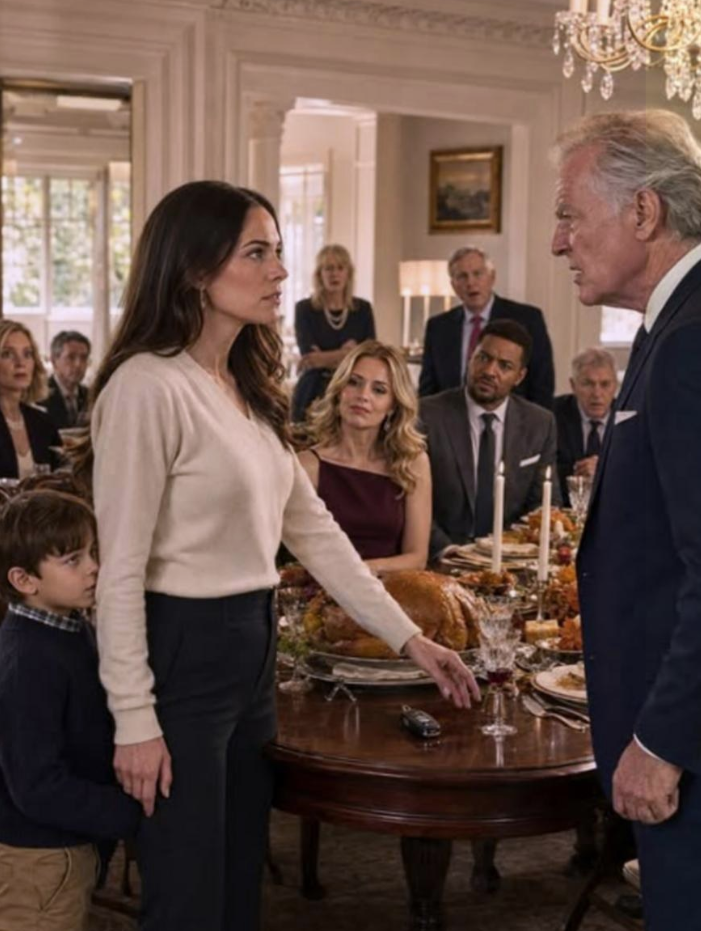
 My father kicked me out of the house at the Thanksgiving dinner, but when I placed the car keys on the table, the smile vanished from his face.
 My parents wanted to throw my belongings out into the yard and keep my child, but the smile vanished from my father’s face the moment I gave my answer.
 I chose the restaurant my son had visited for ten years, and when the waitress approached me, Chloe stopped breathing
 I was holding my child when, two years later, Ethan met me with his fiancée—the smile vanished from his face instantly.
 My parents demanded twenty thousand dollars from my husband, then his quiet condition made my father stop smiling
 After the divorce, I changed my cards, and that very evening, a waiter smiled at my ex-husband while serving his table and looked at his face.