
Part 4
For several seconds, no one uttered a sound in Irakli’s office.
The sheet of paper lay on the desk.
Written across it were my daughter’s name, her date of birth, and the genetic test reference number. The conclusion below was unmistakable: the child did not possess the hereditary disease my mother-in-law had been attempting to prove.
However, the final paragraph brought Irakli to a halt.
The testing raised doubts regarding my husband’s biological paternity.
— “What does this mean?” I asked.
Irakli held the paper up toward the window. The daylight rendered the document translucent.
— “It means the laboratory compared the child’s sample to the father’s sample and found no match.”
— “That’s impossible.”
— “Samples could have been mixed up, deliberately switched, or your husband might know something else entirely. For now, we only have the report.”
The telephone rang.
Irakli answered.
— “Yes, Inspector. We are ready.”
At those exact moments, my husband likely believed he was still in control. He called me, then Mari called me, then Elene called me. Everyone reported that people were entering and leaving his house constantly.
My husband sent a voice message:
“Nino, we can fix everything. Come back and no one will ever see these recordings. Mom only wanted the child to be safe.”
In his second message, he was already screaming:
“If you go to the police, you’ll be arrested too! You struck first!”
By the third message, his voice suddenly turned subdued:
“Please, don’t do this.”
Irakli saved the messages.
— “This is crucial,” he said. “He is now personally confirming his knowledge of the recordings’ existence.”
That same evening, we went to the police. We compiled the videos, text messages, document copies, and the laboratory report into a single file. I still carried my little blue bag with the yellow moon slung over my shoulder. Packed inside were the child’s pajamas, two books, and her favorite wooden spoon.
The inspector hit play on a recording.
My husband’s voice resonated through the room:
“The main thing is that her attack is clearly visible on video. Then the child will be temporarily transferred to us.”
My husband wasn’t present in the room, but his attorney was.
The lawyer lowered his head.
— “We are verifying the authenticity of this recording,” he offered.
— “Is that your client’s voice?” the inspector asked.
The man fell silent.
— “Is that your client’s voice?” the inspector repeated.
— “At this stage, I cannot answer.”
Irakli played the second video. My mother-in-law’s voice filled the room: “The doctor will write that the child has serious problems.”
I placed my hands on my knees. My fingers were trembling, but I was no longer crying.
That exact night, police seized computers and documents from my husband’s house. They didn’t detain my mother-in-law, but informed her that she was restricted from leaving the city while the investigation was underway.
The following day, my husband’s lawyer refused to continue working with him.
— “My scope was a family dispute,” he reportedly said. “A forged medical report and a pre-planned child removal fall outside my domain.”
My husband still tried calling me.
Once, he told me only this:
— “You don’t know why Mom did this.”
— “Then tell me.”
He was silent for a long moment.
— “My father wasn’t my biological father,” he said finally. “Mom hid that secret her entire life, terrified that everything would be exposed. When she found no match on the child’s test, she assumed it originated from me.”
— “So that gave her the right to strike my child?”
— “She thought you were hiding something.”
— “Did you think so too?”
The old hesitation resurfaced in his breath.
— “I didn’t know who to believe.”
— “So you decided the easiest path was taking our child away.”
He had no answer to offer.
A few weeks later, the court issued a temporary ruling: the child was to remain with me, while my husband was granted supervised visits only. My mother-in-law was issued a restraining order prohibiting any approach to the child. An investigation was also launched against the doctor who issued the fake report, as evidence surfaced that he had accepted payment.
Yet the heaviest moment for me didn’t take place in court.
It occurred in a small room where my husband was made to listen to his own recording in its entirety.
His voice drifted from the speaker as though it belonged to a complete stranger:
“If Nino resists us, we’ll take the girl anyway.”
My husband raised his head.
— “I didn’t mean it like that.”
The inspector replied:
— “Yet that is what you said.”
My husband listened to the recording to the end. Hearing his own laughter, he covered his face with his hands. For the very first time, he saw what I had been enduring for two years.
His own words.
His own voice.
His own choices.
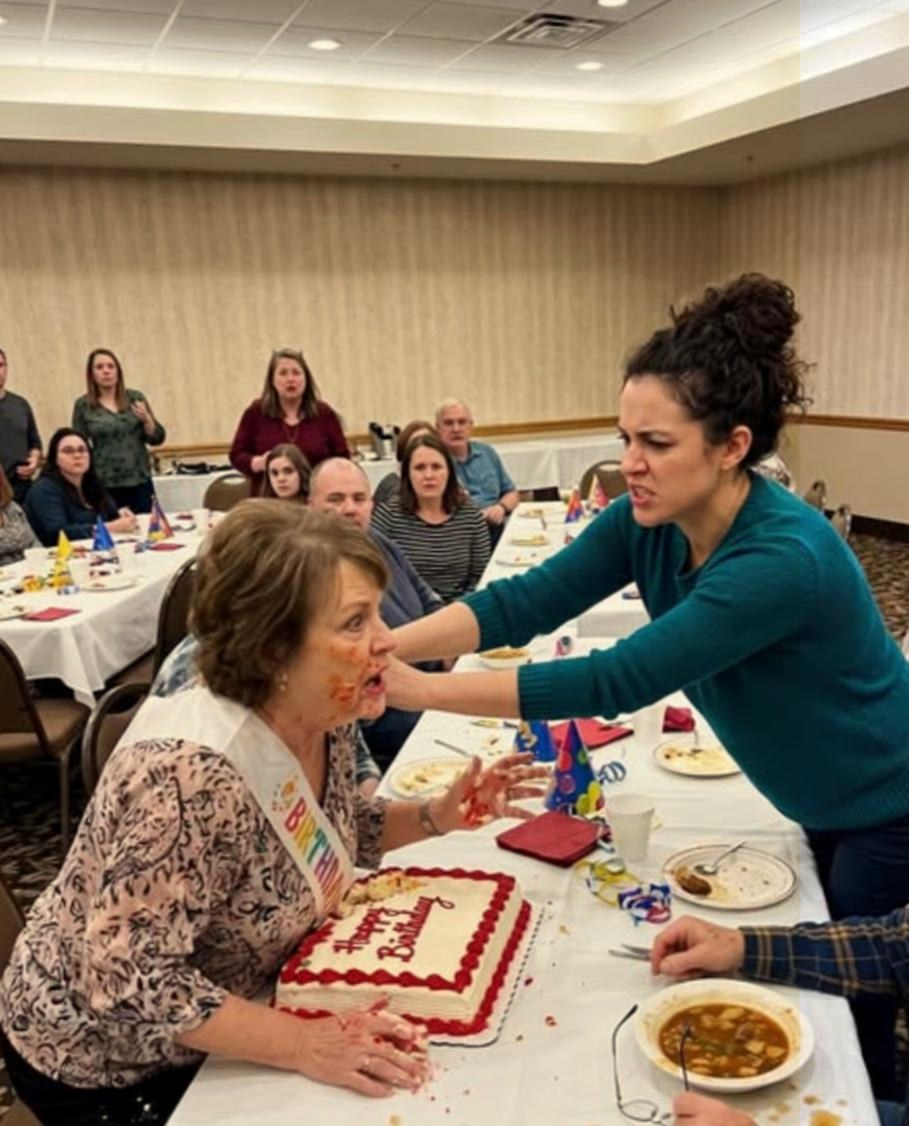
On the day I left our house, I stepped into the child’s room. Her paper birthday crown still hung on the wall. A tiny smudge of red frosting remained in one corner, impossible to remove even after washing. The crib was empty, as I had packed all her belongings into bags when moving to Mari’s.
Only the yellow-moon bag remained on top of the closet.
I touched it and realized for the first time that I was no longer packing for an escape.
I was preparing for a life.
Three months later, I rented a small apartment in another city. In the mornings, the bakery roof was visible outside the window; in the evenings, the streetlamps glowed. I began working at a children’s library. Every morning, I organized books, read fairy tales to children, and for the first time in a long while, I didn’t fear who might call before I left for work.
My girl started preschool.
During the first week, her teacher told me she loved drawing. One evening, she brought a sheet of paper home. Two figures were drawn on it, with a large yellow moon between them.
— “That’s me,” she told me.
— “Who am I?”
— “You. The moon is showing us the path.”
I smiled and pinned the paper to the refrigerator.
My husband sent letters once a month. Sometimes he apologized. Sometimes he claimed everything was his mother’s fault. Once, he wrote that he had changed and was ready to restart our family.
I typed a reply to his final letter:
“I have no intention of returning to your life. You may see the child only under rules that guarantee her peace of mind. I will no longer shield you from the consequences of your own decisions.”
I sent the letter and set the phone aside.
That night, my girl called out to me from her room.
— “Mommy, is the moon still here?”
I walked over to the window. The sky was clear.
— “It’s here,” I told her. “Always.”
I pulled the yellow-moon bag from the closet and set it beside her bed. Once a symbol of readiness and fear, it was now simply a bag for little things: colored pencils, an apple, and a storybook.
My girl took my hand.
This time, no one was chasing us.
I locked the door.
And the moon led the way forward.
Missed the beginning?
Related posts:
 My mother-in-law beat my two-year-old daughter in front of everyone, but my husband stopped breathing for a moment at my reaction.
 My husband asked me to donate an organ to his ex-mistress, but the doctor turned pale after my calm response.
 My husband ordered me to leave the apartment, but when I smiled calmly, the color drained from his sister’s face.
 Three hours after the delivery, my husband demanded that I give up our daughter, but after my calm response, his face suddenly turned pale.
 My parents wanted to throw my belongings out into the yard and keep my child, but the smile vanished from my father’s face the moment I gave my answer.
 After the accident on the coastal road, the police officer called my words a lie, but then suddenly turned pale.