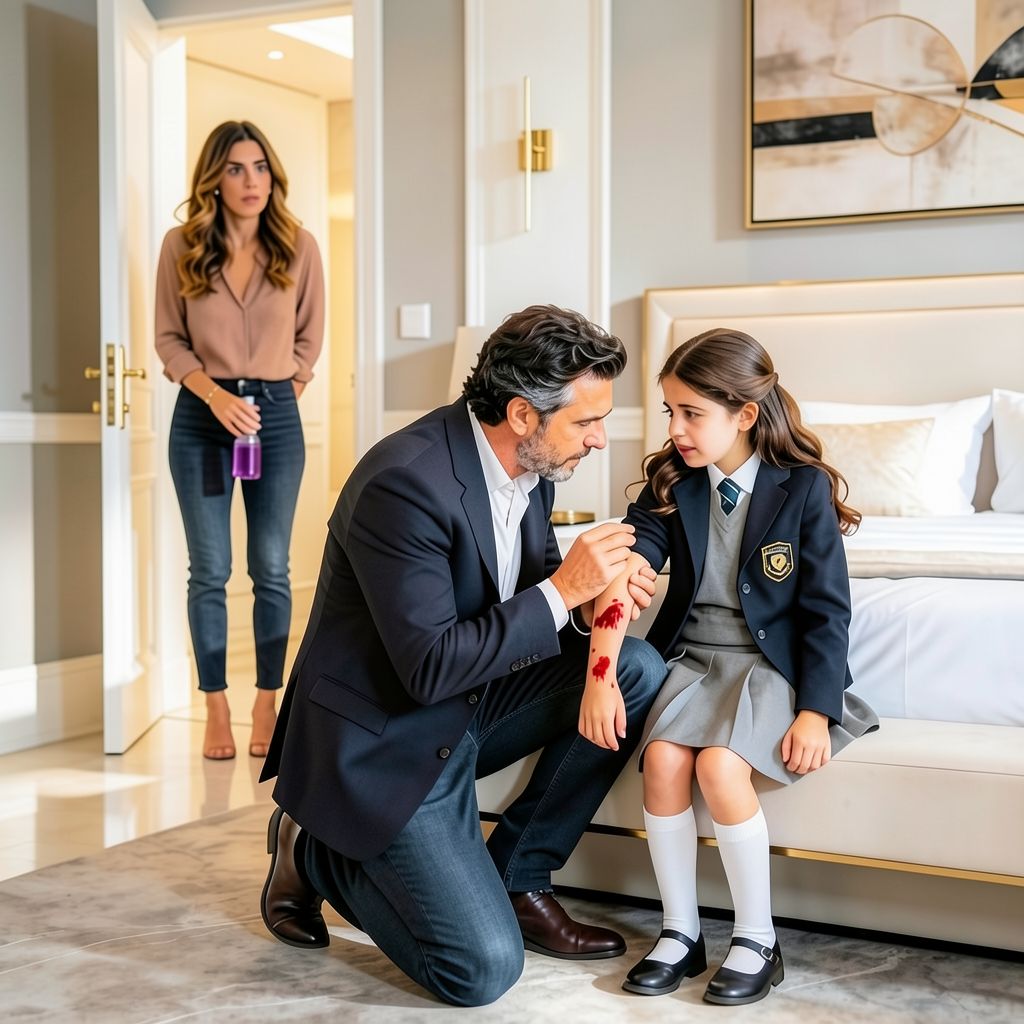
“Mention your mother again, and you will go to bed hungry. This time, I won’t stop at the ruler.”
I heard those words from the hallway and stopped so suddenly that my car keys slipped from my hand. It was Thursday afternoon, just after three. A meeting with investors had been canceled, and I had come home early to surprise my seven-year-old daughter, Waleria, with ice cream.
Instead, I heard a child crying behind her bedroom door.
Not the loud, angry crying of a spoiled child. This was quieter. Controlled. The kind of crying a person learns when they are afraid that even tears might bring punishment.
The door stood open by a few inches. Through the gap, I saw Waleria in her school uniform, her hands pressed against her sides, her eyes fixed on the floor. Zofia, my second wife, stood in front of her with a thick wooden ruler in her hand.
“Hold out your hands,” Zofia ordered.
Waleria lifted them immediately.
She did not hesitate. That frightened me more than the ruler.
I pushed the door open. “Don’t you dare touch her!”
Zofia spun around. For half a second, fear crossed her face. Then she replaced it with an offended smile.
“Andrzej, what are you doing home?”
“I asked you a question.”
“I’m raising your daughter because you’re never here. Someone has to teach her discipline.”
Waleria remained frozen between us. A blue thread dangled from the cuff of her uniform, and one of her buttons was missing. I noticed everything because I suddenly could not bear to look at her face.
I lowered myself beside her. “Waleria, look at me. Has she hit you with that?”
My daughter glanced at Zofia first.
“Look at me,” I whispered. “You’re safe now. Tell me the truth.”
“She started after the wedding,” Waleria said. “First she pinched me. Then she pulled my hair. Then she used the ruler.”
Zofia gave a short, bitter laugh. “She’s exaggerating. Ever since Elena died, she’s been dramatic.”
At the sound of her mother’s name, Waleria flinched.
“What happens when you talk about Elena?” I asked.
“Zofia says dead people don’t matter. She says I have to call her Mommy.”
“And if you don’t?”
My daughter’s lower lip trembled. “The punishment gets worse.”
I felt the room tilt. “Show me.”
Waleria slowly lifted her shirt. Across her back were parallel marks, some fresh and red, others fading yellow. There were bruises around both wrists. Near her sleeve was a dark stain that was not paint.
Zofia moved toward the door. “Think about your company, your name, and the newspapers, Andrzej. Don’t turn this into a scandal.”
I took out my phone. “For the first time in months, I’m thinking about exactly one thing.”
I called the police and an ambulance.
Then Waleria grabbed my shirt with both hands. Her fingers smelled faintly of lavender soap.
“Dad,” she whispered, “don’t let her give me the purple syrup again. She says it’s a vitamin, but afterward I can’t wake up.”
Zofia’s face went white.
Minutes later, in the upstairs bathroom, Detective Karolina Mendes pulled open the cabinet beneath the mirror. Behind a bottle of perfume sat a gray sealed envelope. I reached toward it, but Karolina suddenly caught my wrist and said, “Nobody touches that until I…”…
PART 2
The bathroom door opened wider, and Detective Karolina Mendes extended one gloved hand toward the gray envelope.
“Don’t touch it,” she said. “We’re treating everything in this room as evidence.”
Zofia stood behind the officers, clutching the edge of her cardigan. A small green stone in her ring flashed under the bright bathroom light, but her hand would not stop shaking.
“I want my lawyer,” she said.
“You can ask for one,” Karolina replied. “You cannot leave.”
Waleria sat in the hallway wrapped in a yellow blanket. A social worker crouched beside her, speaking softly while an officer placed the wooden ruler into a clear evidence bag. There was a dried brownish mark along its edge, exactly where the stain on Waleria’s cuff had touched it.
Karolina knelt beside my daughter. “Waleria, can you tell me where the syrup was kept?”
“In the bathroom,” she said. “The purple one is for sleeping. The pink one is for when I cry too much.”
“Did anyone prescribe it?”
Waleria shook her head. “Zofia said doctors don’t understand me.”
An officer opened the cabinet. Three unmarked bottles stood behind the towels. Handwritten labels read night vitamin, calm, and cough. None contained vitamins. One had a sharp medicinal smell that made my stomach turn.
At seven that evening, in the children’s hospital, Waleria lay beneath a white sheet with a tiny bandage on her arm. A plastic bead from her broken bracelet rested on the bedside table.
The doctor studied the first test results. “These contain sedatives and sleep medication,” he said. “The combination could have dangerously slowed her breathing.”
I gripped the metal rail of the bed. “How close was she?”
He looked at me carefully. “Close enough that you should understand this was not harmless discipline.”
Waleria opened her eyes. “Am I in trouble?”
“No,” I said. My voice cracked. “You did nothing wrong.”
That night, she told us what had happened behind the locked doors. Zofia made her stand beside the dining table for hours if she moved while eating. She forced her to finish meals when she was sick. She took away ballet, friends, and bedtime stories whenever Waleria mentioned Elena.
“I wanted to tell you,” Waleria whispered. “But she said you would send me away. She said you believed grown-ups.”
I pressed my forehead against her small hand. “I should have listened sooner.”
At nine, the police searched Zofia’s wardrobe. Inside a shoe box, beneath a scarf smelling of cedar, they found a black notebook. It contained dates, punishments, and chilling notes: Elena mentioned—strict correction. Wouldn’t finish dinner—two hours standing. Asked about father—full dose.
Karolina placed printed messages on the table. They were between Zofia and her sister, Weronika, who worked at a pharmacy.
“They discussed obtaining the medication without prescriptions,” Karolina said. “They also discussed increasing the dose whenever Waleria asked too many questions.”
I read one message dated six days earlier: When she starts looking unstable, Andrzej will agree to send her away. Then everything becomes easier.
“This wasn’t one terrible afternoon,” Karolina said. “It was planned.”
A uniformed officer entered carrying a small black device wrapped in plastic.
“We found this behind the bathroom mirror,” he said. “It contains recordings.”
Zofia suddenly lunged forward. “You have no right to listen to that!”
Karolina blocked her with one arm. “Why not?”
“Because it’s private.”
The detective set the device on the table. I could hear my own heartbeat. Waleria’s fingers tightened around mine as Karolina pressed the button.
First came a child’s muffled sob. Then Zofia’s calm voice began explaining what she intended to do with Waleria—and why my daughter’s disappearance would be useful to her…
PART 3
“Once the girl is far away, Andrzej will depend entirely on me,” Zofia said on the recording. “The house, the travel, the decisions. Waleria is the last thing connecting him to Elena. As long as she stays, I will always be second.”
No one moved in the hospital conference room. Even the clock seemed to stop beneath the fluorescent lights.
The recording continued. Zofia described how easily she deceived me. A good day at school explained away bruises. Grief explained silence. High grades proved that her punishments were working. She laughed when she said I was grateful for any story that allowed me to return to my company and feel like a good father.
I recognized every excuse. I had repeated some of them myself.
Karolina found more recordings, hidden behind the mirror and inside a decorative wooden box in Zofia’s bedroom. They captured punishments, threats, and one conversation in which Zofia told Weronika to make Waleria “sleep longer” after she asked why Elena’s photographs had disappeared from the hallway.
The evidence was overwhelming: the bottles, the medical tests, the ruler, the notebook, the messages, and the recordings.
The school provided its own records. Waleria’s teacher said my daughter had stopped raising her hand, startled whenever an adult lifted an arm, and refused to change clothes during physical education. The school had requested meetings twice. Zofia had redirected the messages to an email address I never saw, claiming our family was handling its grief privately.
Marta, our longtime housekeeper, came forward too. She admitted finding bruises and the ruler hidden among the towels. Zofia had threatened to fire her and accuse her son of stealing from the house.
“I was afraid,” Marta said, twisting a tissue until it tore. “But Waleria was more afraid.”
I could not condemn Marta without condemning myself. I had seen the untouched dinners, the sudden silence, and the way my daughter watched every adult face before speaking. I had simply chosen the explanation that hurt least.
Zofia and Weronika were charged. Their attorneys argued that Zofia had been a strict stepmother and that I had manufactured evidence after a bitter marriage dispute. But the recordings did not care about money, reputation, or performance.
When Zofia proposed an agreement that would keep Waleria from testifying, I asked my daughter what she wanted.
“I don’t want them to ask why I didn’t scream,” she said. “I wanted to scream. I was afraid nobody would come.”
Because of the recordings, she did not have to face Zofia in court. Zofia eventually admitted the abuse, though she called it discipline. The judge interrupted her rehearsed apology.
“This was not discipline,” she said. “It was calculated violence against a child.”
Zofia received more than twenty years in prison and a permanent no-contact order. Weronika was convicted for supplying the medication and helping conceal it.
When I told Waleria that Zofia would never return, she stared at the blue thread still hanging from her uniform cuff.
“Am I safe now?” she asked.
“You are safe even when you’re sad, loud, messy, or refusing broccoli,” I told her. “You never have to earn love.”
Therapy came slowly. So did ballet, friends, laughter, and photographs of Elena returning to the walls. Two years later, Waleria wrote a school essay called The Day Someone Really Looked. She wrote that courage was not staying silent without tears. Courage was telling the truth when adults preferred a comfortable lie.
I read it from the last row, while the pale marks on her back remained visible beneath her dress. They had not vanished completely. But they were no longer Zofia’s secret.
That evening, Waleria took my hand and led me home through the warm rain. For the first time, every light in the house was on, and nothing inside it was hidden.
Related posts:
 My daughter-in-law told my son to put me out of the house I helped buy, and his silence made her smile disappear
 I came home from a business trip to find my family feasting while my hungry daughter froze outside, and my husband suddenly went silent
 I Paid for My Mother’s Seventieth Birthday Party, Then My Family Seated My Children Beside the Potted Plants—So I Changed One Line on the Final Bill
 My Three-Year-Old Daughter Asked New York’s Most Feared Man to Hold Her Hand, and the Sealed Medical File He Had Hidden for Years Exposed the Truth About Why He Stayed Away
 My future mother-in-law handed me a bucket before dinner, but when I reached for my coat, her smile disappeared
 I came home to find my little girl punished for something impossible, but when I reached for the old camera, my husband stopped breathing