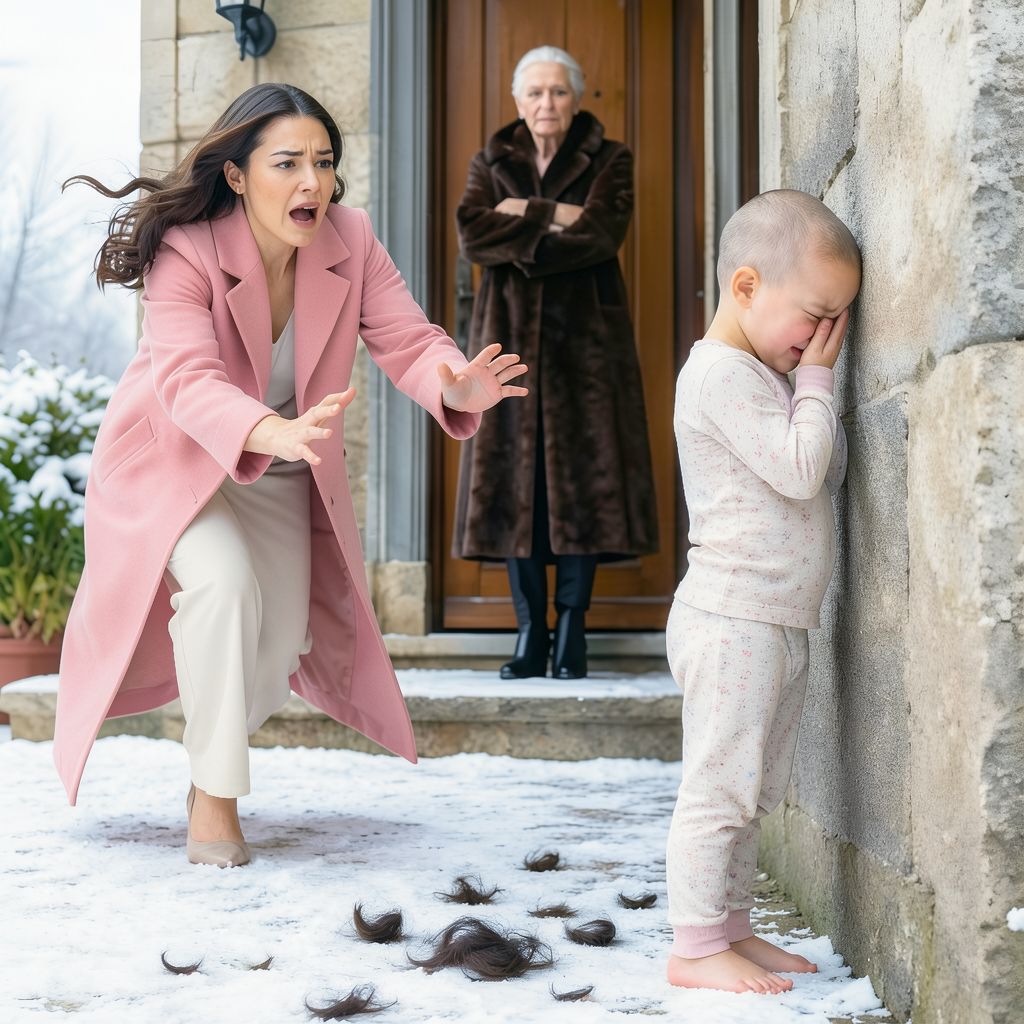
I came home from a weeklong work trip to find my three-year-old daughter shaved bald, trembling against a balcony wall, while my mother-in-law called her a thief.
It was nearly six on a freezing January evening in Monterrey. I had imagined Renata running toward me in her pink pajamas, her dark curls bouncing around her cheeks. Instead, the balcony door stood open, and cold air moved through the apartment like a blade. Renata pressed her forehead to the concrete wall, wearing only a thin nightgown. Loose strands of hair clung to her shoulders.
“Mommy,” she whispered when she saw me. “I didn’t take anything.”
I dropped my suitcase. The blue thread on its broken handle brushed my fingers, but I barely felt it. I crossed the room and pulled her against my chest. Her skull was cold beneath my palm.
Dolores emerged from the kitchen, drying her hands on a floral apron. My sister-in-law, Karla, sat on the gray sofa with her phone tilted toward her knees. Rogelio, my father-in-law, smoked beside the dining table, his silver lighter clicking open and shut.
“Your daughter stole my gold bracelet,” Dolores said. “The one my mother left me. Renata was the only person in my room.”
“She can’t even reach the top drawer,” I replied.
Karla gave a soft laugh. “Children surprise you. Maybe she saw something shiny and hid it in her backpack.”
Renata buried her face in my neck. Her tears soaked through my blouse.
“Do not call her a thief,” I said. “And nobody touches her again.”
Dolores pointed at my daughter. “She is exactly like you. You came into this family with nothing, and now your child steals what belongs to us.”
The words struck deeper than the cold. I had paid half the mortgage, covered Renata’s school, and sent money every month for household expenses. Still, in that room, I felt like an intruder.
“This is not discipline,” I said. “It is abuse.”
Rogelio crushed his cigarette into a chipped ceramic saucer. “Lower your voice. You are in our house.”
“No. I am in the house where my daughter was harmed.”
He crossed the room before I could step back. His hand hit my face with a sharp crack. My lip split against my teeth, and the glass balcony door rattled behind me. Renata screamed.
Nobody moved.
At seven fifteen, I packed our documents, two changes of clothes, my savings card, and Renata’s stuffed rabbit with one torn ear. Dolores caught my arm near the front door.
“If you walk out, do not come back,” she hissed.
“That is the first thing you have said tonight that I believe.”
In the taxi, under the yellow lights of Avenida Vallarta, I texted my husband, Ivan: “Your father hit me. Your mother shaved Renata and punished her for a crime she did not commit.”
His reply came before the taxi reached the hotel.
“My mother is distraught. Come home, apologize, and stop making this worse. We are family.”
I stared at the message until the letters blurred. Then I blocked his number.
At 10:40 that night, in a small hotel room near Plaza del Sol, Renata slept with both hands wrapped around mine. A red mark circled her wrist. I watched her breathe and remembered the old camera I had installed years earlier behind a row of books in the living room.
The device still connected to my phone. My thumb moved through three days of recordings. The screen showed the gray sofa, the hallway, and finally the door to Dolores’s bedroom.
I pressed play. The image loaded in a wash of blue light. Someone stepped into view, carrying a familiar handbag, and my hand froze above the screen…
PART 2
The recording began with a faint hiss. For several seconds, the living room was empty except for the gray sofa and a stripe of afternoon sunlight across the floor. Then the clock in the corner changed to 2:17 p.m., and Karla entered the frame.
I sat upright on the hotel bed. The brass zipper on my overnight bag dug into my knee.
Dolores left the apartment first, carrying a grocery basket. Renata was asleep in our bedroom. Karla looked down the hallway, placed her phone beside the television, and slipped into her mother’s room.
Five minutes passed.
Then Karla came out with something clenched in her fist.
I leaned so close to the screen that my breath clouded it. Gold flashed between her fingers. She wrapped the bracelet in a white handkerchief and pushed it into the inner pocket of her handbag. Before leaving, she turned toward the camera and smiled—not at the lens, but at the empty room, as if she had already decided who would pay for what she had done.
My stomach twisted.
I kept watching. When Dolores returned and discovered the empty jewelry box, Karla widened her eyes, lifted both hands, and pointed toward my bedroom. The microphone was weak, but one word came through clearly.
“Renata.”
At 4:08 p.m., the scene changed. Dolores held my daughter by the shoulders while Karla pinned her little legs against a kitchen chair. Renata kicked so hard that one wooden leg scraped across the tile.
“I didn’t take it!” she cried. “Mommy said never touch Grandma’s things!”
“Stop lying,” Dolores snapped.
The clippers came down. Once. Twice. Again.
Dark curls slid onto the floor like wet threads. Renata’s pink hair clip fell beside them, its cracked butterfly missing one wing. I covered my mouth, but the sound that escaped me was still a sob.
I shut off the recording and pulled Renata against me. Her scalp smelled faintly of soap and fear.
At 7:30 the next morning, I met Mariana, my longtime friend and family attorney, at a medical clinic on Calle Morelos. Fluorescent lights buzzed overhead. The doctor photographed my swollen cheek and split lip while Mariana placed the video files on a silver flash drive.
“Do not return to that apartment alone,” she said.
“They will say I am exaggerating.”
“Let them say it in front of the authorities.”
She watched the footage in silence. When it ended, her fingers tightened around the drive.
“This was not a moment of anger, Elena. They created a punishment, chose a child who could not defend herself, and built a lie around it.”
At noon, a child psychologist spoke with Renata in a room filled with wooden animals. Renata held a red toy rabbit by one ear.
“Why don’t you want to go home?” the psychologist asked gently.
“Because Grandma has the machine,” Renata whispered. “And Grandpa makes faces before he hits.”
Mariana wrote everything down.
Ivan called from three unknown numbers that afternoon.
“You are destroying my family,” he said.
“Your family destroyed our daughter’s safety.”
“Karla says the video could mean anything.”
“Then she can explain it under oath.”
By evening, Mariana sent formal notices demanding protection, therapy costs, repayment for my medical care, and supervised contact only. The messages that followed were frantic. Dolores said she had acted out of panic. Rogelio insisted the slap had been harmless. Karla claimed she had taken the bracelet only to borrow it.
At 11:43 p.m., Karla sent a voice message. She was crying so hard her words broke apart.
“I did it. I sold the bracelet to pay a debt. I blamed Renata because I knew my mother would defend me. Please, Elena, stop this before everyone goes to jail.”
I forwarded the recording to Mariana. She called immediately.
“Tomorrow we meet all of them,” she said. “But I found something else in Ivan’s accounts. The bracelet is not the only secret. The money you sent for the house did not always reach the bank…”
PART 3
At nine the next morning, I entered Mariana’s office with a thick folder pressed against my ribs. Renata was in the adjoining room with her therapist, sorting colored blocks. Ivan sat across from me, pale and unshaven. Dolores kept twisting the corner of her floral apron. Rogelio stared at the floor. Karla’s hands shook beside a paper cup of water.
The old silver flash drive lay on the table between us.
Mariana switched on a recorder. “Karla, do you admit taking Dolores’s bracelet, selling it, and falsely accusing a three-year-old child?”
Karla swallowed. “Yes.”
“Do you admit helping Dolores hold Renata while her hair was shaved?”
“Yes.”
Dolores covered her mouth. “I was furious. I thought—”
“You thought a frightened child was an acceptable target,” Mariana said. “Do you deny what the recording shows?”
Dolores looked at me for the first time. Her green-stoned ring trembled against the tabletop.
“No,” she whispered. “I do not deny it.”
Rogelio admitted striking me, calling it “one isolated mistake.” Mariana slid my medical report toward him. The bruise beside my cheek had turned yellow at the edges.
“One blow is enough to trigger an investigation,” she said, “especially when it happens in front of a minor.”
Ivan leaned forward. “They admitted everything. Can we settle this privately?”
I turned toward him. “Settle what? My split lip? Renata’s nightmares? The hair on that floor? Or the message where you told me to apologize?”
His face tightened.
Mariana opened the second folder. Inside were four years of bank statements. I had believed Ivan’s salary covered most of the mortgage while I paid for groceries, school, insurance, utilities, and nearly everything Renata needed. Every month, I also transferred money for the house.
But much of it had gone elsewhere.
Transfers to Karla. Hotel charges. Expensive purchases. Debt payments. Cash withdrawals from our shared account that Ivan had hidden behind vague descriptions.
I looked at him. “You knew?”
He said nothing.
“Answer me.”
“Yes.”
“And when our daughter was blamed, you protected the lie because telling the truth would expose you too.”
His jaw trembled. “I thought I could fix it.”
“You had years to fix it. You chose silence every time.”
My demands were clear: written admissions, payment for therapy and medical treatment, repayment of the stolen household funds, protective orders against Dolores, Rogelio, and Karla, primary custody of Renata, supervised visits for Ivan, and divorce.
Ivan stared at me. “We can move away. I can change.”
“The problem was never only your parents’ house,” I said. “When Renata needed a father, you chose to be your mother’s son and your sister’s accomplice.”
Rogelio refused to sign until Mariana played the footage and the confession. Then she placed the psychologist’s report beside the medical certificate.
“Sign,” she told him, “or we proceed through criminal and family court.”
His face went gray. Karla signed first. Dolores followed, crying silently. Rogelio’s pen scraped across the paper. Ivan signed last, looking at me as though he expected mercy to interrupt the ink.
It did not.
Protective measures were issued. Karla repaid the bracelet’s value and faced charges for theft and false accusation. Rogelio entered mandatory counseling and lost unsupervised contact. Dolores was ordered to stay away from Renata. The divorce was finalized months later, and the house was sold. I recovered my share and the money Ivan had diverted.
We moved into a small apartment in Zapopan with two bedrooms and a balcony full of sunlight. Renata began therapy. She flinched at electric clippers, but her curls returned, one small ring at a time.
At the park a year later, she touched the hair covering her ears.
“When it grows long, can I choose how to wear it?”
“Always,” I told her.
She ran after a stream of soap bubbles. Later, while I combed her curls before our bedroom mirror, she studied our reflection and smiled.
“Mommy, we are safe here.”
I held her close and listened to those curls brush softly against my wrist—the sound of a life no one could ever cut away again.
Related posts:
 My future mother-in-law handed me a bucket before dinner, but when I reached for my coat, her smile disappeared
 My mother-in-law collapsed beside the boiling soup, but when my husband asked one strange question, the house fell silent
 I came home from a business trip to find my family feasting while my hungry daughter froze outside, and my husband suddenly went silent
 Minha futura sogra me recebeu com uma lista de tarefas, mas quando mencionei uma pergunta, o sorriso dela desapareceu
 Soacra mea și-a vândut casa ca să se mute la noi, dar când a coborât din camion, soțul meu a încetat să zâmbească
 I came home early and found my daughter standing beside a raised ruler, but my wife’s confident smile suddenly vanished