Part 4
That evening, Martin’s phone rang for the first time while he was standing in the hospital corridor.
The call was from the company’s Chief Executive Officer.
— “Where are you?” the CEO demanded.
— “At the hospital with Claire. I have the situation under control.”
His voice echoed loudly down the hallway, as he held the phone close to his ear.
— “You don’t control anything anymore,” the CEO replied. “Your access to corporate accounts has been suspended.”
Martin placed his hand against the wall.
— “That recording was obtained illegally.”
— “That is your voice on the recording.”
— “It doesn’t show the context.”
— “It shows nine minutes and eleven seconds.”
The line went dead.
Martin immediately dialed a second number. His attorney took a long time to answer.
— “Tell me we can fix this,” Martin said the moment the connection went through.
— “I won’t lie to you,” the lawyer said. “I no longer represent the company, and I cannot sign any new motions on your behalf.”
— “You are my lawyer.”
— “I was. Now I will be questioned as a witness in the case, because you told me the recording was deleted due to a technical glitch.”
Martin slammed his phone against the wall.
The screen shattered.
Yet his voice was already echoing elsewhere.
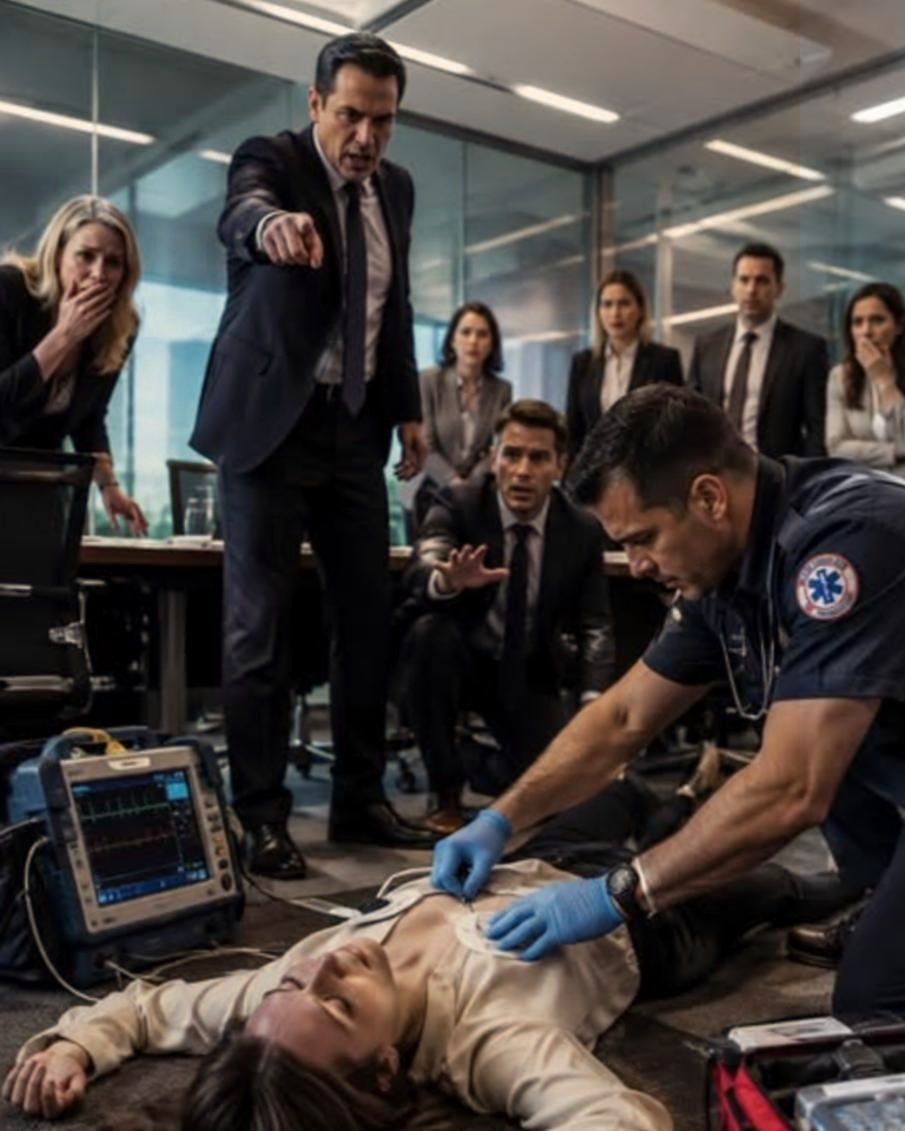
The company’s internal audit team forwarded the recording to all directors, the HR department, and legal counsel. They also attached an exact timestamp report from the camera, the instruction manual for operating the defibrillator, and my medical request letter.
Martin claimed he couldn’t remember anything.
The auditor then led him into a small room.
Inside stood only a table, two chairs, and a speaker.
— “Is this necessary?” he asked.
— “Yes,” the auditor replied.
His own voice came through the speaker:
“She just wants attention. Don’t encourage her.”
Martin lowered his eyes.
Then came:
“Don’t touch her! It will create liability for the company.”
His own voice.
His own tone.
His own decision.
For the first time, he realized he could never convince anyone that those words had been spoken by someone else.
— “I was simply mitigating risk for the company,” he insisted.
The auditor laid a folder on the table.
— “You were already aware that Claire had leg swelling. You received her email, read it, and replied to it.”
— “I am not a doctor.”
— “Yet you passed the first aid training course.”
— “I panicked.”
— “Then why did you stop others from helping?”
Martin had no answer.
At the same time, Jenna gave her official statement. She detailed how she had recorded the security monitor, how she received Martin’s threatening text messages, and how she was left in a dark stairwell at night waiting for the police to arrive.
Nathan kept his statement even briefer:
— “If I hadn’t put my hands on her chest, Claire would be dead.”
That single sentence proved to be more than enough.
Martin’s temporary suspension turned into an immediate termination. The company was forced to cancel his contract, preserve all records, and officially notify law enforcement that its manager had actively obstructed emergency medical aid.
Yet that was not the end of it.
A few days later, the police tracked down another employee—Levan, a former warehouse supervisor. He, too, had experienced leg swelling and severe pain. Three months prior, he had asked Martin for permission to see a doctor.
Martin had written back to his email: “If we let everyone leave over minor discomfort, the business will collapse.”
Levan went to work the next day.
He collapsed on the job and ended up in the hospital.
His email had remained buried in HR’s archives.
My case brought that email back to light.
Martin lost control for the first time that evening. He called the CEO, then the company founder, and finally my sister.
— “Rebecca, tell Claire we can reach a settlement,” he begged. “She’ll get money, full treatment, and the best position available.”
Rebecca replied calmly:
— “My sister needed help while she was dying. You didn’t offer her money back then.”
— “I didn’t mean to kill her.”
— “But you didn’t want to help her, either.”
Rebecca hung up the call.
The following week, I stood up for the first time inside the hospital’s small rehabilitation room. The clock on the wall was five minutes slow, and a mandarin orange Rebecca had brought rested on the windowsill.
The physical therapist extended a hand.
— “Take it slow.”
— “What if I fall?”
— “Then we stand back up.”
Those simple words proved far more empowering to me than any legal document.
I took my first step.
The following day, the police arrested Martin on charges of witness intimidation, attempted destruction of evidence, and reckless endangerment by obstructing emergency aid. The company later reached a settlement with the affected employees and agreed to cover all my medical expenses.
I attended the court proceeding once I was able to walk independently.
Martin sat on his bench, no longer looking in my direction.
The judge played the audio recording.
“She just wants attention.”
His voice echoed across the courtroom.
Martin hung his head.
The judge handed down a severe sentence, while ordering the company to pay restitution to the victims and completely overhaul its workplace safety protocols.
I didn’t label that verdict a victory.
Victory was opening my eyes every morning despite the aching in my ribs.
Victory was Nathan still working there, leading first aid training courses for new hires.
Victory was Jenna no longer entering her apartment building alone in fear.
Six weeks later, I relocated to a small town where old brick houses lined the riverbank. At my new job, I audited financial accounts, but every hour, I made sure to stand up and take a few steps.
The mandarin peel Rebecca had brought no longer rested on my desk. In its place stood a small potted basil plant.
In the mornings, I opened the window.
The air carried the damp scent of the river and the warm smell of the nearby bakery.
Three months later, the first snow arrived. My nephew, Niko, burst into the room holding a drawing in his hands.
The drawing depicted four figures standing in front of a red house. One of them had a tiny brass owl drawn on her chest.
— “That’s you,” Niko told me. “The owl is protecting you.”
— “Who drew it?”
— “Me. But you don’t need protection anymore, right?”
I leaned down and kissed his forehead.
— “Now I know whom to call if I ever need help.”
— “Whom?”
— “The ones who reach out their hands.”
Martin attempted to reach out one final time.
Four months later, a letter arrived at my lawyer’s office from him. In it, he wrote that he was remorseful, that he had simply panicked that day, and that it would be better for both of us if I modified my public statement.
At the bottom, he added a single sentence:
“We both know this shouldn’t have gone this far.”
Simon laid the note in front of me.
— “Do you want to reply?”
I stared at the page for a long time.
Then I picked up a pen.
— “Yes.”
I wrote a single sentence in response: “I am no longer returning to a place where asking for help was treated as a crime.”
Simon nodded and sent the letter back to him.
I never had any contact with Martin after that.
Sometimes I still dream of that conference room. The white projector screen. The carpet pressed against my cheek. Shoes moving around me while no one touches me.
However, the dream no longer ends the same way.
Now Daniel opens the door.
Nathan drops to his knees beside me.
Jenna calls for help.
Rebecca holds my hand.
And I breathe.
One evening, I opened my dresser drawer and pulled out the small brass owl my mother had given me. The chain had snapped that day, but I had it repaired and attached it to my new work bag.
I paused in front of the mirror.
The owl swayed gently as I slung the bag over my shoulder.
It was no longer a symbol of that day’s terror.
It was a reminder that my life was never anyone else’s mercy to give.
Outside the window, the first flakes of snow fell softly over the town.
I locked the door, turned off the lights, and stepped out into the street.
The owl tapped lightly against my chest.
This time, I was choosing my own path.
Missed the beginning?
Related posts:
 I lost consciousness at work, and my boss forbade anyone from helping me, but when the ambulance doctor glanced his way, he turned pale.
 When the dangerous mobster’s son reached out towards me, his father looked at the photo and went pale.
 No one could stop the mafia boss’s son until I approached him—and the color instantly drained from Rico’s face.
 When my husband’s family broke my leg and my husband told me to submit, the smile vanished from his face three days later.
 My father kicked me out of the house at the Thanksgiving dinner, but when I placed the car keys on the table, the smile vanished from his face.
 My husband asked me to donate an organ to his ex-mistress, but the doctor turned pale after my calm response.