PART 4
“Then we need to discuss who has been using your father’s identity…”
Elena did not finish the sentence because the front door burst open.
Two investigators entered first, followed by a uniformed officer carrying a warrant. Behind them came the company’s chief financial officer, Daniel Ruiz, holding a stack of printed bank statements.
Joaquín stood so quickly that his chair struck the wall.
“Alvaro, tell them this is a misunderstanding.”
I remained seated beside Clara.
“It isn’t.”
Marta grabbed her phone. “I’m calling a lawyer.”
“Call whoever you want,” Daniel said. “But don’t touch the accounts.”
Mercedes began dialing with shaking fingers.
Her lawyer answered after three rings. She put him on speaker.
“Tell them to leave my clients alone,” he said.
The officer held up the warrant. “Your clients are being investigated for unlawful confinement, coercive control, assault, fraud, and attempted misappropriation of corporate assets.”
There was a pause.
Then the lawyer said, “Joaquín, I’m withdrawing from representing you until I review the financial records.”
“You can’t do that!” Joaquín shouted.
“I just did.”
The call ended.
For a moment, the only sound in the room was the ticking clock above the fireplace.
Joaquín turned toward me as if I had personally betrayed him.
“You planned this.”
“I planned protection for my family.”
“You are my family!”
“No,” I said quietly. “You were the people I trusted.”
The investigators collected the memory card, the medical report, the forged messages, and the original deed. They photographed the bruised wrist. They photographed the mattress beside the laundry room. They photographed the red enamel lunch tin with the stale bread still inside.
Marta tried to stop them.
“That tin proves nothing!”
“It proves the child was being fed,” I said. “It proves he needed to hide food.”
Leo pressed against Clara’s side. She wrapped both arms around him.
At noon, the investigators played the recording in the sitting room while Joaquín, Mercedes, and Marta stood near the window.
I had heard their words the night before, but hearing them through a speaker was different. The room gave every syllable back to them.
Marta’s voice came first.
“Let her eat the leftovers.”
She looked toward the floor.
Then Mercedes’s laugh.
“Tomorrow, when Alvaro signs the power of attorney, this will finally be over.”
Mercedes covered her mouth.
Finally, Joaquín’s voice filled the room.
“First we get that woman and the boy out of the house. Then we transfer the shares.”
Joaquín stared at the speaker.
“That doesn’t sound like me.”
Daniel looked at him. “It is your voice.”
“I was angry.”
“You were explaining the plan,” I said.
“No one was supposed to hear it.”
That was when he understood.
The recording had not changed his words. It had only removed the power he believed he had over them.
The financial investigation uncovered everything else. Joaquín had created an account using my dead father’s identity six months earlier. He had moved company funds into it in small amounts, hoping the transfers would look like old family investments. Mercedes had helped him obtain Clara’s banking details. Marta had intercepted my wife’s calls and used my name in messages designed to frighten her.
The power of attorney was never activated.
Clause Seven froze every transfer before the money could disappear.
The house remained protected by the family trust, exactly as my late mother had intended. She had created it after seeing how quickly Joaquín treated other people’s property as his own. I had never told my in-laws because I wanted to believe they loved us rather than the things attached to our name.
That belief ended at the kitchen table.
Joaquín, Mercedes, and Marta were taken away for questioning that afternoon. No one shouted as they left. No one begged me to reconsider.
Marta stopped at the door.
“You destroyed this family.”
I looked at Clara.
“No. I stopped protecting the people who were destroying it.”
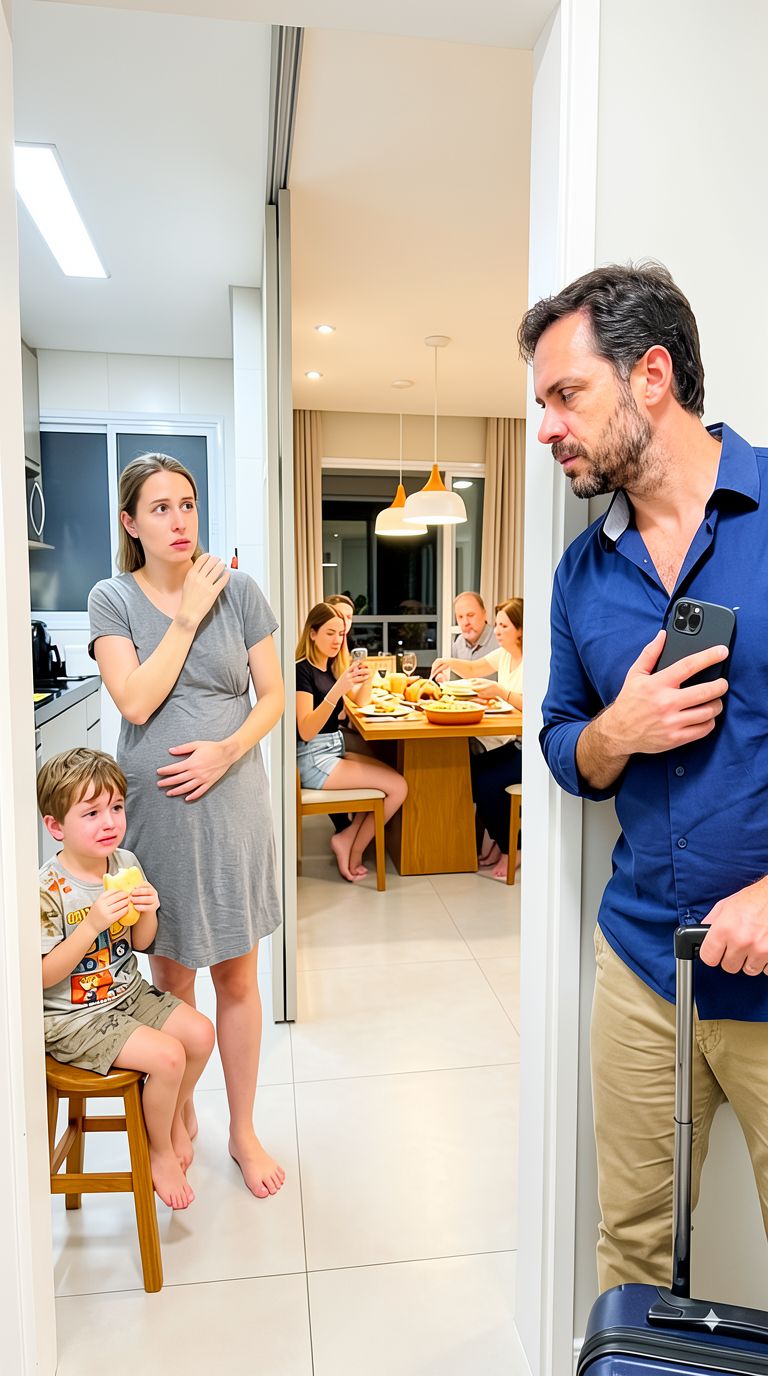
The next morning, Clara and I moved out of the house temporarily. We rented a bright apartment near the maternity clinic, with wide windows and a bakery downstairs. The first night, Leo slept through until dawn.
I woke before him and walked into the kitchen.
The red enamel lunch tin sat on the counter, its dented lid catching the pale morning light.
I washed it carefully, dried it with a clean towel, and placed fresh fruit inside.
Then I left it beside Leo’s schoolbag.
Three weeks later, our daughter was born.
We named her Sofia, after Clara’s grandmother, who had once told her that a home was not a building but the place where nobody had to ask permission to be safe.
Clara said those words while holding Sofia against her chest.
Leo sat beside her, drawing with a box of colored pencils. He had drawn four people around a yellow table. There was a red tin in the middle, with a lid wide open.
“Why is it open?” I asked.
“So everyone can have some,” he said.
I had to look away for a moment.
The legal process lasted several months. The court ordered restitution, protective measures, and financial penalties. Joaquín received a prison sentence for fraud and unlawful confinement. Mercedes received probation and community service after cooperating with the investigation. Marta was barred from contacting Clara and Leo while her assault case proceeded.
I did not attend every hearing.
I did not need to watch them fall apart to know I had saved my family.
The company’s audit cleared my name, and Daniel helped me rebuild the board with people who understood the difference between loyalty and obedience. I stopped traveling every week. I began eating breakfast at home. I learned that Sofia slept best when I hummed badly, and that Leo hated peas but loved cutting strawberries into uneven stars.
On Mondays, I walked him to school.
On Thursdays, Clara returned to designing small public spaces for the city. She placed a plant on every windowsill in our apartment, even though I repeatedly forgot to water them.
The first winter snow came on a Tuesday morning.
Leo pressed his hands against the glass.
“Daddy, does snow stay?”
“Not forever.”
“Then we should enjoy it now.”
He was five years old, but he already understood something I had taken forty years to learn.
In February, a letter arrived from Joaquín’s attorney.
He wanted to see me.
The letter said he regretted his actions. It said he had been manipulated by fear. It said families should not be destroyed over money.
I read it twice.
Then I placed it in a drawer and did not answer.
A week later, another message came through an unknown number.
Your father would be ashamed of you.
I deleted it.
The third message arrived in the middle of the night.
Please let me explain. I am still your family.
I sat beside Clara while she slept, Sofia’s tiny breaths rising and falling against her shoulder. Outside, snow tapped softly against the window.
I wrote one reply.
I have nothing more to discuss. Do not contact us again.
Then I blocked the number.
There was no triumph in it.
Only quiet.
Months later, we returned to the house after the court approved the trust’s permanent protection. The dining room had been repainted. The heavy curtains were gone. Sunlight reached the table now.
Clara stood in the kitchen, slicing peaches for breakfast. Leo raced down the hallway with Sofia laughing in his arms, even though he was not supposed to run indoors.
“Slow down,” I called.
“I’m being careful!” he shouted, while immediately bumping into a chair.
Clara smiled.
I opened the cupboard and saw the red enamel lunch tin on the highest shelf. Its dent was still visible. I could have replaced it a dozen times, but I never did.
That little tin had carried the first proof that something was wrong.
It had held a crust of bread when my son believed hunger was something to hide.
Now Leo reached for it himself.
“Can I pack Sofia’s snack?” he asked.
“She can’t eat solid food yet.”
“Then I’ll pack mine.”
He filled it with apple slices and a small sandwich, leaving the lid open.
Clara came to stand beside me.
“Are you all right?” she asked.
I watched Leo carry the tin toward the front door.
“For the first time,” I said.
She slipped her hand into mine. Her wrist had healed, though a faint mark remained beneath the skin. I kissed it gently.
Outside, the morning was clear. The house no longer felt like a place where secrets waited behind closed doors. It was simply a home now: noisy, imperfect, and safe.
Leo held up the lunch tin.
“Daddy?”
“Yes?”
“Can we eat at the big table today?”
I looked at Clara, at Sofia, and at the sunlight spreading across the room.
“Yes,” I told him. “Every day.”
The red lid snapped shut like a promise.
Missed the beginning?
Related posts:
 I Came Home Early and Found My Pregnant Wife Eating Scraps—Then My Sister’s Smile Vanished
 Mein Verlobter erklärte vor allen, ich sei wertlos geworden, doch als ich antwortete, verschwand sein selbstsicheres Lächeln
Când părinții mi-au refuzat un colț de garaj, am acceptat cheia mătușii, iar zece ani mai târziu fratele meu a amuțit
Weniger als einen Tag nach meiner Hochzeit sah ich meine vergessene Liebe mit einem Kind, und meine Frau wurde plötzlich kreidebleich
Mein Verlobter erklärte vor allen, ich sei wertlos geworden, doch als ich antwortete, verschwand sein selbstsicheres Lächeln
Când părinții mi-au refuzat un colț de garaj, am acceptat cheia mătușii, iar zece ani mai târziu fratele meu a amuțit
Weniger als einen Tag nach meiner Hochzeit sah ich meine vergessene Liebe mit einem Kind, und meine Frau wurde plötzlich kreidebleich
 Mi-am crescut singur fiul după ce mama lui a dispărut din spital, iar când a deschis plicul, vecina a început să plângă
 I came home early and found my daughter standing beside a raised ruler, but my wife’s confident smile suddenly vanished