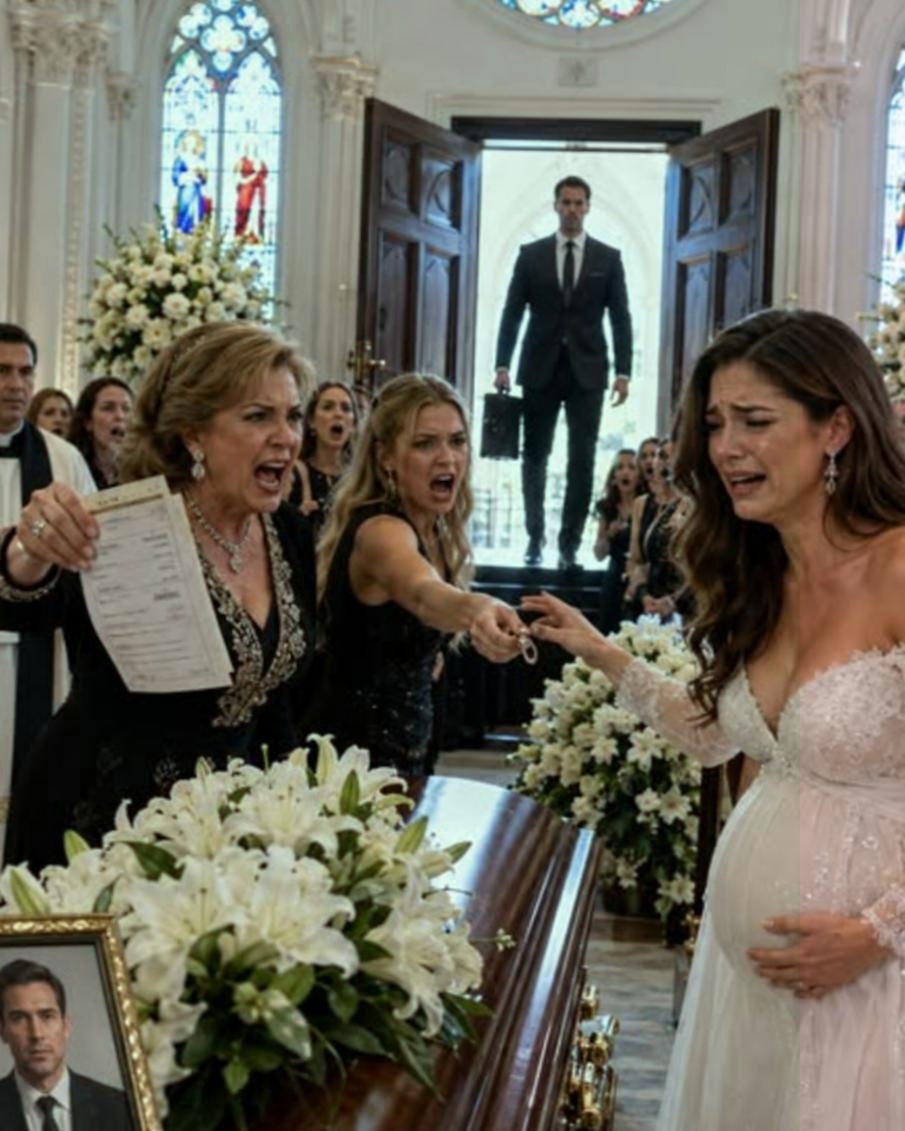


When I read Eleanor’s message, the air in the room seemed to disappear.
David took the phone from me.
His face turned white.
“I left a camera in the nursery,” he said. “This photo was taken just now.”
Harris immediately spoke into the radio.
“Lock all exits. We already have the address.”
Sterling stood in handcuffs and was still smiling.
“You are much too late,” he said. “Eleanor is not alone in the house.”
David looked toward him.
“You knew every address of my family.”
“That is why I always won.”
“No,” David replied. “I simply trusted you for too long.”
We got into the police cars. I sat in the back seat with David beside me, while Harris continuously took calls from the front. Every minute I thought about the little room where the baby’s crib was empty and someone’s hands had touched my medallion.
Three police units were waiting for us at our house.
The gate was open.
Everything in the living room was turned upside down. Books lay on the floor, and in the hallway was a white blanket taken from the nursery.
“Sarah!” David shouted.
No one answered.
The sound of things breaking came from upstairs.
I ran toward the stairs, but Harris grabbed my arm.
“Stay back.”
Eleanor’s voice came from behind the door.
“David, you always thought money would protect everything for you.”
“Do not touch the baby, Mother.”
“The baby? That woman will humiliate you for the rest of your life.”
“You have already done everything to destroy my life.”
Harris broke down the door.
Eleanor stood by the window. There was no one in the nursery. The crib was empty, and my silver bird medallion lay on the windowsill.
Eleanor raised her hands.
“The baby is no longer here.”
A scream caught in my throat.
David knelt beside the crib. He picked up the blanket and found a small white sheet on it.
“The baby was never here. This was only part of the plan.”

Harris came up behind Eleanor.
“You sent a false message, broke into the house, and tried to intimidate a witness. You are under arrest.”
For the first time, Eleanor lost control.
“I protected my son!”
“You ordered his murder,” David said.
“You have already lost everything.”
“No. You only made me lose four days.”
The detectives led her out of the room.
Downstairs we played Sterling’s voice, explaining his plan in the warehouse. In the recording his voice was calm and confident.
“David will die, and Sarah will be forced to transfer everything to me.”
In another recording he said:
“If the woman resists, we will show her the story of the child’s disappearance.”
Sterling lowered his head.
For the first time, he heard his own voice from someone else.
“It is edited,” he said.
Harris shook his head.
“It is your voice. These are your words. These are the funds transferred from your accounts.”
Sterling looked at David.
“You prepared all this against me?”
“No. You prepared it yourself. I only recorded it.”
That same day both women and Sterling were arrested. Chloe gave a statement to the investigators and admitted that she had damaged the car’s brakes on her mother’s orders. The court later confirmed that the false paternity result had been falsified at the private clinic, while the real result lay in David’s safe.
David got his estate back.
But he did not take everything back immediately.
We spent the first weeks in the hospital. His shoulder was waiting to heal, while I counted every movement of the baby in my belly.
One evening he carefully asked me:
“Do you still love me?”
Snow began outside the window.
“I thought you were dead for four days,” I answered. “Love saved me. But trust cannot return through love alone.”
He lowered his head.
“I know.”

“Never hide the truth from me again, even if the truth hurts both of us.”
“I promise.”
We did not preserve that promise for long as beautiful words. Every day we tested its truth through a small action: he went to the doctor on time, and I no longer kept questions in my heart.
Six weeks later, our daughter was born.
We named her Nina.
When David held her for the first time, tears came to his eyes.
“She is mine,” he said quietly.
“Yes,” I told him. “But this was never proof of your worth. She is simply our child.”
We moved from Manhattan to a small coastal town, where David began managing the company remotely and I began working at an architectural studio. In the morning I made Nina porridge, and in the evening I put her drawings on the refrigerator.
The first months were difficult.
Sometimes I heard the sound of the cathedral’s heavy doors and returned again to that day. Sometimes I saw the wooden surface of a coffin in my dreams. But every morning I woke up, and the child’s breathing in the room reminded me that we had not let death take our life.
Three months later, David sent me an envelope.
Inside was only a letter from Eleanor.
“Come see me. I am still your mother-in-law.”
David said nothing to me. He left the decision to me.
I wrote a reply.
“You were a member of my family until the day you used my grief as a weapon. I may learn to forgive one day, but I do not want to go back. Please do not contact me again.”
I sent the letter by mail.
Then I tore up the envelope.
On the day Nina turned six months old, she sat on the living-room floor and drew a house with a pencil. The house had tall windows, and three people stood beside it.
“Who is this?” I asked.
“Us,” she told me, placing her finger on the first two figures. “And this is Nina.”
In the corner of her drawing she drew a small silver bird.
I touched the medallion. It now hung around my neck, together with the wedding ring. The old bloodstain was almost no longer visible, but I knew where it was.
David came out of the kitchen and set two cups of tea on the table.
“Are you still afraid?” he asked.
The first snow was coming through the window.
“Sometimes.”
“Then touch the bird.”
I smiled.
“This time I will come.”
Nina stood up laughing and hugged us both.
That night I hung the medallion beside the baby’s crib, where I had once found the empty paper left by Eleanor.
The small silver bird swayed slowly.
I no longer expected anyone to come save me.
I was already home.
Missed the beginning?
Related posts:
 At My Husband’s Funeral, My Mother-in-Law Threw Me Out of the House, but the Moment the Door Opened, One Man Lost Color
 When my twelve-year-old daughter was ordered to clear out her own room, my husband’s calm smile suddenly made them go pale
 They Humiliated Me at the Holiday Table, and I Left Quietly — When My Son Saw My House, the Color Drained from His Face
 The Mafia Boss Came to the Abandoned Infant’s Crib, but When Everyone Saw the Name Engraved on the Ring, Everyone in the Room Stopped Breathing
 Part 4 — They Humiliated Me at the Holiday Table, and I Left Quietly — When My Son Saw My House, the Color Drained from His Face
 When the dangerous mobster’s son reached out towards me, his father looked at the photo and went pale.