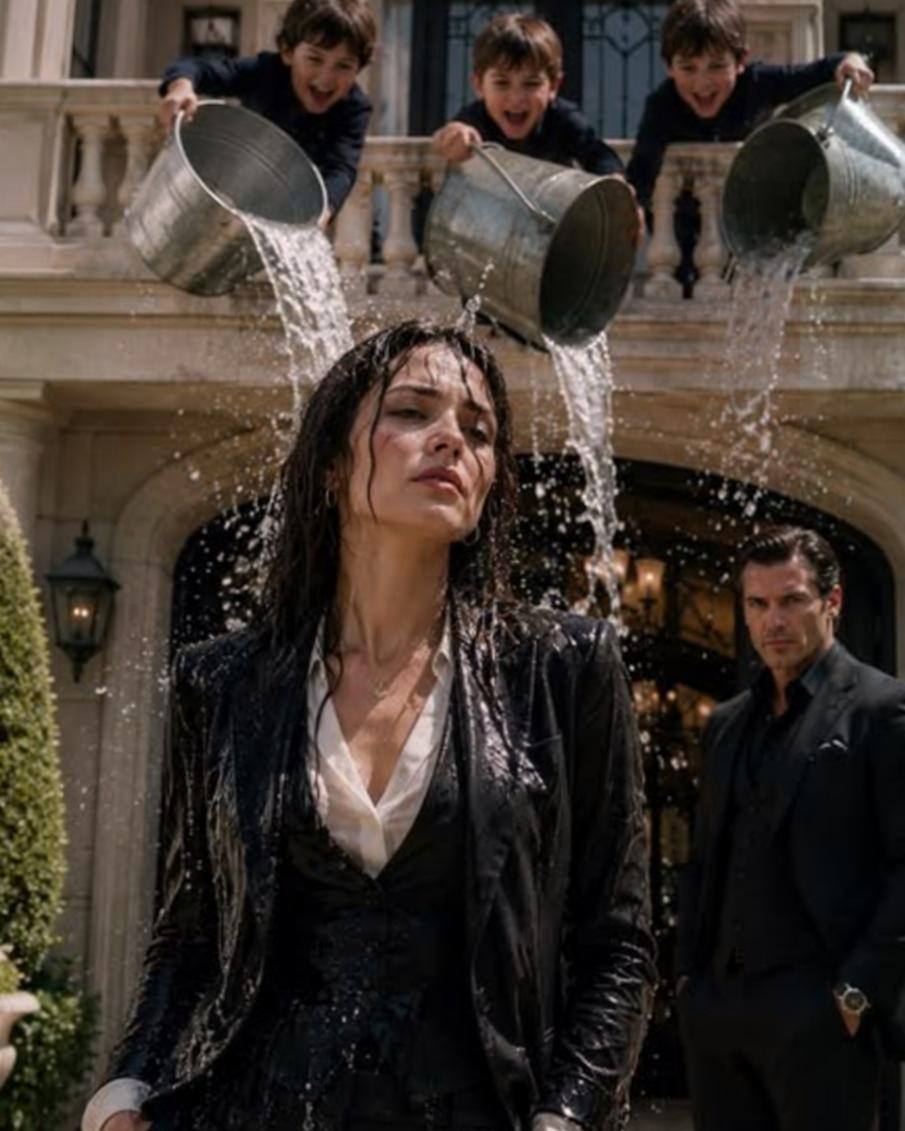

The woman stopped by the gate and did not walk toward the house.
The police officers raised their weapons.
Adrian released my hand and stepped forward.
“Elena?”
The woman removed her glasses. She had a thin scar on her left cheek and a small silver medallion around her neck.
“No,” she said. “But your wife was my sister.”
The boys came down from the stairs.
“Aunt Mira?” Marco whispered.
The woman nodded.
Adrian seemed to have aged.

“Mira, where were you for four years?”
“I thought you were dead. I thought the same about you.”
The police chief raised his hand.
“Everyone enter the house. Now.”
Victor had already been taken away, but his words had remained in the house like heavy smoke. I took the children into the playroom. Leo still held that missing carriage.
“Aunt Mira looks like Mom,” he said.
“I know.”
“But she is not Mom.”
“I know.”
“If Mom were alive, would she come back to us?”
I could not find an answer to that question. I hugged the children and realized for the first time that sometimes telling the truth is more cruel than silence.

Downstairs, Adrian’s phone rang.
“It’s the lawyer,” he said.
He answered.
“Tell me that we have enough evidence against Victor.”
As he listened to the answer, his face changed.
“And my signatures?”
He listened silently for several seconds.
“No. I did not sign these deals.”
Mira laughed coldly.
“You did not sign them, but you knew something was happening.”
Adrian looked toward her.
“What do you mean?”
“Elena was not asking you for protection. She was telling you that Victor was watching the children. And you told her she was paranoid.”

Adrian’s hand relaxed on the phone.
“I don’t remember it that way.”
“Because you are lying to yourself.”
The lawyer said clearly through the phone:
“Adrian, I advise you not to say anything else. Federal investigators are also checking your connections. If you do not hand over all the financial records today, I will refuse to defend you.”
Adrian lowered his eyes.
“You’re leaving too?”
“I defend a client, not the truth he has hidden.”
The call ended.
Adrian stood motionless for a long time.
Then he went to the small screen by the wall and turned on an old video recording.

Elena’s voice sounded in the room.
“Adrian, the children are not safe beside you.”
Adrian’s younger face appeared on the screen. He stood irritated, holding a glass.
“You see danger in everything. Victor is my most trusted person.”
“A trusted person would not secretly install cameras in the house.”
“Enough, Elena. I know what I’m doing.”
The recording stopped.
No one in the room was breathing.
Adrian put his hand on the screen.
“Did I say that?”
“Yes,” I answered.
“Really me?”
“In your own voice.”
He sat down on a chair. For the first time, I saw that this man was a prisoner not only of criminals, but also of his own denial.
“Why didn’t you tell me that you found the recording?” he asked.

“Because I first had to understand whom I was believing.”
“And now?”
“Now I believe what I heard.”
Mira put a metal box on the table.
“Elena left this with me. She told me to hand it over only when the children found someone who would not be afraid of their games.”
Adrian looked at me.
“You knew?”
“No. The children knew that I would not run away.”
Inside the box were three letters from Elena, one for each child. They said that Mother would never abandon them and that if the house ever became dangerous, they must not let go of one another’s hands.
That same evening, investigators took Adrian for questioning as well. Not as a murderer, but as a man who had failed to ask too many questions for too many years.

His house became empty.
Victor was charged with financial fraud, stalking, threats, and conspiracy connected with Elena’s death. It was later confirmed that a man hired by Victor had damaged the car’s brakes. Elena survived the accident, but later died in the hospital because Victor deliberately delayed calling for help.
Mira had to testify in court.
And I moved temporarily with the children into a small house.
That night, when I was taking my suitcases out of the Moretti mansion, my room was almost empty. Only one thing remained on the bed—the small brass key card numbered two hundred fourteen.
Adrian stood in the doorway.
“You will receive the money, as I promised,” he said.
“I need the money. But this is not a debt.”
“I know.”
“Will the children stay with Mira?”

“Temporarily. After that, they can stay with you too, if you want.”
“I want to.”
His eyes lit up, but he extinguished it at once.
“Why?”
“Because running away has already become an answer too many times for them.”
He lowered his head.
“I also have to learn to stay.”
“That is for you to decide.”
Weeks passed.
Victor sent letters from prison. At first he threatened me, then begged me, and finally said that Adrian was guilty of everything.
I opened none of the letters.
Adrian sold his clubs, closed one construction company, and handed all the accounts over to the investigators. The court still awaited him, but for the first time in his life he was no longer trying to lock a door for someone else.

One evening he took the children for a walk. They were standing in front of a fountain in the park when Niko asked:
“Dad, are you not a bad man anymore?”
Adrian thought for a long time.
“Sometimes I behaved badly.”
“That means you are bad.”
“No. But if I behaved badly, I have to make it right.”
Leo turned a small stone over in his hand.
“Would Mom forgive you?”
Adrian lowered his eyes.
“I don’t know.”
Marco said:
“Claire said that forgiveness does not mean that nothing happened.”
Adrian looked toward me.
I stood far away, holding the bag I had brought Lily home from school.

Three months later, we moved to another city. I began working at a child development center. In the morning I braided Lily’s hair, while the boys competed to see who would find the missing sock faster.
The house was small, but the doors no longer locked from the inside.
A drawing by Lily hung beside the kitchen window: four children, one woman, and a large yellow house with every window open.
The first snow came at the end of November.
The children made three little snowmen in the yard. They put a toy train carriage on one of them as a hat.
That evening I received a message from Adrian.
“I want us to start over when you are ready. Not as employer and nanny. As people.”
I looked at the screen for a long time.
Then I wrote back:

“Starting over is impossible. But choosing a new path is possible. For the children. With the truth.”
His reply came a few minutes later.
“This time I understood.”
I put the phone on the table.
Lily entered the room.
“Mom, do you still have that little key?”
I took the brass card from my pocket. The number two hundred fourteen shone in the snowlight.
“It always will.”
“What does it open?”
I went to the window. The children’s laughter could be heard in the yard, and the door had remained open.
“The place I came out of at last.”
I placed the card in Lily’s hand.
She clasped the little object with both hands.
And for the first time, I no longer needed to lock the door.
This time I left the door open.
Missed the beginning?
Related posts:
 Three Little Boys Met Me with Humiliation, but When I Told Their Father the Truth, the Glass in His Hand Stopped Motionless
 I Overheard My Husband’s Secret Conversation at the Airport, but When He Mentioned Losing My House, His Companion Suddenly Turned Pale
 At the Wedding, My Husband Confessed His Love to My Sister, and When I Took the Microphone, His Smile Began to Disappear
 She left her pregnant wife behind the palace gate, but a black SUV appeared behind my car and the guards lowered their eyes
 I Went to the Cemetery with Five Children, and My Ex-Husband’s Gaze Suddenly Froze
 I Was Carrying an Engagement Ring for Another Woman When I Saw Three Unknown Children in the Rain and the Smile Disappeared from Grace’s Face