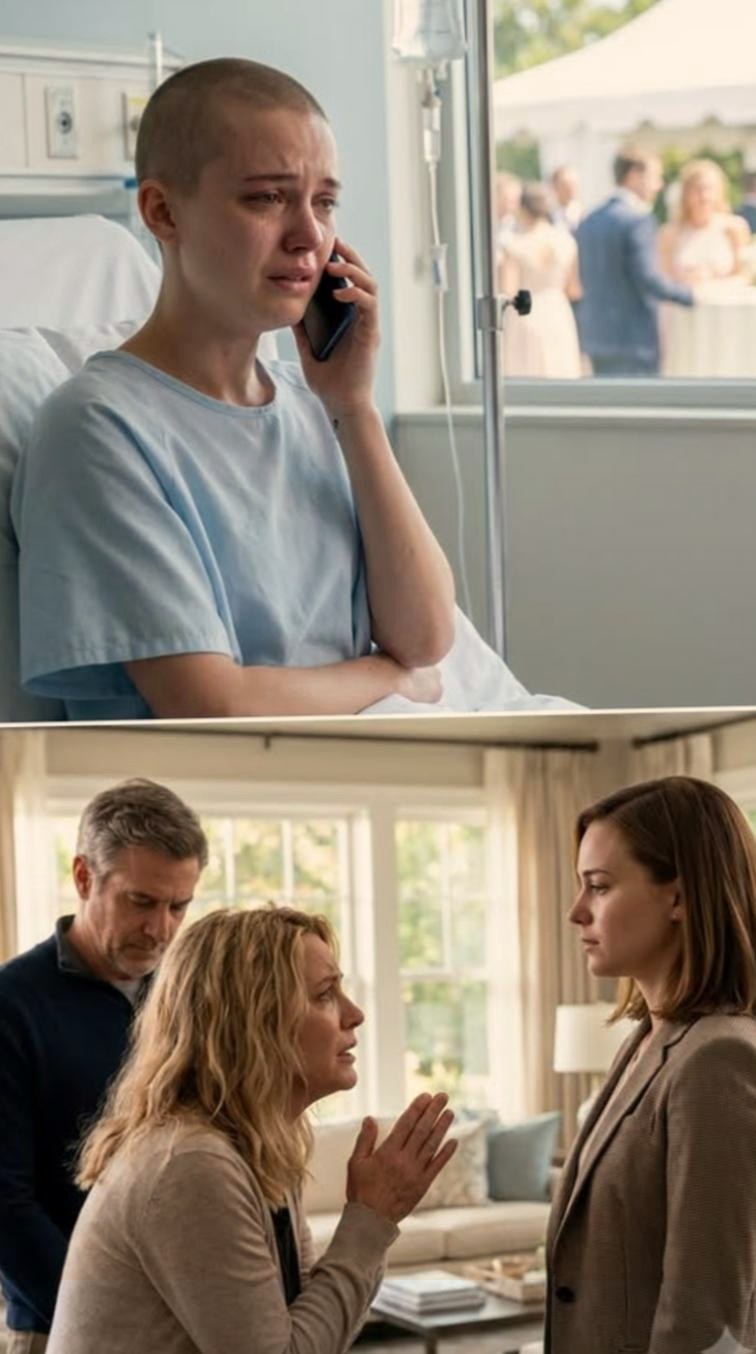

I was twenty-eight when I called my mother from a small hospital restroom and told her that I might die soon.
I held the phone so tightly that my fingers were trembling. The mirror hanging on the wall reflected my pale face, while outside the intermittent sound of machines could be heard.
“Mom, the doctors found tumors,” I barely said. “It is stage three. I have to start chemotherapy immediately.”
Silence fell on the other side.
At that moment I thought my mother was crying. I thought she could not find the words.
But she only sighed heavily.
“Nino, I know it is serious, but there are six weeks until your sister’s wedding. The whole family cannot fall apart now.”
Tears ran down my cheeks.
“I may die.”
“Don’t exaggerate, child,” she told me. “Doctors often make everything sound more dangerous.”
Those three words broke something inside me.
My father took the phone.
“Your mother is very tense,” he told me. “When the wedding is over, we will definitely visit you.”
“When?”
My father fell silent.
Then I heard my sister Salome laughing in the background. It was so cheerful, as if it had nothing to do with my life.
I did not call them again that day.

Chemotherapy began the following Monday. The clinic’s bright room was filled with the sharp smell of disinfectant. They inserted a thin needle into my left hand, and the medicine slowly flowed through a transparent tube.
“Is someone with you?” the nurse asked.
“No,” I answered.
“Will someone come?”
I looked at the plastic chair standing by the window.
“No.”
That day I went alone and returned alone. At traffic lights I clung to a bag hidden in the car because of vomiting. After arriving home, I locked myself in the bathroom and sat down on the floor.
When my hair began to fall out, I had to shave it myself. The first time I looked in the mirror, my head seemed to belong to a strange woman.
At that time, photos from Salome’s wedding multiplied on social networks. Mother wore diamonds around her neck, father was making a toast, and everyone was smiling.
No one mentioned me.
Four months later I saw Salome for the first time. Her house was full of the smell of fresh flowers. She looked at my shaved head and quietly said:
“Couldn’t you really wait until the wedding was over?”
“What was I supposed to wait for?”
“For the attention to return to me.”
I laughed, but that laugh stuck in my throat.
“Stay calm, Salome. I do not want your attention anymore.”
I walked toward the door.

None of them knew that before the illness began I had worked in financial compliance for five years. During treatment, when I had the strength, I continued working from home.
One evening I was checking my father’s work files and noticed strange transfers. Money was moving from the family trust fund to an account controlled by Salome. At first they were small amounts, then thousands, and finally tens of thousands.
All the transfers had the same description: wedding expenses.
I did not argue with anyone. I took a small leather notebook numbered with a blue pen and wrote everything down: dates, signatures, letters, lies.
Chemotherapy taught me one thing: when you have nothing left to lose, fear becomes silent.
And I was already preparing for the day when I would survive and my family’s door would close by itself…
Eventually that day came. It was ten in the morning in the doctor’s office, raindrops striking one another on the window, when the oncologist turned the screen toward me.
“There are no longer any signs of the disease,” he told me with a smile. “At this stage everything is clear.”
I could not answer anything. I sat down on the chair and began to cry.
These were no longer the tears of the day I heard the diagnosis. Now fear was no longer choking me. For the first time I felt that my life was mine again.
I did not call my mother. Nor my father. Nor Salome.

That same evening I opened the small metal box in which I had kept my savings during treatment. Then I called the lawyer Tako.
“What do you want from them?” she asked me the next morning in a café where the smell of coffee hung in the air and my fingers touched the warm ceramic of the cup.
“Nothing.”
Tako raised an eyebrow.
“Then why did you come?”
“I want to be sure that they will never again be able to take away what is mine.”
From that day my life changed. I bought a small house, expanded my work, and created a consulting company for discovering financial fraud. Eighteen months later people were calling me from different cities.
I was already helping people who thought, as others did, that their relatives would never betray them.
One morning the bank called me.
“Ms. Nino, your father tried to access your trust account,” the manager told me. “We refused him.”
“Why did he have a reason to try to access it?”
“Apparently, he thought that changing the account beneficiary was still possible.”
Tako checked the documents again that same week. It turned out that in my grandfather’s will I was named the protected beneficiary. Investments worth nearly one million two hundred thousand lari were held in the fund.
My parents knew about this. They were simply certain that I would never reach that money.

Tako opened another folder.
“Nino, there is something worse here.”
“What?”
“Your father and Salome were trying to transfer part of the fund’s assets into their own names. The attached documents are forged.”
Before me lay papers on which my supposed consent was written. The signature was mine, but the movement of the pen was not. I knew what a genuine document looked like and how a forged paper left the smallest trace.
“Let’s go to the police right now,” Tako said.
“Not yet.”
“What are you waiting for?”
“For them to come themselves.”
Three months later Salome called me. The old coldness was no longer audible in her voice, but there was no warmth either.
“Mother says you have to come home.”
“Why?”
“We have to become a family again.”
“Does Father know that you are calling me?”
Silence.
“No.”
“Good.”
She lowered her voice.
“Your company is doing well. We know how much you earn.”
The white ceiling of the hospital opened before my eyes.
“When I was sick, you did not know how to find time for me.”
“It was a different situation then.”
“No, Salome. Then you thought I was going to die soon.”
She hung up.

One week later my mother called me. She cried, apologized, and told me that she had been afraid of my illness.
I listened silently.
Then she said:
“We are family. Family helps one another.”
On my desk lay the forged documents, transfers, and emails. In one letter Salome wrote that I probably would not be alive by the time I received the inheritance.
Then I finally understood: they had not abandoned me because they were confused. They abandoned me because my death had already been written into their plans.
Tako put down the phone and looked toward the window.
“Nino, they still think you have only evidence.”
“What else should I have?”
She showed me an unknown number on the screen. The message contained only one sentence: “If you take the family to court, we will reveal to everyone a secret hidden since childhood…”
It was seven in the evening in Tako’s office. Streetlights spread across the wet glass, while the phone lying on the table did not stop flashing even after the new message.
“Is this Salome’s number?” I asked.
“No. The number was taken recently,” Tako replied.
“Then who is so afraid?”
She pushed the folder toward me.
“The person who knows that in court we will not be considering only the transfer of money.”

There was a document in the folder taken from my grandfather’s notarial archive. Tako had requested its full copy in advance, and now her finger rested on one paragraph.
“Your grandfather did not create the fund only for you. He knew that your parents were in debt and were trying to transfer property into Salome’s name. That is why he appointed you as the only protected beneficiary.”
“But why did they hide this secret from me?”
“Because your father had the right to manage the fund until you turned thirty. He thought you would not reach that age.”
The air in the room seemed to grow heavier.
“They assumed my death,” I said.
“They did not only assume it. They planned it.”
Tako turned on the computer. My family’s emails appeared on the screen. In one of them Father wrote: “After the wedding everything will fall into place. If Nino cannot endure the treatment, the fund issue will also be resolved.”
Salome’s reply was visible below: “She has never used that money anyway. We should start transferring it.”
My hands became cold.
“Are these their words?” I whispered.
“These are emails extracted from their accounts. The examination confirmed their authenticity.”

At that moment the office door opened. Father and Salome entered. The collar of Father’s gray coat was wet, while Salome was still wearing around her neck the same diamond necklace she had worn on her wedding day.
“This is a family matter,” Father said and slammed the door.
“No,” I answered. “This is a financial crime.”
Salome took a step toward me.
“Nino, we were simply trying to keep the money in the family.”
“So you forged my signature?”
Father’s face changed.
“You were ill. You could not make decisions.”
“But I could approve wedding expenses?”
Tako spread all the transfers across the table.
“Here it is shown that you used part of the money to buy Salome’s apartment. And part to cover private debts.”
Salome stepped back.
“We thought you would never need that money again.”
“You thought I would no longer exist.”
For the first time Father hid his eyes.
Tako pointed to the next document.
“Both of your signatures are on this document. And here it says that in the event of Nino’s death, Salome would receive the assets.”
“That was only an assumption,” Father said.
“No,” I answered. “That was the price of my life, which you calculated in advance.”

Someone knocked beyond the door. Tako picked up the phone.
“The investigators have arrived,” she said. “But first you need to know this: they already have the records obtained from the bank.”
Father staggered.
“You prepared all this in advance?”
“Yes.”
“Why did you not confront us immediately?”
I looked at his face and, for the first time, felt neither anger nor the desire to prove anything to him.
“Because I wanted you, at least once, to tell the truth in your own words.”
Salome began to cry.
“Nino, please, we are your family.”
“You are family when a person is ill. But you remembered me only when you saw my name on the account.”
Someone knocked on the door once more.
But before Tako could get up, Father’s phone rang. He looked at the screen and turned pale.
“Who is it?” I asked.
Father could not utter a sound.
Tako turned the screen toward me. The caller was my deceased grandfather’s old notary.
He had sent only one sentence: “You have not yet seen the main document related to the fund…”
მამამ ჩემი ჩანაწერი მოისმინა და პირველად დადუმდა…
მე მეგონა, ყველაზე რთული სიმართლის გაგება იყო. მაგრამ ფინალმა მაჩვენა, რას ნიშნავს საკუთარი ცხოვრების უკან დაბრუნება.
„მე მაშინ გთხოვდი, მამა.“
მან თვალები დახარა.
😱 გაიგე, რას მალავდნენ ისინი →
👇 ისტორიის ფინალი უკვე გახსნილია
Related posts:
 My father promised my house and car to my sister as an inheritance, but the morning call immediately erased his smile
 Part 4 — Six weeks before chemotherapy began, my family replaced my death with wedding plans, and then my mother smiled strangely
 Two days before my brother’s wedding, my mother forbade me from coming, and when she read my reply, April’s smile disappeared
 My Sister Ruined the Wedding Photos with My Wheelchair and Sent Me to the Back Corner, but Jamal Stopped Smiling After a Few Minutes
 The Husband Married Another Woman in Front of Three Hundred Guests, but After My Calm Response, the Lawyer Put His Phone on the Table and Turned Pale
 My Father Was Fed by a Poor Woman at Night, but When I Followed Her Trail, a Stranger’s Face Suddenly Turned Pale