
I showed Marina the warehouse address. It was five in the morning, but there was no sign of sleep left in her eyes.
“You won’t go there alone,” she told me.
“I’m not going anywhere alone.”
Natalia was taken into the ambulance. Her neck was strained, her leg was broken, and she received three stitches on her face. Before the door closed, she squeezed my hand.
“I didn’t know,” she whispered.
“What didn’t you know?”
“That you were supposed to fall.”
Tears came to her eyes.
“I know,” I told her, although I was not completely sure.
The police took Andria from the house. He was wearing handcuffs, but he still tried to give orders to everyone.
“Call my lawyer!” he shouted. “This is my family!”
His lawyer called for the first time at half past six in the morning.
“Mrs. Melnik, my client is ready to cooperate if you withdraw your complaint—”
“The complaint has already been filed.”
“You can agree on the amount.”
“Don’t put a price on my life.”
Galina’s lawyer made the second call. He told me that Galina was a frightened elderly woman and that everything had happened as a result of a misunderstanding.
I asked only one question.
“Did your mother bring the oil onto the stairs by accident?”
I received no answer.


We arrived at the warehouse at twenty minutes past six in the morning. The door was half open. Inside there was the smell of dampness, cardboard, and old paint. A small table stood against the wall, and on the table were a charging device and a memory card.
Marina stopped me with her hand.
“Don’t touch it.”
The police officer put on a glove and picked up the device.
There was a video on the memory card.
In the footage, Andria was sitting in the same warehouse. Galina stood in front of him.
“Mother, if she still does not sign tomorrow, everything will be frozen,” Andria was saying.
“And then?”
“They will consider the fall an accident. The insurance will be paid. The loan will take effect. The child will stay with me.”
Galina’s voice was trembling.
“What if she survives?”
Andria raised his head.
“She won’t survive.”
As I watched the video, I could no longer feel my own breathing. What hurt most was not his words, but my name when he said calmly: “Elene will understand nothing, because she has trusted me all her life.”
The recording ended.
Marina turned off the screen.
“Now we have everything,” she said.

But for me, something else turned out to be the heaviest. When I returned home, I entered Andria’s study. Photographs of my father hung on the walls, and my company seal lay in the middle of the desk. Beside it I found a small wooden box.
Inside were letters that Andria had never sent to me. They all belonged to the same woman—Larisa, his former partner. The letters said that our marriage was only a temporary step and that after taking control of my company they would begin living together.
I was no longer angry.
Sometimes the truth is so cold that it freezes even tears.
That same day the court issued an order for temporary protection of my property. The bank froze all suspicious accounts. The investigator confirmed that the video, audio recording, traces of oil, and forged signature were being joined into one case.
Andria changed lawyers. Then another one. Finally, his last lawyer also refused the case.
“My client constantly tries to hide evidence,” he told me. “I cannot continue such a defense.”
Several weeks later Andria himself heard his words for the first time in the courtroom. The investigator played the video. His face appeared on the large screen, and his voice rang through the courtroom.
“They will consider the fall an accident.”

Andria sat on a chair and watched the screen.
“I didn’t say that,” he whispered.
The prosecutor looked at him calmly.
“It is your voice.”
“It is my voice, but the context—”
“You created the context too.”
Then Andria heard his own words for the first time as I had heard them that night. He could no longer hide them with a smile, turn them into concern, or blame them on pregnancy hormones.
Galina confessed to the crime and received a sentence. Natalia gave testimony to the investigation. She told me that for years Andria had given her the company cards and told her not to think about anything.
“I thought I was simply spoiled,” she told me at the hospital.
“You made a bad choice,” I answered. “But that does not give you the right to take someone else’s life.”
On the day I returned home, Andria’s room was empty. Only one crumpled shirt remained in the wardrobe. A photograph from our wedding hung above the bed, but my image had been removed from the frame. On the desk lay the black pen with which he had signed the company papers.
I took the photograph down from the wall.
I took the shirt to a charity center.
For the first time, the room did not look like a prison.

Three months later my son was born. I named him Nikolai—in honor of my father’s name, but not the man to whom I had been married. My father’s name was Nikolai, and he was the one who taught me that opening the door of your own home is trust, although locking the door is not betrayal.
I continued to run the company. I put a new desk in the study. At eight in the morning I checked the accounts, at noon I went to Nikolai’s doctor, and in the evening I put him to sleep by the window, from which the city lights could be seen.
The first snow came at the end of December.
Nikolai was seven months old then. He stood by the window and drew small circles on the glass with his fingers. I was making tea in the kitchen when I received a message on my phone.
Andria was writing to me.
“Elene, I know I did everything badly. Let me explain at least once. I want to see the child. We are a family.”
Then a second message arrived.
“If you go all the way against me in court, you will lose everything too.”
I looked at the screen for a long time. Before, words like these would have kept me awake all night. Now I only looked at Nikolai’s drawing.
“Mother, look,” he said in his still incomprehensible voice, pointing to the crooked line drawn on the window.

“I see it, my little one.”
I wrote a reply to Andria.
“Our family ended that night when you turned my death into a plan. The child will meet you only by court decision. I am not returning to you.”
Then I blocked the number.
That evening, while brushing my hair, I accidentally took the small copper swallow-shaped clip in my hand. It had cut into my skin by the stairs that night, when my life hung by a single moment. Now it lies on a shelf in Nikolai’s room.
Sometimes, when the child cries, I take the swallow in my hand and remember that then I was standing one step back, but still moved forward.
Outside the window, snow was falling silently.
I held Nikolai to my heart, while the copper swallow shone in the light of the lamp.
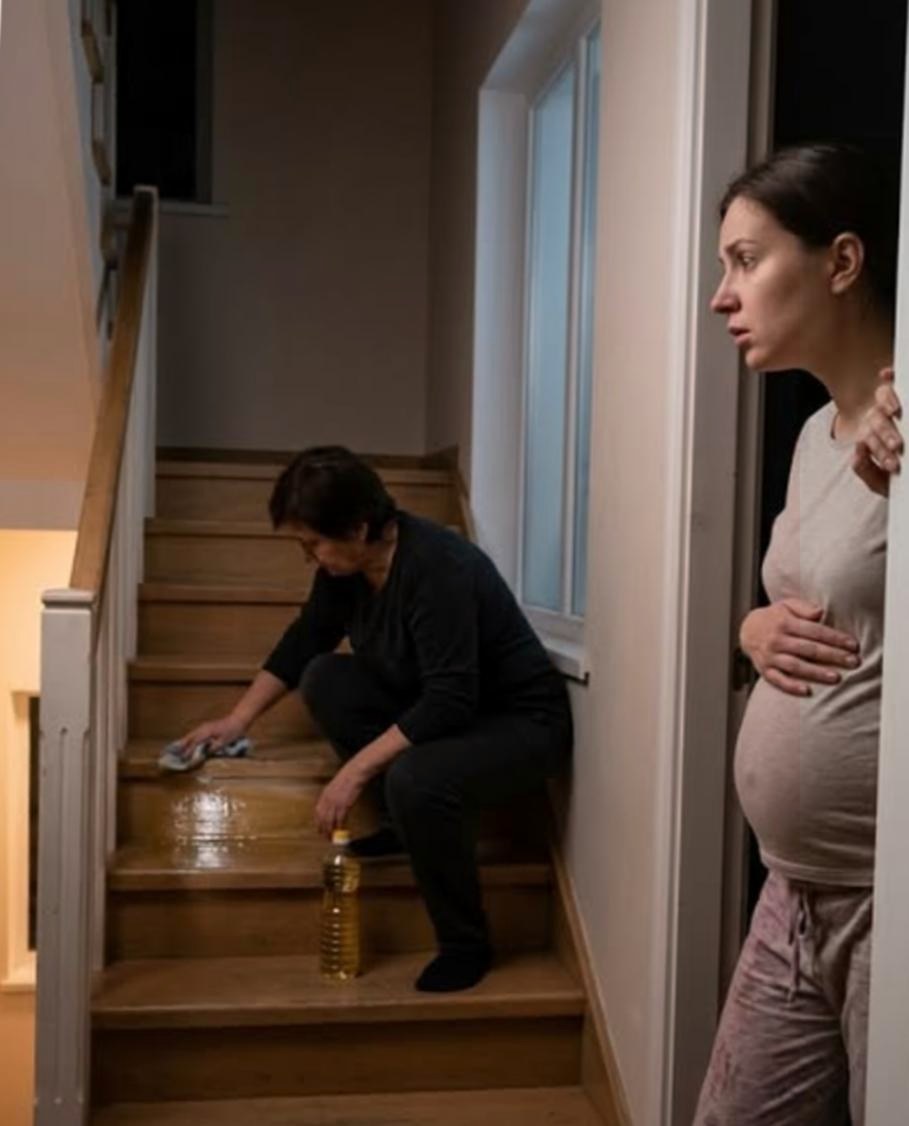
That night, oil remained on the stairs.
My path did not.
Missed the beginning?
Related posts:
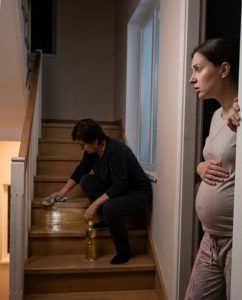 In the eighth month of pregnancy, I saw oil on the stairs, but when a scream came from below, my husband froze
 My husband left me and the children in poverty, but his mother stopped at the door, and her expression changed strangely.
 Mein Vater zerrte mich schwanger aus meinem Haus, doch als ich telefonierte, verschwand sein selbstsicheres Lächeln
Part 4 — My husband left me and the children in poverty, but his mother stopped at the door, and her expression changed strangely.
Mein Vater zerrte mich schwanger aus meinem Haus, doch als ich telefonierte, verschwand sein selbstsicheres Lächeln
Part 4 — My husband left me and the children in poverty, but his mother stopped at the door, and her expression changed strangely.
 Mi prometido llegó con mi hermana usando mi anillo, y cuando exigieron que sonriera, alguien detrás de mí dejó de hacerlo
 An Unknown Man Humiliated Me in Front of Everyone, but the Restaurant Owner Looked at Me Only Once — and His Smile Immediately Disappeared