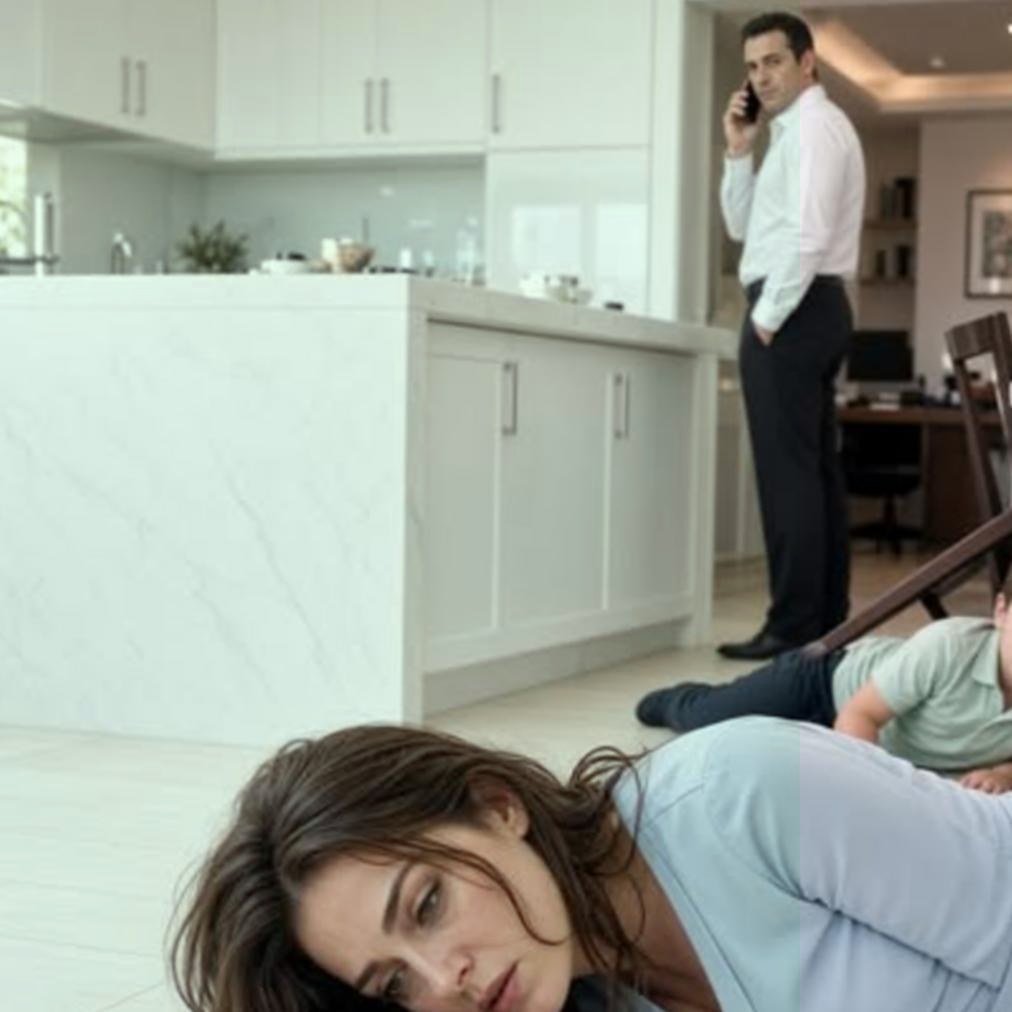

That same morning the doorbell rang for the second time.
Lucia did not let the lawyer pass.
“Show me the order.”
The man standing in the corridor was dressed in an expensive coat and held a leather folder in his hand.
“I am a representative of Mr. Diego Mendoza. I have an urgent request for the child’s protection.”
“The child’s father is suspected in a poisoning case,” Lucia told him. “No one is taking a step out of here.”
The man looked at Diego for a moment.
“This is a misunderstanding.”
“No,” I told him. “This is a plan that was recorded.”
Lucia picked up the memory card.
Diego immediately became angry.
“Valeria, if you spread this recording, you will destroy Mateo’s life. Everyone will pity him.”
“You planned his death, and now you are afraid of his shame?”
His lawyer raised a hand.
“My client does not need to say anything else.”
“For the first time you are saying the right thing,” Lucia replied.

The bank specialists connected Diego’s phone to a secure system. The transfer was still stopped. The second code arrived on his device.
The policeman placed the screen in front of him.
“Say the code.”
“I will not.”
“Then we will open it by court order.”
Diego clenched his teeth.
“You cannot prove that I sent it.”
Elena calmly opened the folder.
“The bank has already confirmed that the last three operations were carried out through recognition of your face. We also have the camera.”
Diego fell silent.
His phone vibrated on the table. Camila’s name appeared on the screen. He looked at the call, but did not answer.
Lucia turned on speakerphone instead of him.
“Diego, tell me that everything is all right,” Camila’s voice sounded. “The lawyer says that if we cannot transfer the money today, I will receive nothing.”
Diego’s face changed.
Camila continued:
“And why did that woman wake up? You said neither of them would be able to get up until morning.”
Silence fell.
Diego stared at the phone. It was as if he had heard his own lie from someone else’s mouth for the first time.
“Camila, shut up,” he said.
“I acted according to your plan! You told me the child would get in your way!”
The call ended.
Diego’s lawyer lowered his eyes.
“Mr. Mendoza, from now on I am refusing my services.”
“What are you doing?”
“You asked me to hide facts from you. Now I have heard the recording.”
“I paid you!”
“I will return the remaining money to you.”
This was the first moment when Diego felt completely alone in the room.

Then he was taken to the detention room. Camila was arrested that same day on charges of financial fraud and participation in planning the crime. Investigators confirmed the forged signature, the insurance policies, the house documents, and all the transfers.
Our money was frozen by the bank.
The false rights placed on the house were canceled.
The insurance company suspended the policies.
But for me the hardest thing was still the court’s decision.
The judge left Mateo’s temporary and then permanent custody with me. Diego was forbidden to contact him until child psychologists and the court confirmed his safety.
When we left the courthouse, Mateo took my hand.
“Mom, will Dad go to prison?”
“Maybe,” I said. “But it is not your fault.”
“You still helped him when he was ill.”
Those words struck my heart more strongly than any court document.
“I thought helping was part of love,” I said. “Now I know that protecting yourself is also love.”
Several weeks later I sold our house.
I could no longer enter the kitchen. Every night I saw again those cold tiles, that table, and that door. Especially the small corded telephone that I had hidden in the pantry cupboard.
I took the telephone with me.
In the new apartment I hung it on the hallway wall, although I did not connect the line. I simply wanted to remember that sometimes the thing that brings us closer to survival is the thing everyone advises us to throw away.


I found a new school for Mateo. In the mornings he tied his own shoelaces. In the evenings we prepared food together in the kitchen. Every time he asked me:
“Is this safe?”
I no longer answered automatically. I read the label, checked the ingredients, and then told him:
“Now it is.”
Three months later the first snow came.
Mateo stood by the window and drew a house on a white sheet of paper. The house did not have a high fence. A yellow light was burning at the door.
“This is our new house,” he told me. “No one will come in here unless we want them to.”
“It is a very good house.”
“Should I draw the telephone too?”
“Definitely.”
In the corner he drew a small black telephone, and beside it two people holding hands.
That evening I received a letter from Diego. He had sent it through a lawyer.
“I was not myself. Camila tempted me. You and Mateo are my family. Give me a chance to fix everything.”
I read the letter three times.
Then I hid it behind Mateo’s drawing, not because I wanted to answer, but because I did not want to forget what a person sounds like when he blames others for his own choice.

A week later a second letter came.
This time it contained only one sentence:
“If you ever need me again, call me.”
The corded telephone hung on the wall. The line was disconnected.
Still, I went to it.
Mateo stood behind me.
“You are not going to call?” he asked me.
“No.”
“Why?”
I touched the telephone’s black surface with my finger. Then I remembered the cold tile, the quietly spoken words, my child’s trembling, and that one old device that had kept us alive that night.
“Because now I know whom to call when I need help.”
“Whom?”
I turned toward him.
“Myself.”
Mateo took my hand. Outside, snow was still falling, and the streetlights spread golden across the window glass.
That night the telephone did not ring.
And for the first time in a long while, this silence no longer seemed like danger.
The corded telephone remained on the wall.
The line was disconnected, but I was free.
Missed the beginning?
Related posts:
 I lay unconscious on the floor with my child when my husband made one call and lost the color in his face
 When I Returned Home, I Saw That My Parents Asked Permission Even in Their Own Kitchen, and My Brother’s Smile Suddenly Disappeared
 On the third day after my C-section, three children were left at my door, but after the call my husband’s face turned pale
 An Unknown Man Humiliated Me in Front of Everyone, but the Restaurant Owner Looked at Me Only Once — and His Smile Immediately Disappeared
 Mateo saw an unfamiliar mark on my neck, and I calmly told him the truth — and his hand trembled from time to time for the first time
 When They Mocked My Mother’s Truth in the School Hall, the Admiral Saw My Name and Immediately Turned Pale